Pages 8–25
Diamond: The Making and Unmaking of the “King of Gems”
By Erwin Geiss

Issue
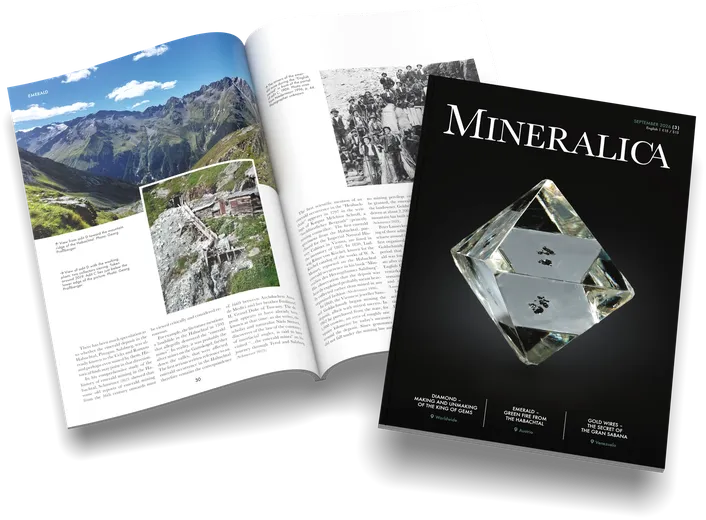
What a specimen tells by itself and what we have to record for it: traces on diamond crystals, a hidden emerald from the Habachtal, gold wires from the Gran Sabana and four ways to document a collection.
Already a subscriber? Sign in

From the editor
Dear readers,
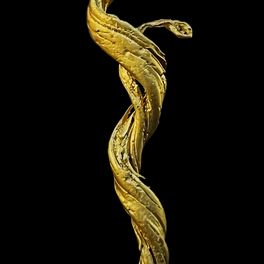
Gold can be weighed. A mineral specimen cannot be judged that way. In the Gran Sabana in southern Venezuela, even delicate gold wires are cut apart with pliers and divided among the miners by weight. For them the gold is raw material and payment above all: a gram stays a gram, whether it has grown as a wire, as a crystal or as a shapeless nugget. For mineral collectors it can be precisely the intact, unusual crystallization that makes a piece unique. For us, the value of a specimen therefore often begins exactly where the scale stops measuring.
Every specimen carries a double-sided biography. One half it holds within itself: its formation, its growth, its shape, its inclusions, fractures and alterations, everything that geological processes have shaped over millions of years. The other half we add ourselves. We establish and document the locality and the circumstances of the find, we recognize what is special about a particular form, and we record the path a piece has taken through various collections over time. This issue is about both halves of that biography.
Michael Wachtler and Alejandro Stern take us to the gold mines in the triangle between Venezuela, Brazil and Guyana. Since 2022 the area has again been yielding wire gold of a kind that hardly any other locality produces. Much of it ends up in the melting pot. What survives and reaches the trade often carries vague or simply wrong locality data. The authors put the occurrences back in order and give an up-to-date overview of the new finds.
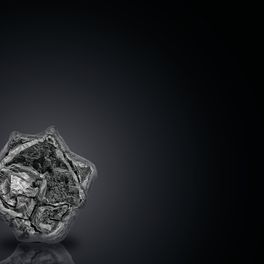
How much the shape of a crystal reveals about its formation is shown by Erwin Geiss, with diamonds as his example. Growth, dissolution and erosion can leave distinct traces on the crystal faces. The size of the crystals makes no difference. A hand lens is enough to find even the smallest clues to the eventful history of a stone.
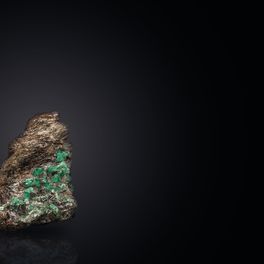
That a stone which has long been part of one’s own collection can still hold surprises is shown by Edith and Otmar Wallenta with a find from the Habachtal. When Otmar picked out a specimen with a single fine emerald crystal for a piece of jewelry, a second and even larger emerald came to light beneath it as he cut it free. The hidden crystal was noticed in time only while sawing. Had the cut gone elsewhere, it might never have seen daylight. How many remarkable crystals may still lie unnoticed in the matrix of pieces in our collections?
So that the half we add is not lost, the closing article shows how collections can be kept in good order. It presents four methods from about a hundred years, from the handwritten ledger to the digital database. In all of them one constant remains indispensable: a unique number that ties the piece permanently to its data.
A stone preserves its formation in its shape, its structure and its substance. Its origin, the story of its find and its path through collections survive only if we document them. One half of their story your specimens already bring with them. The other half you give them.
With warm regards,
Maximilian Schiller
Publisher
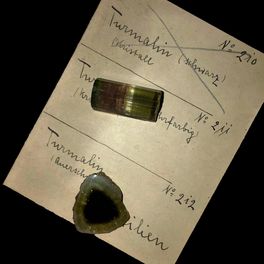 Free
FreeLeaf through the whole issue. The first pages of each article are open; the full issue is for subscribers.
This page is fully readable with a subscription. See subscription
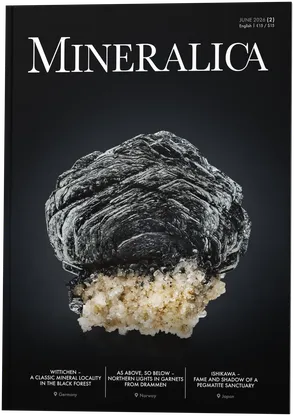
Where the familiar holds something new: rare minerals from Wittichen in the Black Forest, iridescent garnets from Drammen, Norway, the pegmatites of Ishikawa, Japan, and farewell to the Maucher mineral shop.
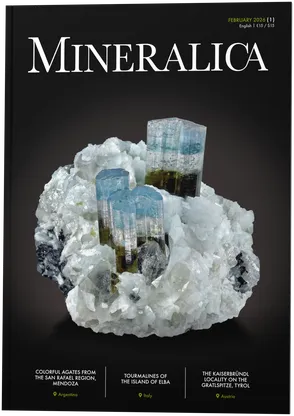
What makes a locality significant: colorful agates from San Rafael in Argentina, the tourmalines of the island of Elba and the microminerals of the Kaiserbründl on the Gratlspitze in Tyrol.