Maximilian Schiller (2026): From the Ledger to the Database: How do I manage my collection? Mineralica 2026-3, pp. 58–64.
Online
Maximilian Schiller (2026): From the Ledger to the Database: How do I manage my collection? Mineralica online, September 2026. https://mineralica.com/a/ptsnWt (accessed October 13, 2026)
For generations, a slip of paper next to the specimen was all there was. Four examples show how collectors bring order to their collections: from the numbered ledger and card index to digital lists and a database of their own.
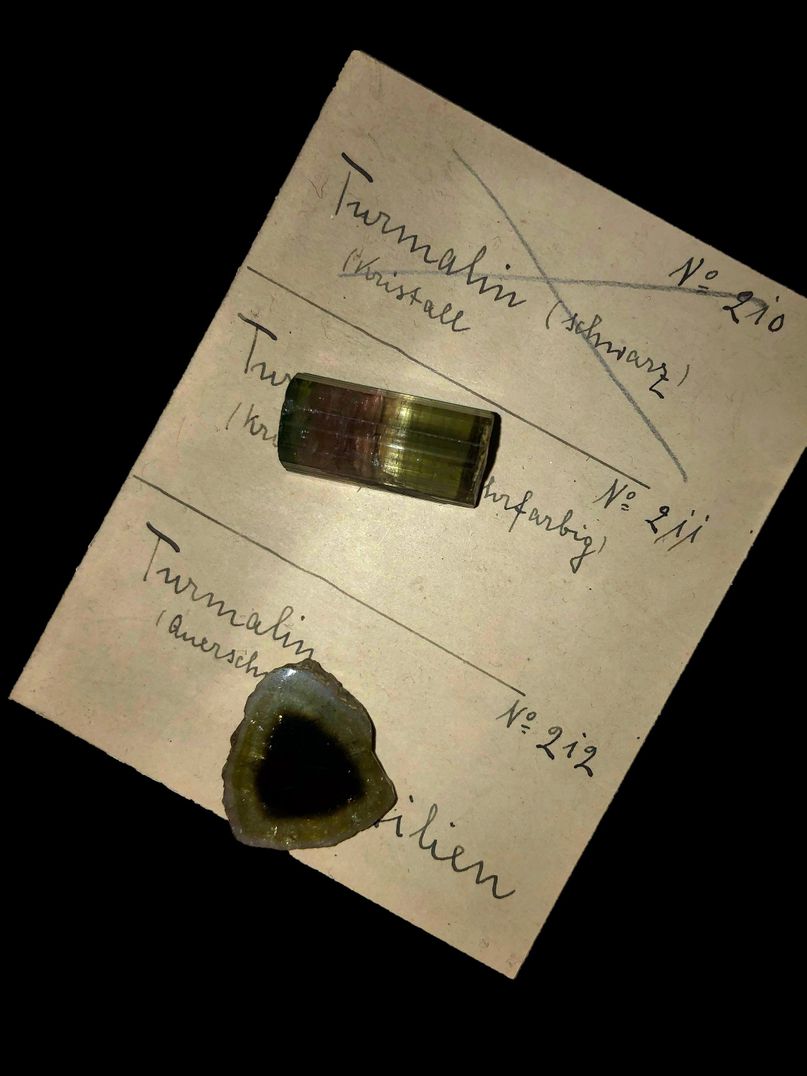
A label with three slots, only two of them still filled; the collector struck out the top one. Traces like this show how the collection was ordered and how it developed. Maximilian Schiller photo.
A slip of paper beside the specimen, for generations nothing more was customary. It names the mineral and the locality, sometimes the dealer, and as long as it stays in the same box it does its job. Let it slip and the provenance is gone: a documented specimen turns into a pretty stone without a story. Anyone who wanted more had to devise something. Over many decades, every collector therefore found a personal answer to the question of how to order a collection and keep it accessible. The results are correspondingly idiosyncratic. One collector of our acquaintance still sorts the drawers by the postal codes of the localities. We show four methods, four examples out of many. All of them take on the same problem, all of them solve it in their own way, and every solution brings new problems that the next one tries to fix.
A ledger, a number, a lot of handwork
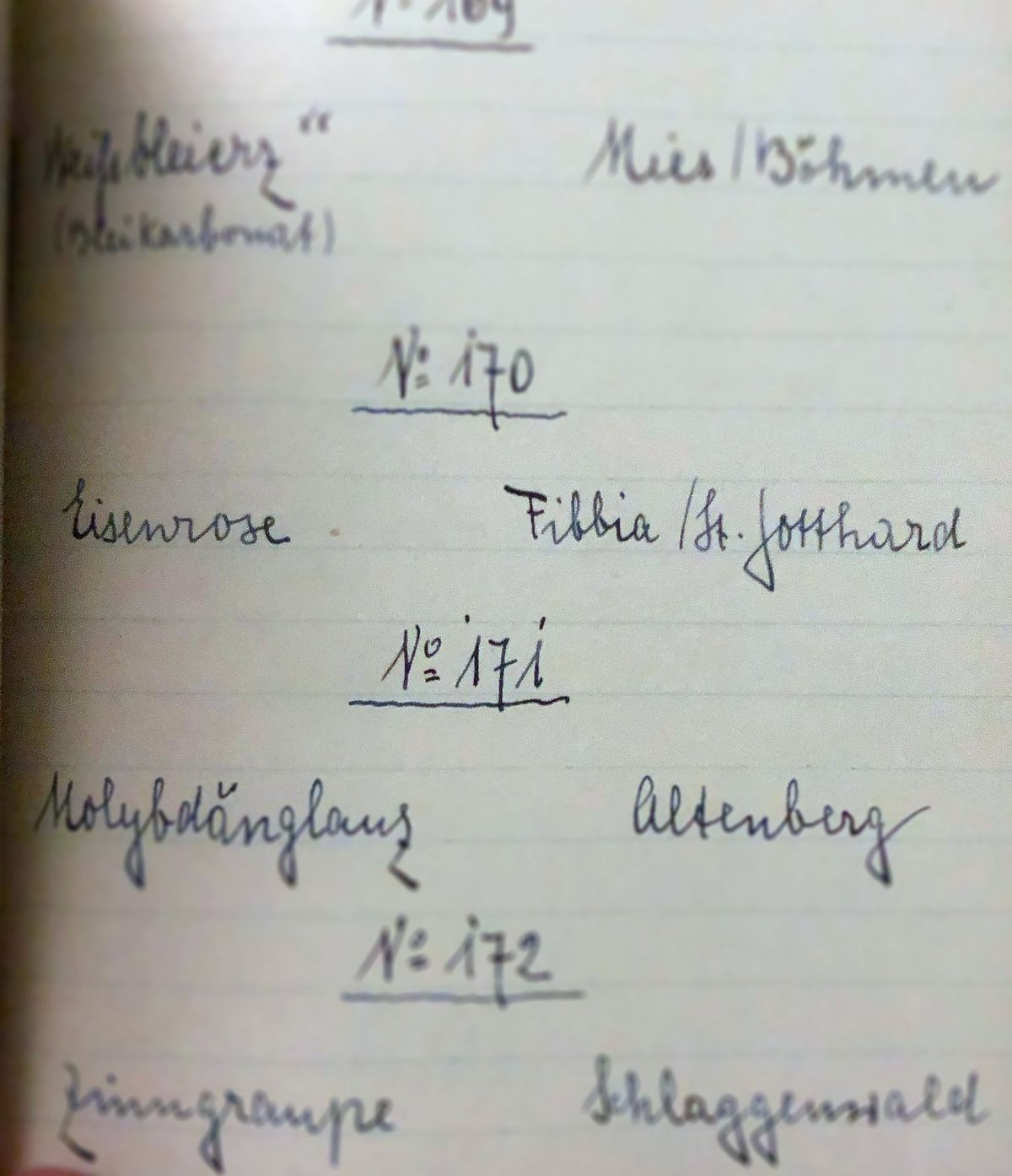
The oldest example is the Richter collection, which I was able to take over some time ago. It was built up mainly between 1910 and 1930. Its heart is a slim ledger. Every line holds three entries: a running number, the mineral name, the locality. Nothing else. Alongside its label, every specimen carries a number of its own, glued to the piece.
Three entries were enough: the number first, the mineral below it on the left, the locality on the right. The ledger of the Richter collection, built up mainly between 1910 and 1930, records the holdings and, incidentally, the order in which they came together. Only this chronology makes visible how the collector’s taste shifted over the years. Thomas Christfried Richter collection, Maximilian Schiller photo.
That was double the work, and that is precisely where the progress lies. The information sits in two places, on the stone and in the ledger, linked by the number. If a label falls out of the box, the piece can still be identified. Above all, though, the ledger solves a problem familiar to anyone whose collection has outgrown a handful of drawers: whoever no longer knew exactly where a specimen lay had to open drawer after drawer, lift piece after piece and read the labels. With the ledger the collection became readable as a whole for the first time, without opening a single drawer. Most collectors of that period did not go to this trouble.
A ledger like this cannot be searched, however. Anyone wanting to know whether a particular locality is represented has to leaf through it. Measured against searching the drawers, that is still an enormous gain.
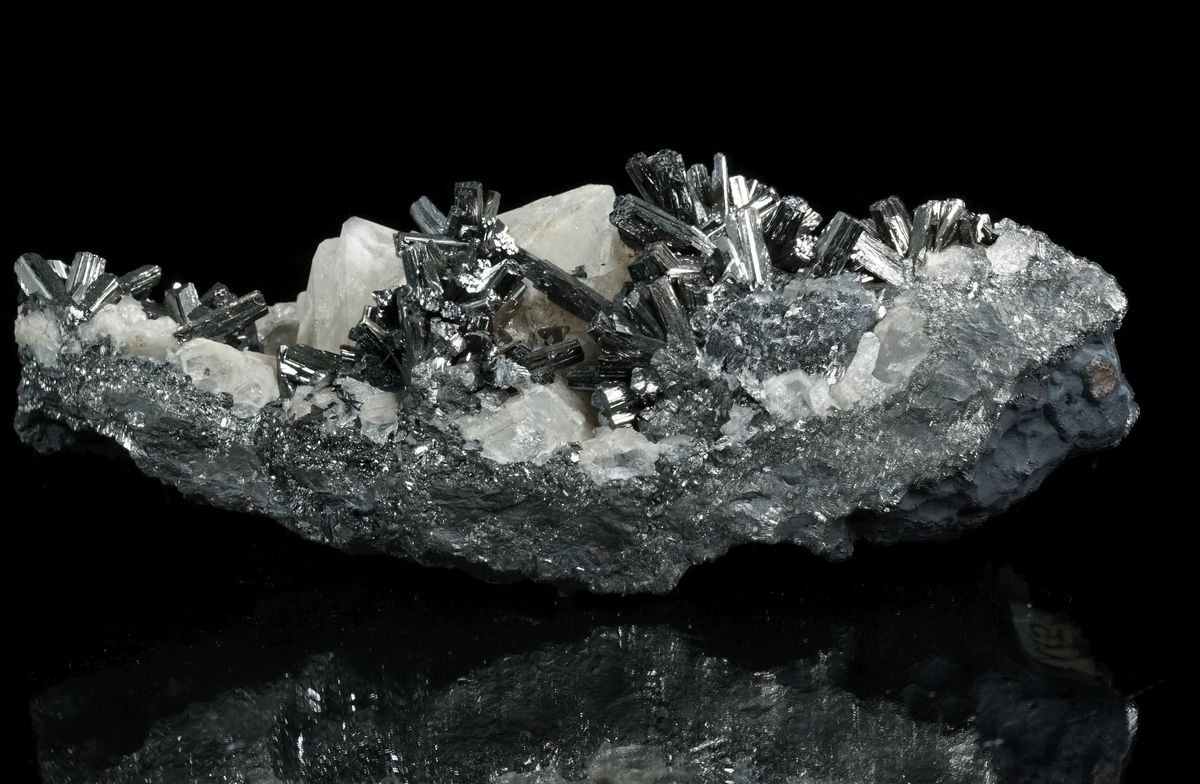
Manganite in rare combination with quartz from Ilfeld, Germany. About 12 cm long. The handwritten number glued to the back links the specimen to the ledger and to the label. Formerly Thomas Christfried Richter collection, Berlin, now Maximilian Schiller collection and photo.Maximilian Schiller photo.
The card index systems that later became standard follow the same basic idea. One card per specimen, the same number, the same link to the piece. The difference lies in the mobility: new cards can be slipped in at any time, the box grows with the collection, and the cards can be reordered by mineral, by locality, by year of acquisition. A bound ledger can do neither.
In return the ledger can do something a card index loses, something its author never intended. Because a book is necessarily filled in the order of acquisition, it records a chronology. Leaf through the pages and you read the development of a collector’s taste. In the Richter collection the earliest entries are almost exclusively German localities. Then Bohemian occurrences accumulate. Toward the end of the ledger the collection grows steadily more international, down to pieces from the United States. For a central European private collection of those years that is remarkable, since American material was still the exception here. Quite incidentally, and well beyond its actual purpose, such a ledger has become a historical document.
That also brings a weakness with it: this ledger exists exactly once. Beyond that, the glue has not held everywhere over the decades, and here and there the numbers have come away from the specimens.
Collecting in the digital age
The spread of the computer made the next step in collection management possible: the digital list. It can be extended at will, sorted and filtered with a click, and copied, printed or shared as often as you like. In one respect it remains limited: the search finds only what was spelled exactly that way. One typo during entry and the piece is invisible to every later search.
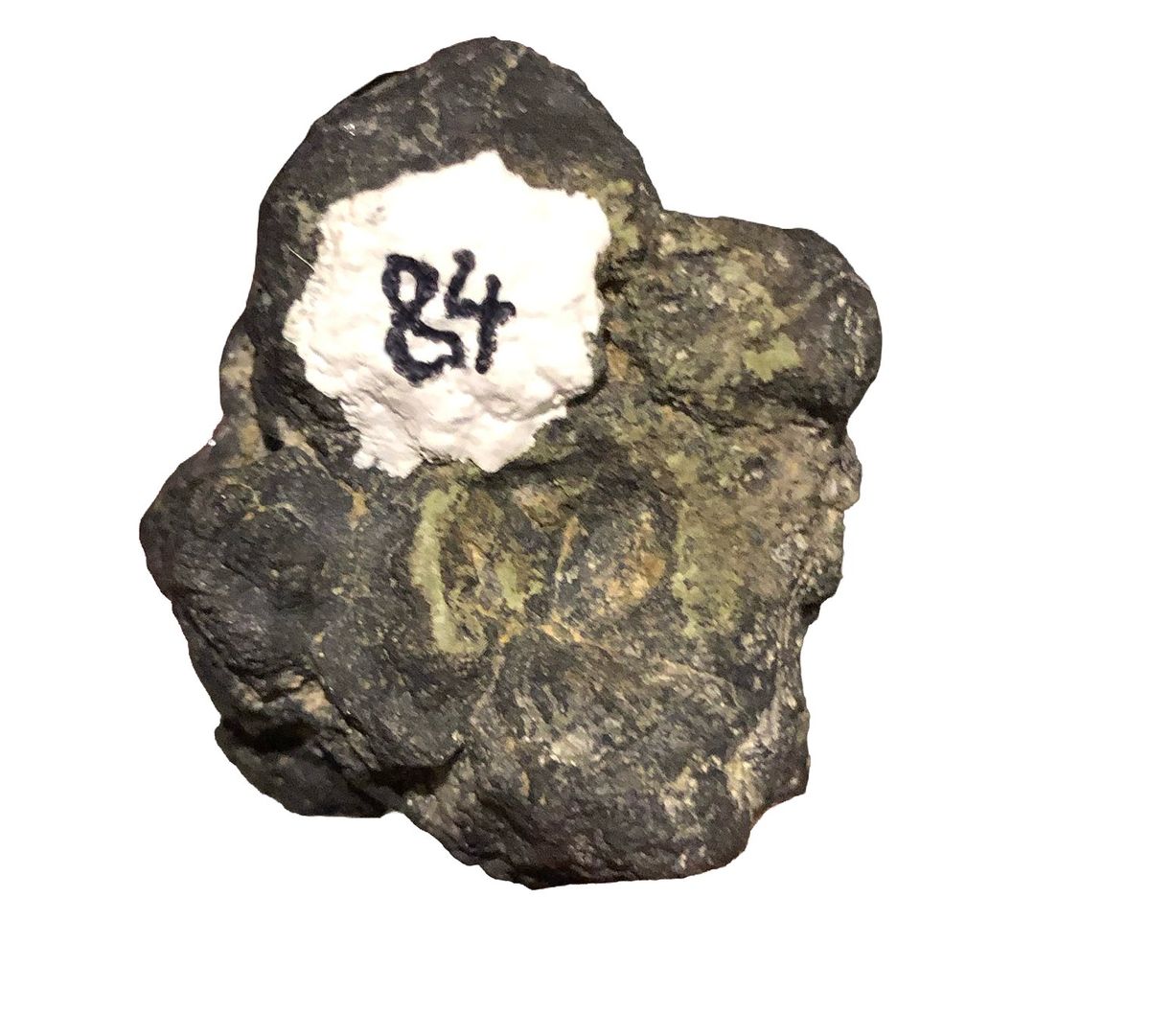
How far this method carries is shown by the collection of Alfred Pichler. The Carinthian is an institution on the collecting scene: he has worked through the minerals of his home state systematically over decades and documented them in several books. His collection list runs to some 4,000 lines. Every line stands for one piece in his collection. He applies the ascending numbers directly to the pieces with a paint pen.
That solves the glue problem. The marking sits on the stone instead of adhering to it, and it survives every move, every repacking and every change of display system. Anyone who has ever sorted an inherited collection in which the slips lay loose among the specimens knows what that is worth.
Galena from the Rischberg, Petzen, Carinthia, seen from the back: a white ground of paint carrying the collection number in black. Formerly Alfred Pichler collection, Klagenfurt, Maximilian Schiller photo.
The method is not uncontested, though. The paint is an intervention on the piece itself, and some collectors cannot bring themselves to it. On unstable matrix it is out of the question anyway, and on a single free-standing crystal there is simply no spot one would want to sacrifice. Permanence has its price, and every collector weighs it differently.
With the digital list, an overview of one’s own collection is a matter of seconds. Like the handwritten ledger before it, the digital list ties the entry to the piece through the individual number. One problem remains: where a collection holds several pieces of the same mineral, the same locality or the same size, they can be confused with one another. Keen collectors therefore kept a photo archive as well, which sat in separate folders and could be linked to the entries in the list only with a good deal of skill.
Software made to measure
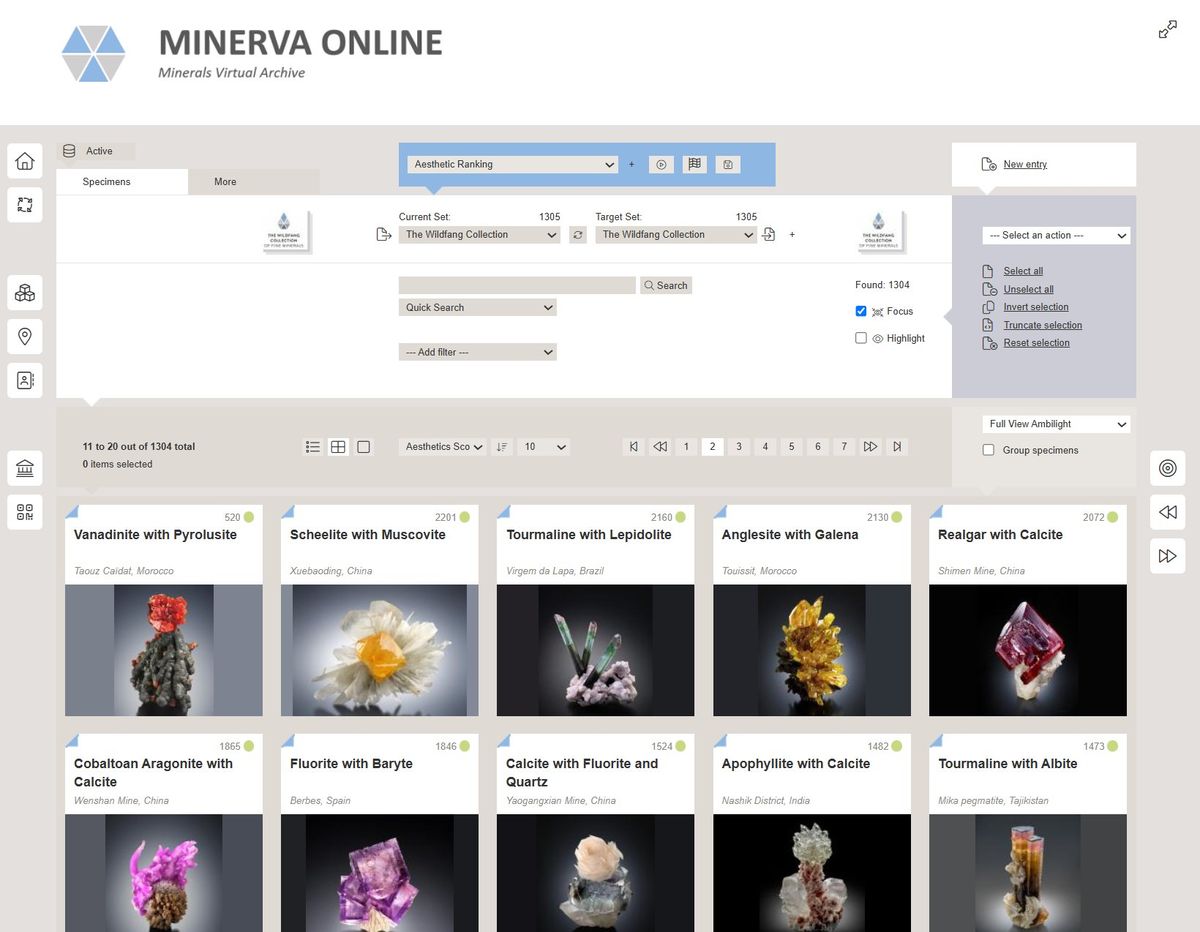
When even a digital list is no longer enough: the well-known collector Fabian Wildfang has managed his collection with software of his own for four decades. He first programmed “Minerva” himself in 1985, on a Commodore C64 at the time, and developed it further from platform to platform over the years. Minerva has run as a web application since 2006, and although a programmer now handles the implementation, the concept, the screen layouts and the functions still come from Wildfang himself. What has emerged is an application of the kind otherwise known from collection management systems for museums or large institutions. Every piece has its own record with images, plus filters, page-by-page navigation through large holdings and a search that finds what is meant even with typos and variant spellings. Anyone who has ever had to search separately for “Aquamarin” and “Aquamarines” understands the difference at once.
Practical as this solution is, it has its hurdles: anyone wanting an application of their own needs the know-how and the stamina to design it themselves over years, or the budget to have it built. And the dependence on a path once taken is enormous.
Images held with the record, filters and a fault-tolerant search: Fabian Wildfang had his collection management software written for him. The application covers everything a list leaves open. Fabian Wildfang photo.
Advertisement
GemTrackr: the collection as a database
This is exactly where a new generation of ready-made software comes in. GemTrackr is a Windows application which, in the version released in September 2026, is aimed specifically at mineral and gemstone collectors and at gemologists, and which could become interesting for professional use in future. It is developed by Christoph Maaß and Dominik Khan, the two founders of edenDevelopment UG.
The seed of the idea, software made specifically for collectors, did not come out of nowhere. As a young man Maaß went with his father to mineral shows and fairs and dealt early on with recording a collection in a structured way, in the early 2000s in the classic manner with Excel files, later with an Access database and hundreds of digital photographs on data carriers or entirely in analog form in photo albums.
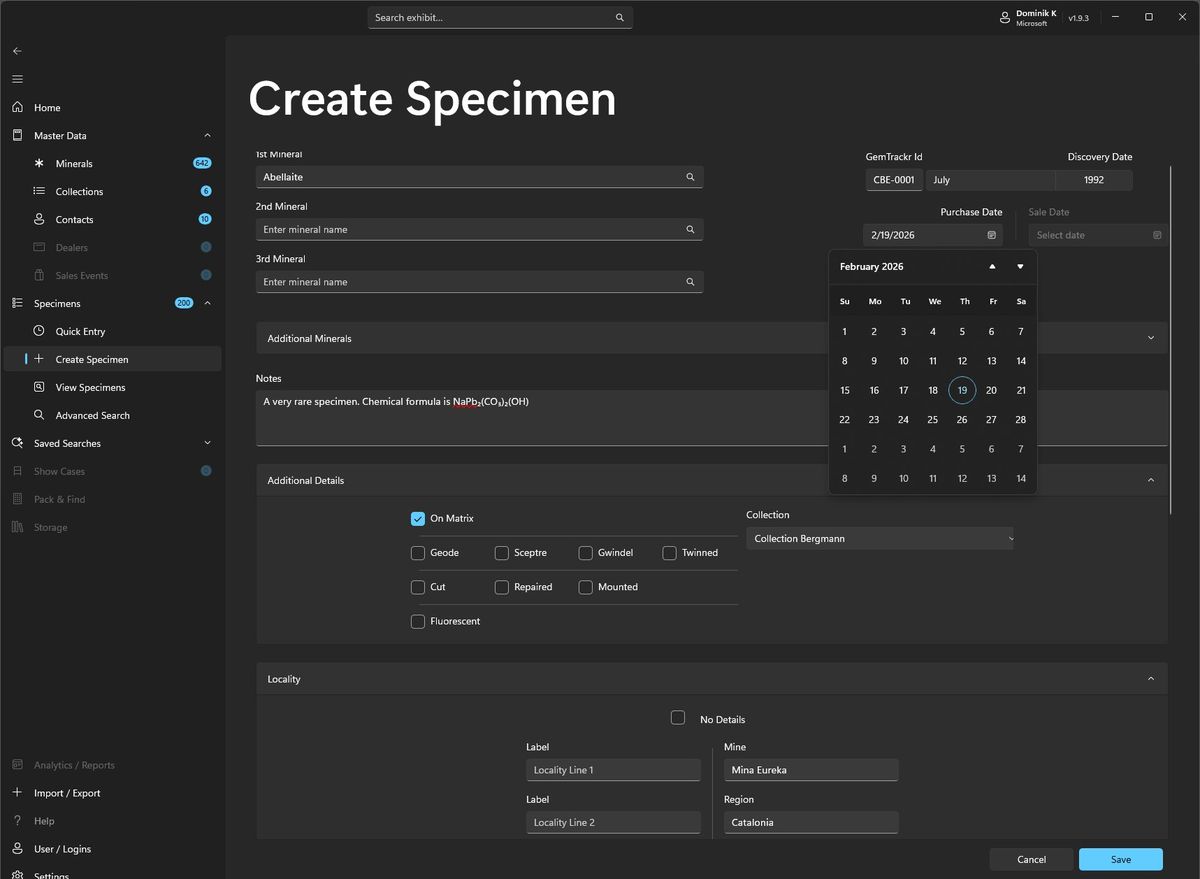
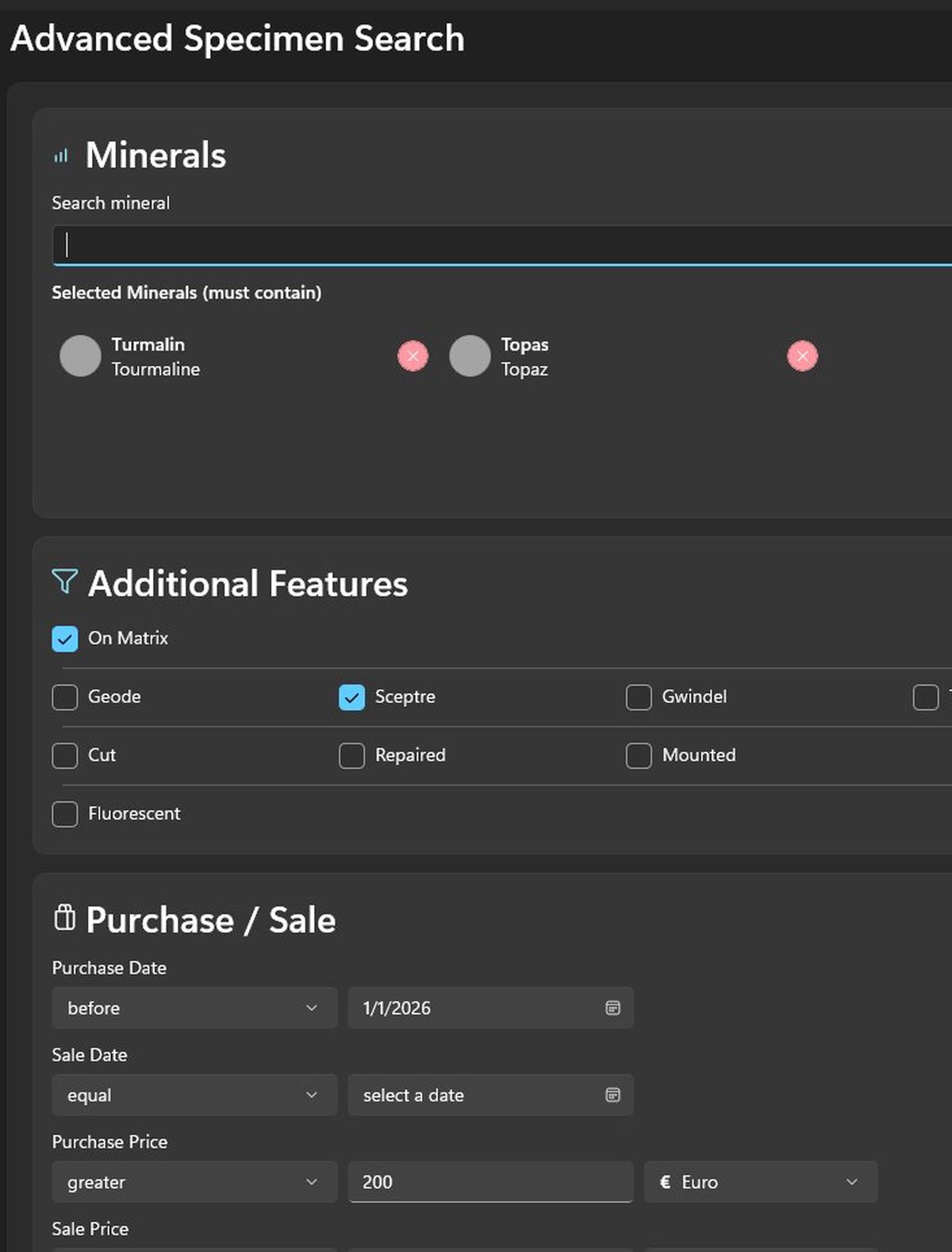
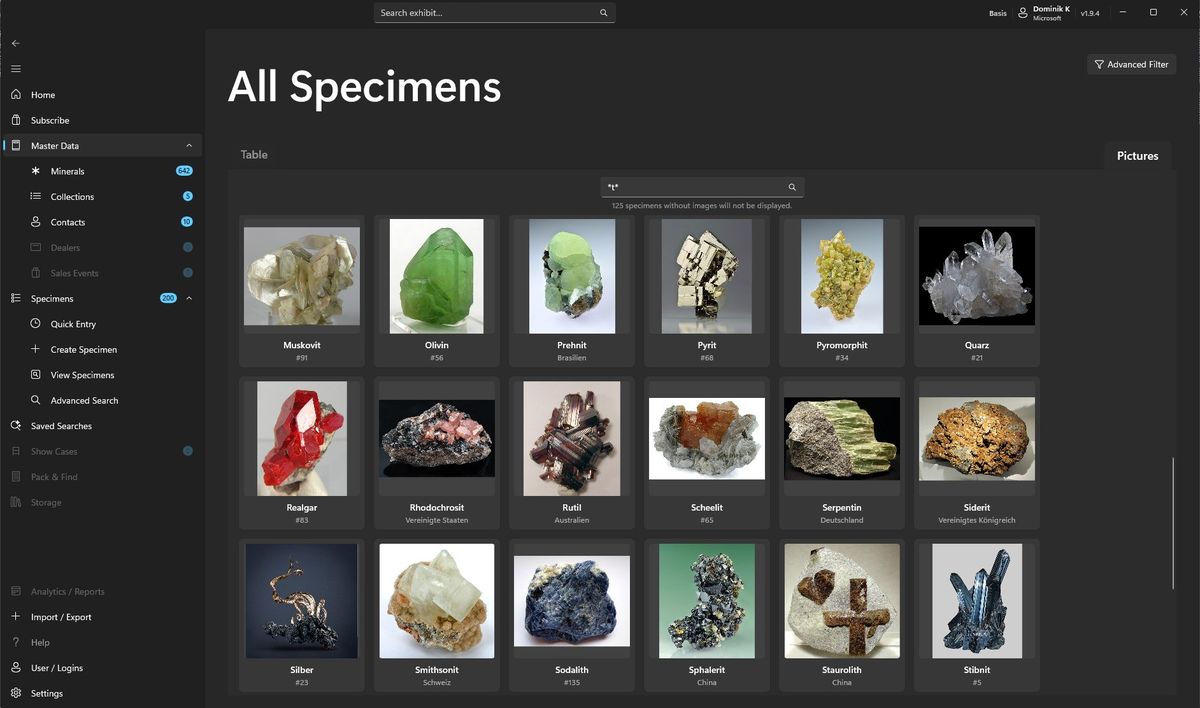
GemTrackr brings locality data, commercial data and high-resolution photographs together in a single record. The mineral data follow the standards of the International Mineralogical Association. Image: edenDevelopment.The advanced search combines different search parameters, either to find one particular item or to look at the collection from different angles. Questions such as “What is my oldest item?” or “Which items have no images yet?” can be answered quickly. Image: edenDevelopment.
In early 2025 Maaß won his co-founder over to the following idea: “These days every one of us carries a small supercomputer in the form of a smartphone in a trouser pocket. Why not give mineral collectors what my father could not have in his collecting days: the collection in digital form, in your pocket?” With the first concept, however, the two ran into an understandable hurdle: nobody wants to record a whole collection all over again on a small mobile device, especially as many collectors already keep their pieces in a spreadsheet.
For that reason they shifted the focus to a Windows application, which is now publicly available with either a German or an English interface. On a PC or notebook a collection can be recorded comfortably, and existing data can be imported into the application without difficulty. Existing lists are taken over directly, so the collection does not have to be entered by hand a second time.
Every item gets a complete record covering locality, history, size and purchase price, allows many further details such as “on matrix” to be recorded, and can be supplemented with any number of images of the specimen. Correct mineral names, chemical formulas and classifications are suggested according to the standards of the International Mineralogical Association, which keeps the spellings consistent across the entire holdings. Duplicate items are told apart by unique IDs.
The developers have paid particular attention to searching the collection and to finding individual items together with their images: from a simple quick search to complex logical search patterns that can be saved for later reuse. This makes it possible to build individual filters that show, for example, every stone bought at a particular show.
GemTrackr shows the items either as a table or, as here, in a gallery view; search criteria and filters apply automatically to both views. A click on a search result leads straight to the item. Image: edenDevelopment. Mineral photos: Wikimedia Commons – Robert M. Lavinsky, Tiia Monto, Ra’ike, H. Zell (CC BY-SA 3.0); Ivar Leidus, Didier Descouens, DerHexer (CC BY-SA 4.0).
GemTrackr leaves the choice of where the data is kept: by default all data and images sit exclusively on one’s own computer, entirely offline and without any tie to a cloud service. Anyone wanting to maintain the collection from several devices can store the data on a network drive. In both cases the database behind it is built for speed, which keeps navigation fast even with thousands of specimens and extensive image material.
GemTrackr can already be used extensively, but it will develop further. The focus is on expanding existing functions and working in customer feedback. Alongside that, a display case management feature is in preparation which maps one’s own exhibition layout and transfers the real location of an item into the digital world.
And the original vision remains the goal: apps for Android, iPhone and iPad are planned for 2027, allowing users to take their GemTrackr data into the mobile world, to friends, relatives or the mineral show. Also in development is a protected online platform through which collectors can present selected top pieces, if they wish and by their own doing. That way the shared pleasure in special pieces can be had without a visit in person.
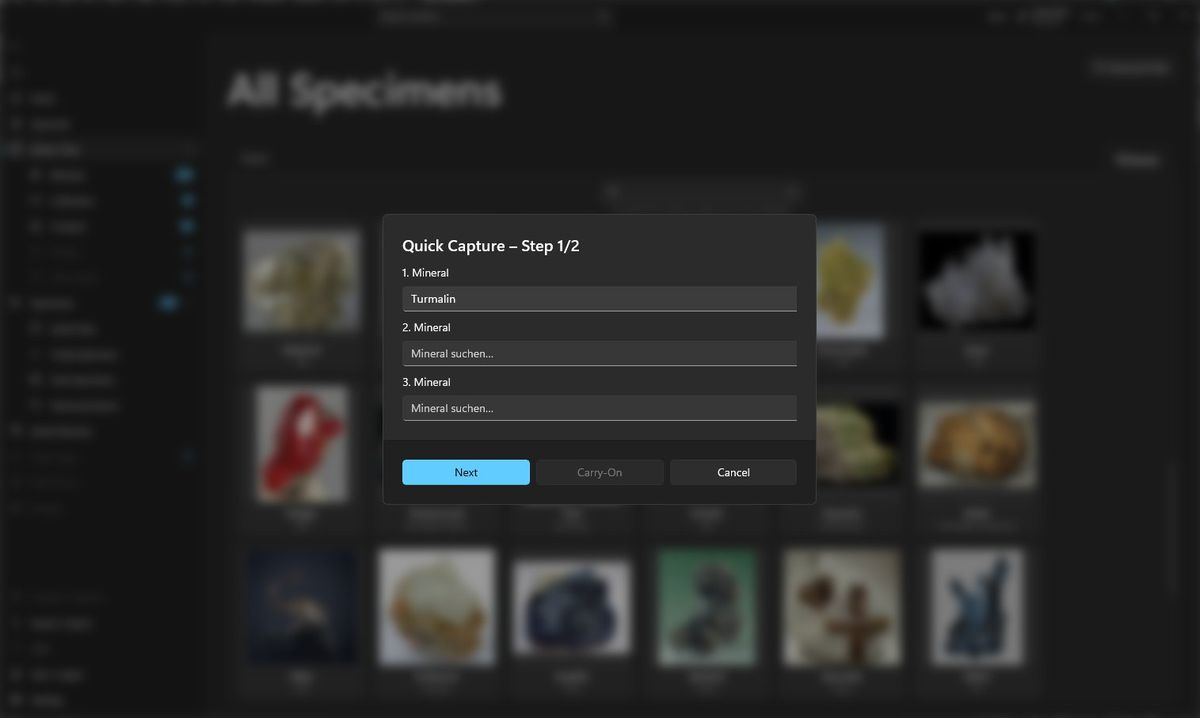
Quick entry makes it easy to create several identical items one after another. Image: edenDevelopment. Mineral photos: Wikimedia Commons – Robert M. Lavinsky, Tiia Monto, Ra’ike, H. Zell (CC BY-SA 3.0); Ivar Leidus, Didier Descouens, DerHexer (CC BY-SA 4.0).
What remains
Four methods, four answers to the same problem, and in all four the same constant: a number that links the stone to its description. Whether it is glued on, painted on or assigned as a record makes no difference to its task.
Something else is remarkable. Durability runs backward through this sequence. The ledger of the Richter collection can be opened and read by anyone. The digital list needs a program to open it. The web application needs a server and, in case of doubt, the developer who wrote it. The more capable the system, the more conditions it has to meet.
And one question has still not been settled: how a stone can be assigned to its entry beyond doubt. Glued-on numbers fall off, paint dots damage the piece or are not possible in the first place. New software such as GemTrackr meets this problem by holding several images with every record, so that a piece can be recognized by its own portrait if need be.
One piece of information is also almost always lost on the way from ledger to database. The ledger preserved the order of acquisition without anyone intending it to. In any sortable system that order survives only if the date is deliberately entered. Anyone documenting a collection today should take that one field seriously. It is the only one that will still tell a story a hundred years from now.
In Mineralica 2026-3
This article runs on pages 58–64. The first 2 pages are free to browse.
This page is fully readable with a subscription.See subscription
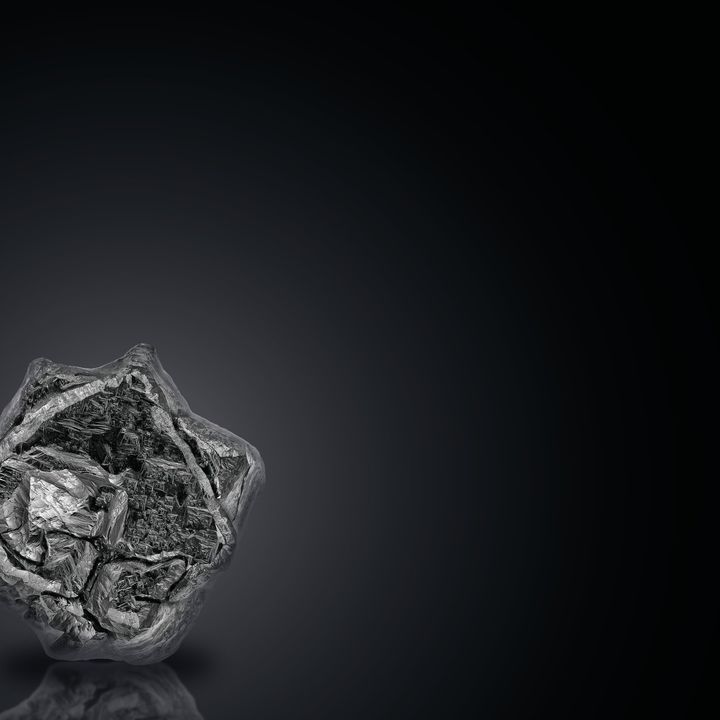
Growth, dissolution and erosion leave traces on diamond crystals that a good loupe already reveals. Erwin Geiss explains what these surfaces tell us about the journey up from deep inside the Earth.
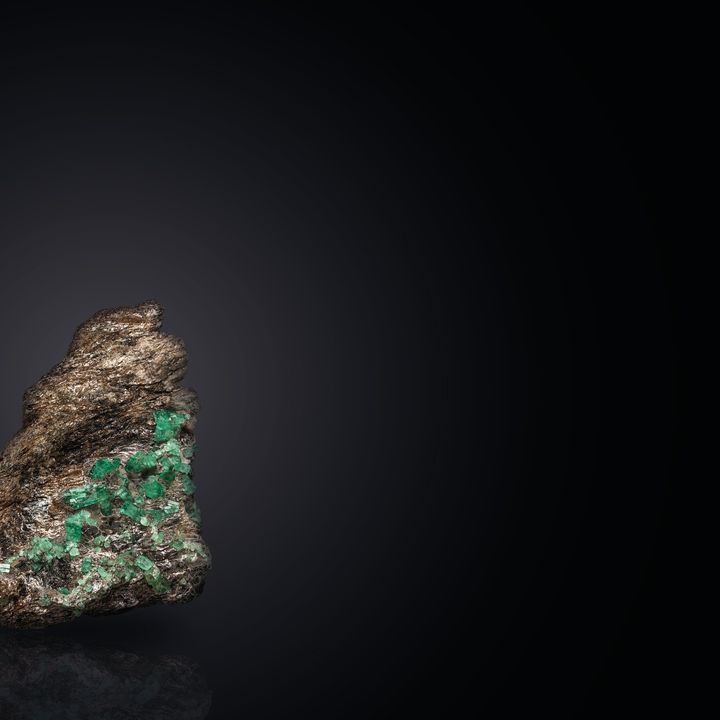
With its emeralds, the Leckbachrinne in the Habachtal is one of the best-known localities in the Eastern Alps. Edith and Otmar Wallenta untangle its patchy mining history and tell of an emerald that only the saw revealed.
Since 2022, three remote mines in the Gran Sabana have been yielding gold wires like few other localities. Michael Wachtler and Alejandro Stern report from the jungle between Venezuela, Brazil and Guyana.

/mineralica-magazine/ptsnWt/p59-01.jpg)