Diamond is regarded as the gemstone par excellence. Its hardness was already known in antiquity, and its name derives from the Greek ἀδάμας, adámas, meaning “unconquerable”.
In his Naturalis Historia, the Roman historian Pliny describes an experiment that should definitely not be tried at home: “It is tested on the anvil, for genuine stones resist the blows so strongly that the hammer shatters on both sides and even the anvil cracks. Its hardness is beyond measure, and its nature likewise defies fire: it cannot be heated. […] If one does succeed in breaking a diamond, it shatters into flakes so fine that they can hardly be seen with the naked eye. These fragments are sought after by gem cutters, who set them in iron and use them to drill through any hard material with ease.”
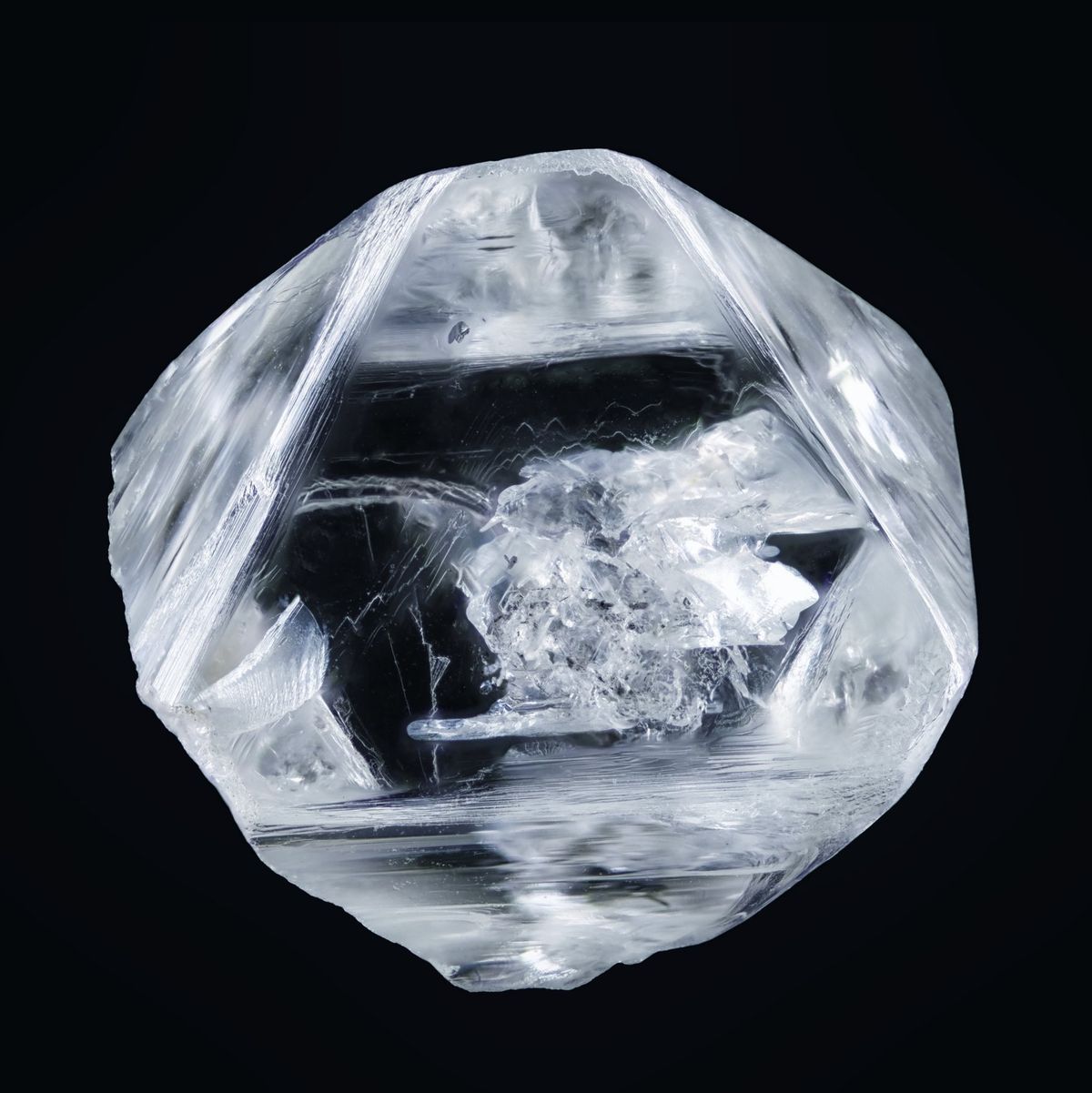
Pliny even comments on the crystal form: the diamond, he writes, has “two opposing points and the shape of two spinning tops set against each other at their broader faces”. This is evidently a description of the octahedron.
Since diamond was virtually impossible to cut in antiquity because of its hardness, the intensely colored red, blue and green gemstones such as ruby, sapphire and emerald generally ranked higher in esteem than diamond.
Today it is not only a coveted gemstone but also an important industrial mineral, and it remains of great scientific interest.
One consequence of this commercial interest is that diamond, from a mineral collector’s point of view, is by no means a “rare” mineral. Fine, large crystals, however, remain out of reach for most collectors. But if you settle for small crystals of just a few millimeters, a rich selection is available at prices that usually stay within the double-digit euro range. Add a decent magnifying optic, which many collectors own anyway, and the journey into the world of diamonds can begin.
My own diamond story goes back to the late 1970s, when my father gave me a small pile of so-called industrial or drilling diamonds: perhaps 20 to 30 fragments, each two to five millimeters in size, to which I initially paid little attention. Only when I upgraded my optical equipment a few years ago did I take another look at these tiny specimens, and I was fascinated by the wealth of structures on and inside the crystals. A few purchased crystals have since joined them. Even so, the entire contents of my “diamond collection” would still fit comfortably into a thimble.
As a geophysicist, I am naturally interested in the processes taking place deep below us in the Earth’s mantle. Diamonds provide a wealth of information on exactly that, written, as it were, all over their faces.
The time scales involved could hardly differ more: while the growth of a diamond is thought to take on the order of millions of years, the dissolution features described below probably form within hours to days during the ascent of the kimberlite.
Since there is plenty of literature on the formation and uses of diamond, I will not go into these topics here, but concentrate instead on what collectors can observe on their own specimens.
What is true of diamond applies to minerals in general: every natural crystal we find is the product of growth following crystallographic rules, and at the same time of everything that happened after that growth, namely deformation, dissolution and erosion.
1. Growth
How diamonds grow is governed by their environment deep inside the Earth: by the amount of carbon available, the presence of other substances, and the prevailing pressure and temperature conditions and their changes (cf. Sunagawa 2005). All of this influences size, color, inclusions and much more. Since inclusions can only be studied in suitably equipped laboratories, we will focus here almost exclusively on external form.
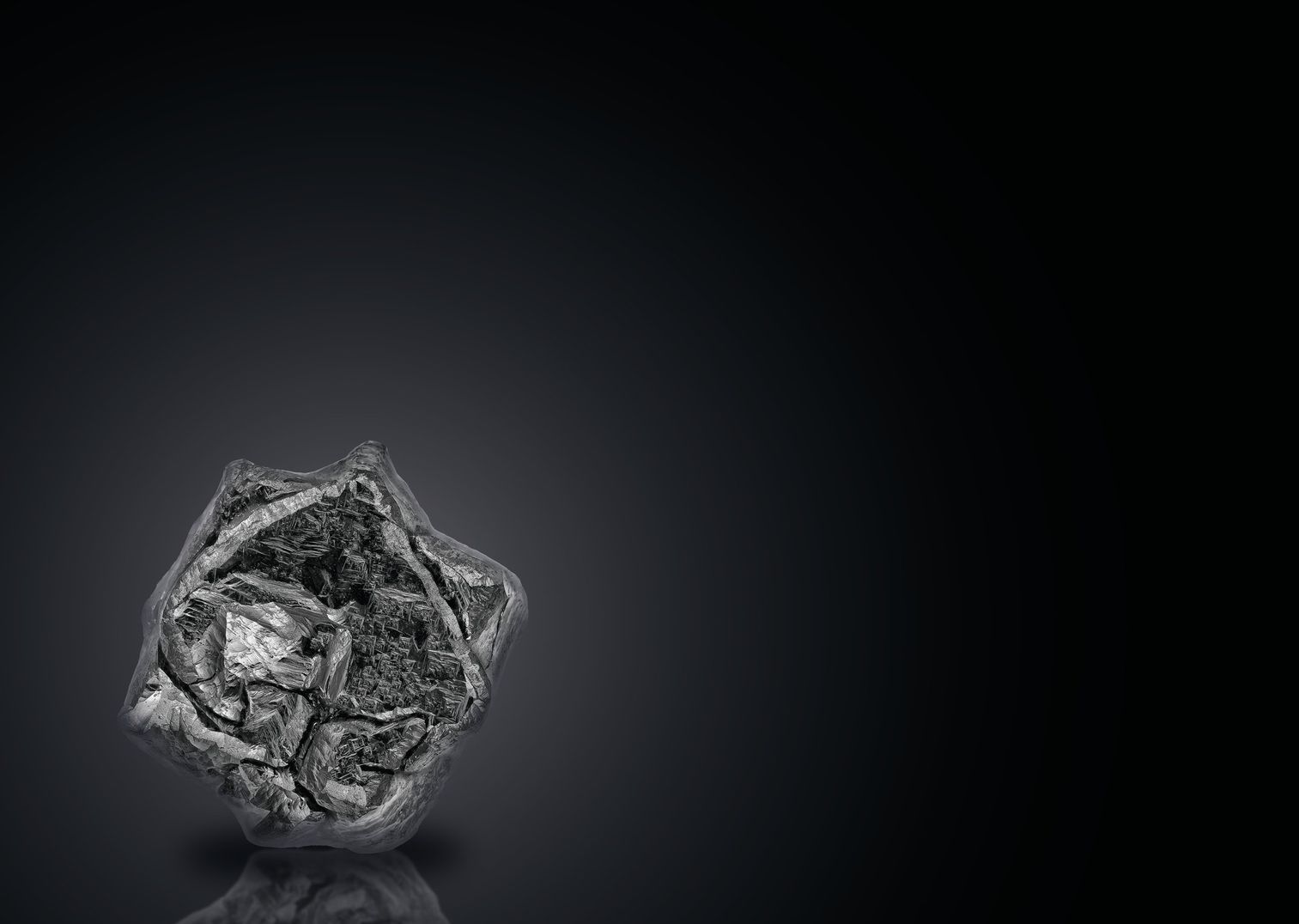
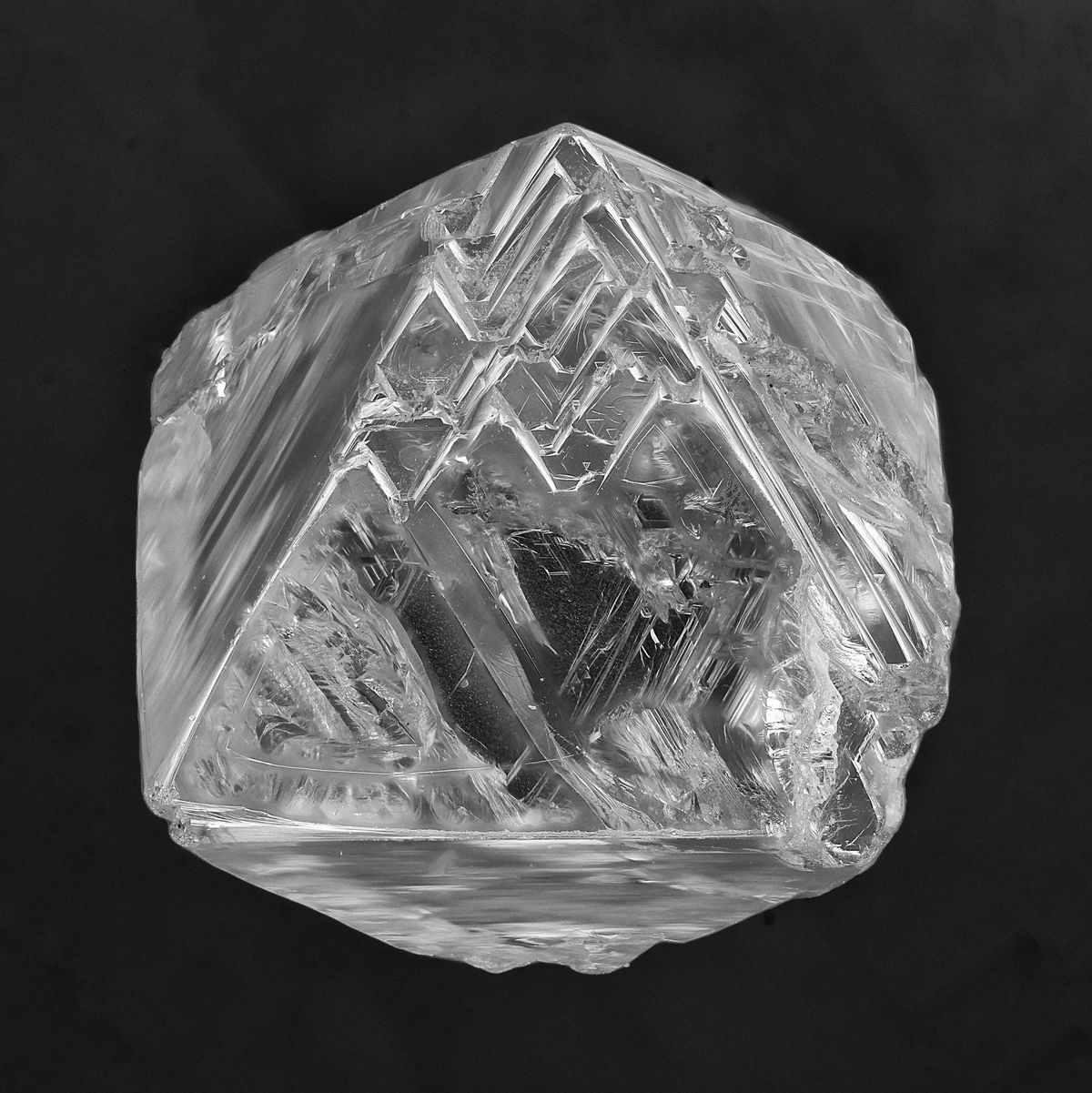
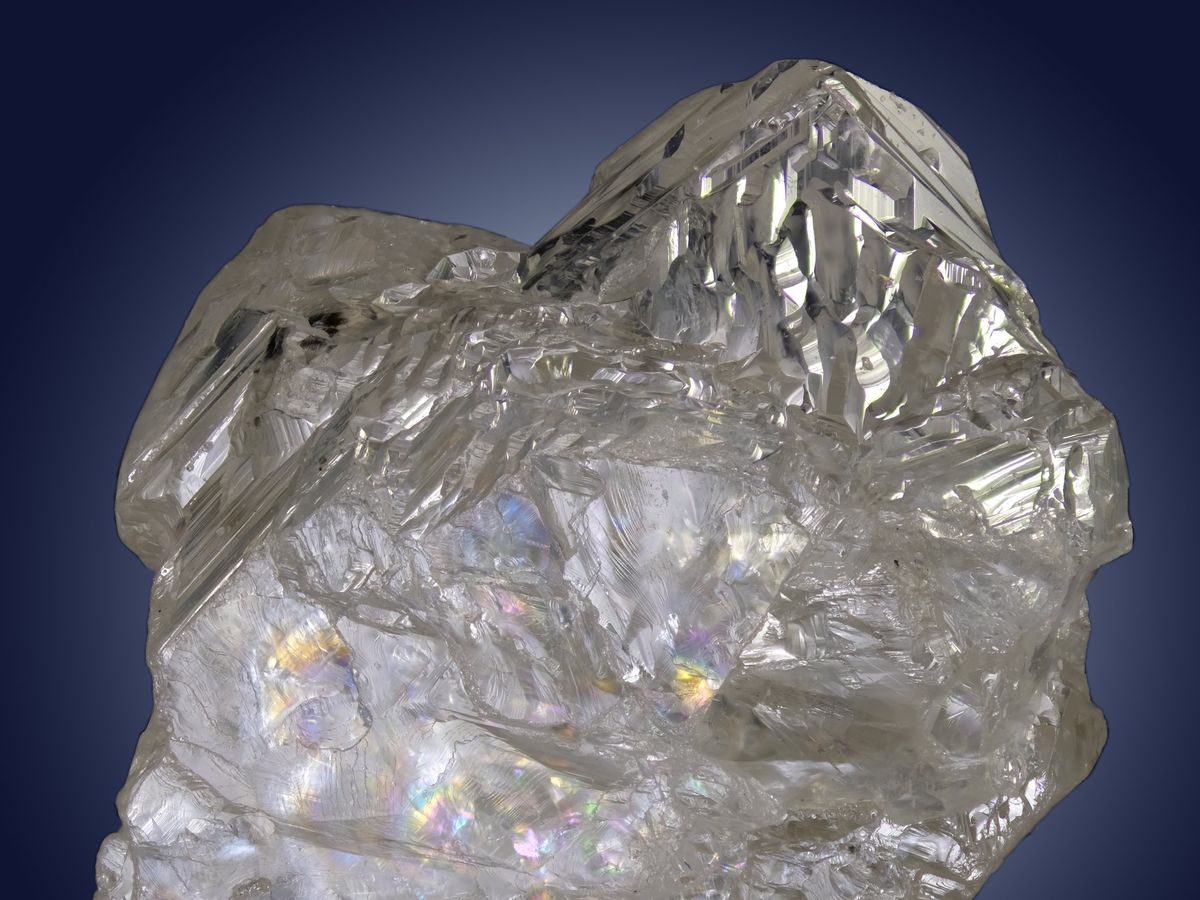
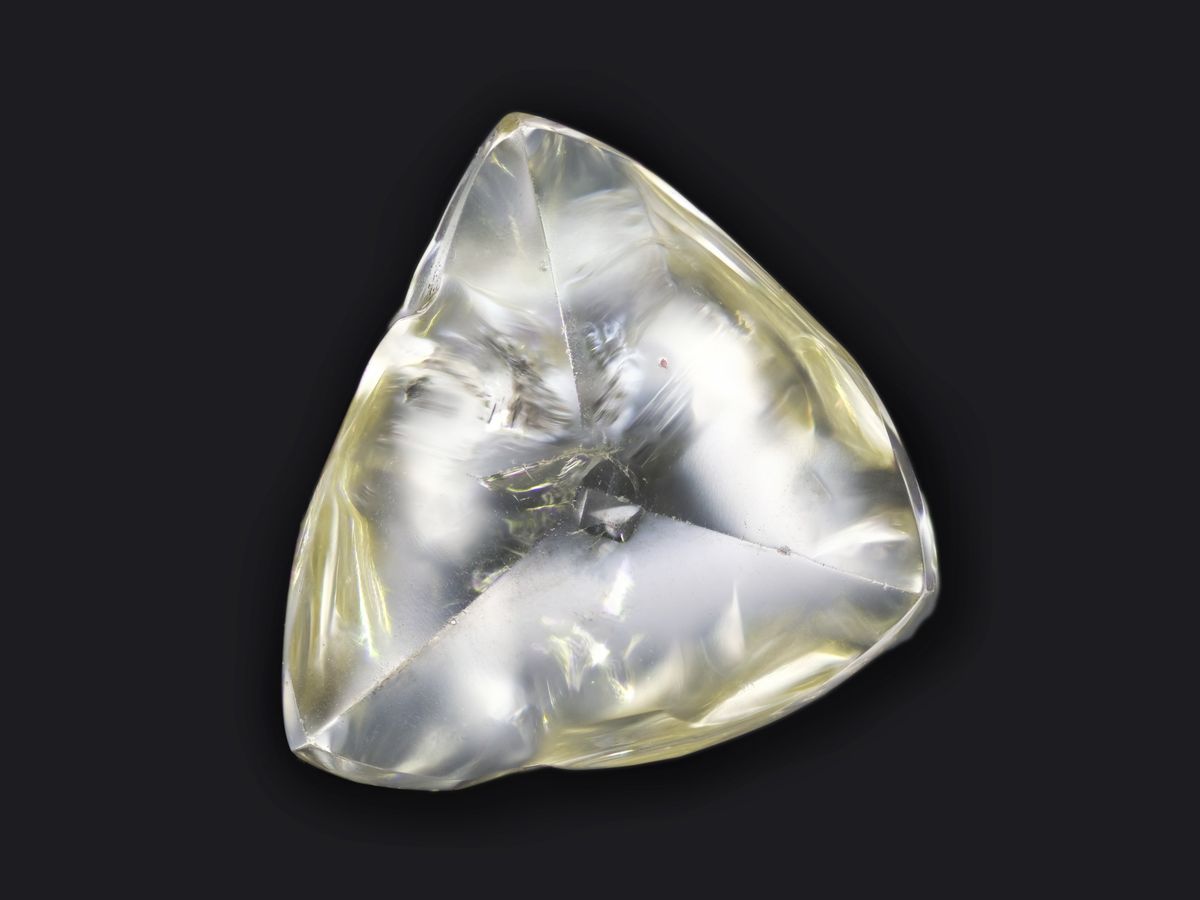
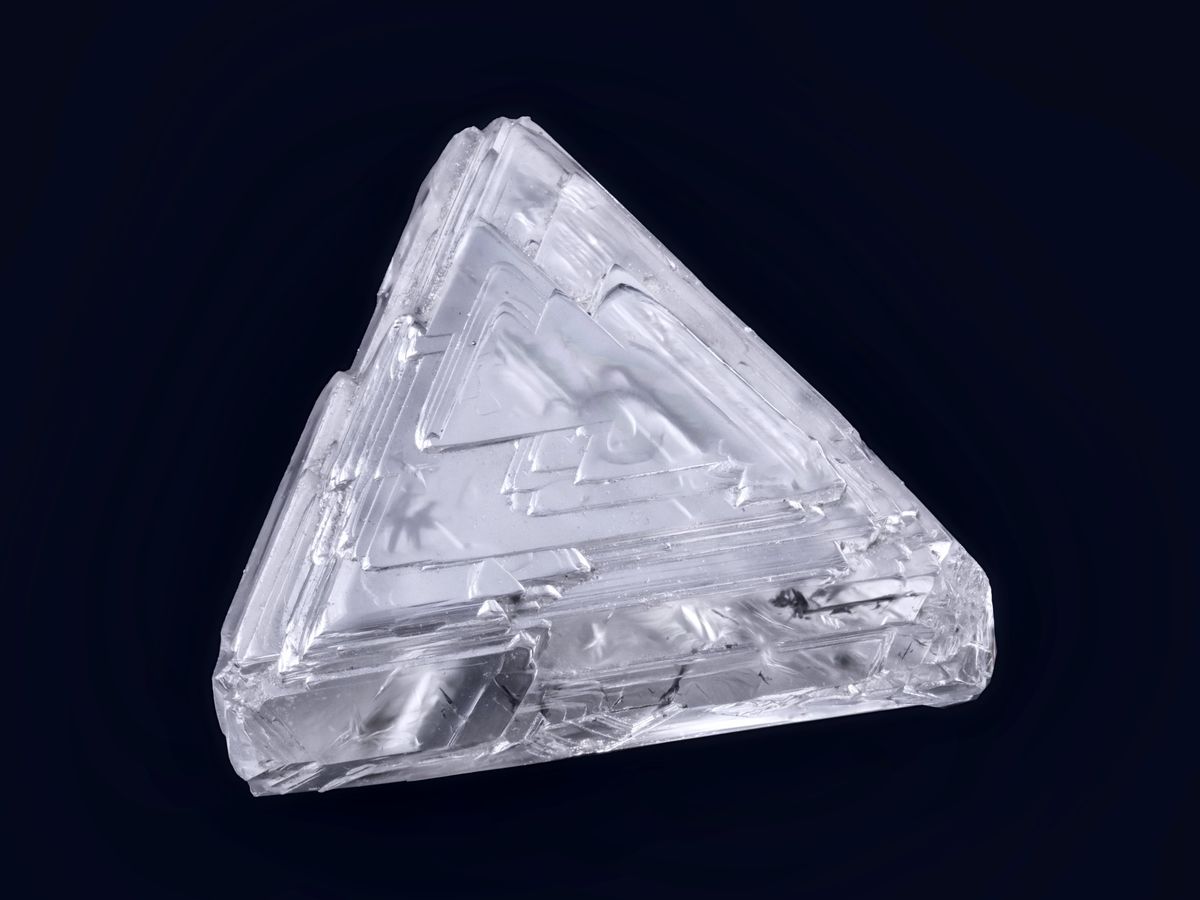
The basic form of diamond is the octahedron. As a rule it is better developed in small crystals than in large ones (Fig. 1). Parallel growth is also a common sight (Fig. 2). Where many crystals grow in a confined space, irregular crystal aggregates form (Fig. 3). Sometimes these octahedra are flattened, producing triangular shapes that resemble so-called spinel twins (Tappert & Tappert 2011). Since virtually every crystal, as we shall see, also shows dissolution features, it is not always easy to decide what is a trace of growth and what is due to dissolution.
Twinning is quite common in diamond (Figs. 4 & 5). These are usually contact twins following the spinel law, familiar from the mineral that gave the law its name. In diamond they often take the form of triangular crystals with seemingly rounded surfaces.
The shape of a crystal also depends on how fast it grows. Given time, well-formed octahedra develop. At higher growth rates the edges grow preferentially while the faces lag behind, producing the funnel-shaped hopper crystals familiar from fleur de sel (Fig. 6).
If growth is accelerated even further, for instance by supersaturation, a “fibrous” coat forms over a clear core crystal (Fig. 7). Because large amounts of foreign material and fluid are incorporated in the process, the crystal takes on a milky or cloudy, often colored to black appearance. This is frequently accompanied by a transition to a cube-like habit (“cuboids”, Figs. 8 & 9). These are nevertheless single crystals, as the orientation of the crystal lattice is preserved.
2. Dissolution
When conditions in the surrounding environment change, material may also be dissolved away again from the crystal that has already formed, in other words resorbed. In fact this can be observed on virtually all diamond crystals. Whether the resorption took place deep in the Earth’s mantle or during ascent in a magma rich in volatiles such as CO2 usually cannot be determined.
Resorption leads to a progressive rounding of the edges (Figs. 10 & 11). It is easy to picture how this works: material is removed most easily at the corners first, then along the edges, and only after that from the faces. In this way octahedra turn into dodecahedra or dodecahedroid forms (Fig. 12).
The most dramatic changes, however, probably occur during the diamond’s journey to the Earth’s surface. Only its extremely stable crystal lattice enables it to survive transport from depths of up to 800 kilometers at all, a journey that is completed within a matter of days, or even hours.
Many crystals accordingly show deformation lines, the outward signs of glide planes. Along these planes the crystal was plastically deformed by directed pressure inside the Earth (Figs. 13a & b). In many cases these lines follow the crystallographic octahedral faces. Such crystals very often show a brown color or brown color bands in their interior (see Fig 13).
The most conspicuous dissolution features on diamond crystals are the etch figures found on almost every crystal face. They are caused by CO2- or H2O-rich fluids acting on the crystal during its ascent. The symmetry of these etch figures matches that of the faces on which they form: triangles on octahedral faces, squares on cube faces, elongated features on dodecahedral faces (Figs. 16, 17 & 18; see also Figs. 5, 9, 11 & 14).
Narrowly confined fluid flows running along the crystal surface can also carve deep, canyon-like features (Figs. 9 & 14). These features often start from zones of weakness such as deformation lamellae.
Finally, gas bubbles may attach themselves to the crystal during ascent, much like the bubbles clinging to the lemon slice in a gin and tonic. At these spots dissolution is temporarily blocked, and circular features result (Fig. 19).
3. Erosion
Once a diamond has arrived at the Earth’s surface in one piece, the worst of it is over for the time being. If erosion eventually brings it back to daylight, however, it happens often enough that contact with other diamonds, during river transport for example, quite often grinds down its edges. The result is rough edges and, in extreme cases, surfaces that look veritably “sandblasted” (Fig. 20).
4. “Inner Values”
4.1 Colors
The great interest that diamonds attract from both the gem industry and the scientific community means that extensive studies exist on both the colors and the inclusions of this mineral. As the photographs in the preceding sections have already shown, diamond is by no means predominantly colorless. In fact there is a wide color spectrum ranging from completely colorless to opaque black. The causes are the subject of intense discussion in the literature (cf. Tappert & Tappert 2011). One important “coloring agent” is nitrogen, which, incorporated at different sites in the atomic lattice, is frequently responsible for a more or less pale yellow tint. Based on nitrogen content, diamonds are divided into two major groups: Type I diamonds contain nitrogen, Type II diamonds contain none, or less than 5 ppm. The first group comprises 98 percent of all natural diamonds; the second, however, includes the particularly coveted large colorless stones. The canary-yellow stones in particular (Fig. 18) have a relatively high nitrogen content. Blue diamonds, such as the famous “Wittelsbach Blue”, are highly sought after. These are Type II diamonds with a relatively high boron content. For the average collector they are practically unattainable.
The very common brown coloration of many diamonds has an entirely different cause, and it points directly to the mineral’s formation at great depth: the color arises from the deformed crystal lattice, which absorbs light. Brown crystals therefore frequently also show pronounced deformation features (e.g. Fig. 12). The crystal in Fig. 21 displays distinct brown bands in its interior. The coveted pink diamonds likewise owe their color to plastic deformation during ascent.
Natural green diamonds are also found on occasion. The most famous is probably the “Dresden Green”, a Type II diamond of 40.7 carats on display in the Green Vault in Dresden. The color is caused by natural radioactive irradiation, which creates defects in the crystal lattice that absorb light and thus produce the green hue. Nowadays, however, so many green diamonds are on the market that one can safely assume virtually all of them owe their color to artificial radioactive irradiation.
Isolated greenish spots, on the other hand, are not at all rare even on untreated crystals. They result from prolonged contact with alpha emitters, that is, tiny radioactive mineral grains.
4.2 Inclusions
While the jewelry trade looks for stones that are as free of inclusions as possible, ideally flawless, from a scientific point of view it is precisely the inclusions that are extremely valuable. They are, in effect, “capsules of time and space” from deep inside the Earth. Thanks to their extremely stable crystal lattice, diamonds are not only able to withstand the enormous differences in pressure and temperature between their birthplace deep in the Earth and the Earth’s surface; they can also carry tiny samples of the Earth’s mantle up inside them. Much of what we know about the mineralogical composition of the lower lithosphere and the upper mantle has been derived from the study of inclusions in diamonds (cf. Smit et al. 2022). Typical inclusion minerals are olivine, pyroxenes, garnet, chromite, pyrrhotite, pentlandite, graphite and many others. Without sophisticated modern analytical methods, however, it is hardly possible to identify these “companions” more precisely. The assignments given below therefore rest solely on a visual comparison with published results.
Fig. 23 shows a whole range of inclusions in an otherwise colorless diamond. The colorless crystal-shaped inclusions may be pyroxene or olivine, while the gray-black disks are probably due to secondarily formed graphite. Disk-shaped, brass-colored inclusions are frequently caused by sulfides.
Diamond crystals from Zimbabwe, which have been appearing at mineral shows and on the internet for some time now, display particularly interesting structures: graphite precipitation has produced phantom crystals within them. These are often sawn into wafer-thin slices which, depending on the orientation of the cut relative to the crystal axes, reveal different geometric figures (Rakovan et al. 2014).
Finally, some stones repeatedly show colorful light interference associated with pressure or strain features (Figs. 3 & 26). Such “strained” stones are of course unsuitable for cutting into jewelry. Lucky for the collector!
5. Summary
Diamond is an extraordinarily exciting mineral for the collector, too. Few mineral species illustrate growth and decay in the mineral kingdom as impressively as diamond does. For those content with small crystals, a fascinating world opens up without any risk of financial ruin. And for hardly any other mineral is so much information available online and in the literature.
Editor’s note: a stone that shows almost everything
What Erwin Geiss describes on the preceding pages using many small crystals can occasionally be read from a single stone. A yellow diamond of 3.49 carats from a private American collection was examined in 2025 by Isabella Pignatelli (CRPG, Nancy) and Cristiano Ferraris (Muséum national d’Histoire naturelle, Paris), non-destructively, using spectroscopy and white-light interferometry. The result reads like a summary of the three chapters of this article.
Growth. The rounded crystal, about seven millimeters across, shows well-developed octahedral faces {111} joined by rounded trisoctahedral microfaces. Much suggests that it first grew as a cuboid and that the octahedral faces gained the upper hand only later. A mixed habit, then, of the kind that develops in a water-rich carbonatitic fluid as carbon supersaturation declines.
Dissolution. Shallow negative trigons with edge lengths between 160 and 625 micrometers sit on the octahedral faces, tetragonal etch pits in the cube areas. Precisely the symmetry rule described in the article, here traceable on a single object. The tetrahexahedral faces have been dissolved away completely and replaced by stepped microrelief. The flat-bottomed form of the trigons points to water-rich fluids and to part of the dissolution having taken place while still in the mantle, that is, before the kimberlite ascent.
Color and irradiation. The yellow goes back to N3 and N2 centers, the classic Cape defects. Added to these are hydrogen defects and so-called platelets. Particularly appealing for collectors are the few brown spots just below the surface. They stem from alpha radiation emitted by neighboring radioactive minerals or fluids and were originally green. Only later heating turned them brown. Such spots are known above all from placer deposits, for example in South Africa, Brazil, Venezuela and Zimbabwe.
Where this diamond was found, nobody knows. Its history could be read from nothing but what is written on and inside it. For collectors that is the genuinely good news: you do not need a locality label to see what a crystal has been through. A good lens is a good start.