Pages 8–46
Wittichen: A Classic Mineral Locality in the Black Forest
By Frank Oppenländer and Matthias Reinhardt

Issue
Where the familiar holds something new: rare minerals from Wittichen in the Black Forest, iridescent garnets from Drammen, Norway, the pegmatites of Ishikawa, Japan, and farewell to the Maucher mineral shop.
Already a subscriber? Sign in
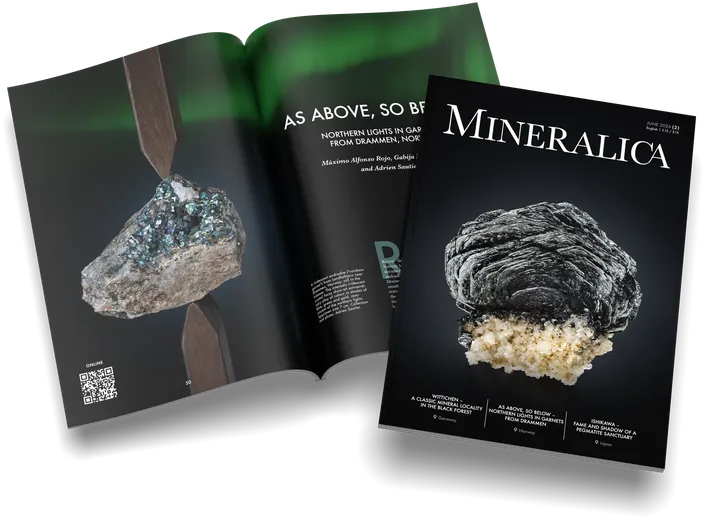

From the editor
Dear Readers,
In conversations about our hobby, I keep encountering a quiet wistfulness: the great localities are exhausted, all that matters has long since been described, the best lies behind us. This issue of Mineralica tells a different story — one of discovery and of preservation, and of how both are so often a race against forgetting.
Hardly any place brings this home as vividly as Wittichen in the Black Forest. Frank Oppenländer takes us into this remote side valley, once a center of silver and cobalt mining and roamed by collectors for generations. The dumps are slowly becoming overgrown, or were long ago carted off as road gravel. And yet there is still something new to discover in the district: only recently, a new locality came to light at the Aichhalder Mühle.
The article expressly does not regard itself as a complete inventory. But it outlines some of the rarest minerals of the district, documented through first-rate specimens and, in part, entirely new images never shown before.
Just how much devotion it takes to keep a locality in memory at all is shown by the article on Ishikawa in Japan. The pegmatites of this small town in Fukushima Prefecture rank among the country's richest sources of so-called rare-element minerals. At the same time, the locality carries a dark legacy: during the Second World War, men dug here desperately for uranium to feed a nuclear weapons program that, in the end, never came to be. For this piece, Kōta Harihara set out on his own expedition, exploring the historic mining area anew in search of the last traces of that dark era.
That nature can surprise us again and again, in wholly unexpected ways, is shown at last by the article by Máximo Alfonso Rojo, Gabija Maršalkaitė, and Adrien Sautier. From the region around Drammen in southern Norway, long known for its garnets, comes a find no one had counted on: iridescent andradites whose crystal faces glow in blue, green, violet, and gold, recalling the shimmering hues of the northern lights. Fine garnets had been known here for generations; that iridescent ones would appear among them — for the first time anywhere in Europe — no one had suspected.
Three articles, three very different places — and yet the same lesson: the field is never closed. That is precisely why, when faced with the objection that there is nothing new left to find, I prefer not to answer with words at all. I smile, slide an issue of Mineralica across the table, and ask: why not simply leaf through it?
And at the very end of this issue, finally, a taste of the next: a brief sketch of the history of the legendary Munich mineral dealership Maucher, which now closes its doors after more than a hundred years.
With warm regards,
Maximilian Schiller
Publisher
/mineralica-magazine/l7j7f1/p8-01.jpg)
Pages 8–46
By Frank Oppenländer and Matthias Reinhardt
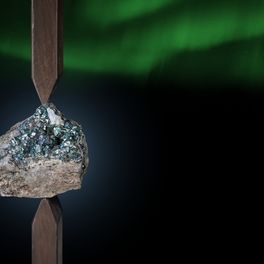
Pages 50–59
By Máximo Alfonso Rojo, Gabija Maršalkaitė and Adrien Sautier
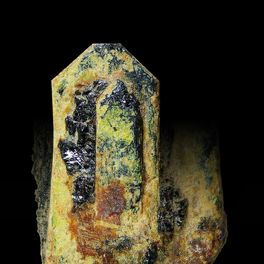
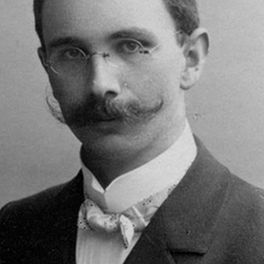 Free
FreeLeaf through the whole issue. The first pages of each article are open; the full issue is for subscribers.
This page is fully readable with a subscription. See subscription
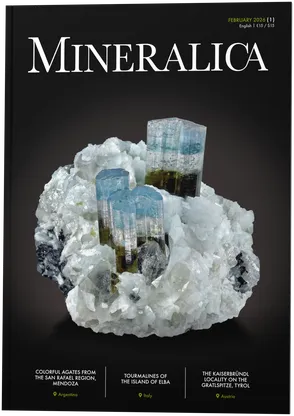
What makes a locality significant: colorful agates from San Rafael in Argentina, the tourmalines of the island of Elba and the microminerals of the Kaiserbründl on the Gratlspitze in Tyrol.
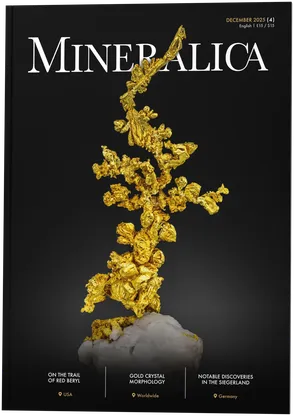
Rarity, form and fortune: red beryl from Utah's Thomas Mountains, the crystal forms of gold, new microminerals from the Siegerland and three legendary amazonite specimens from Colorado.