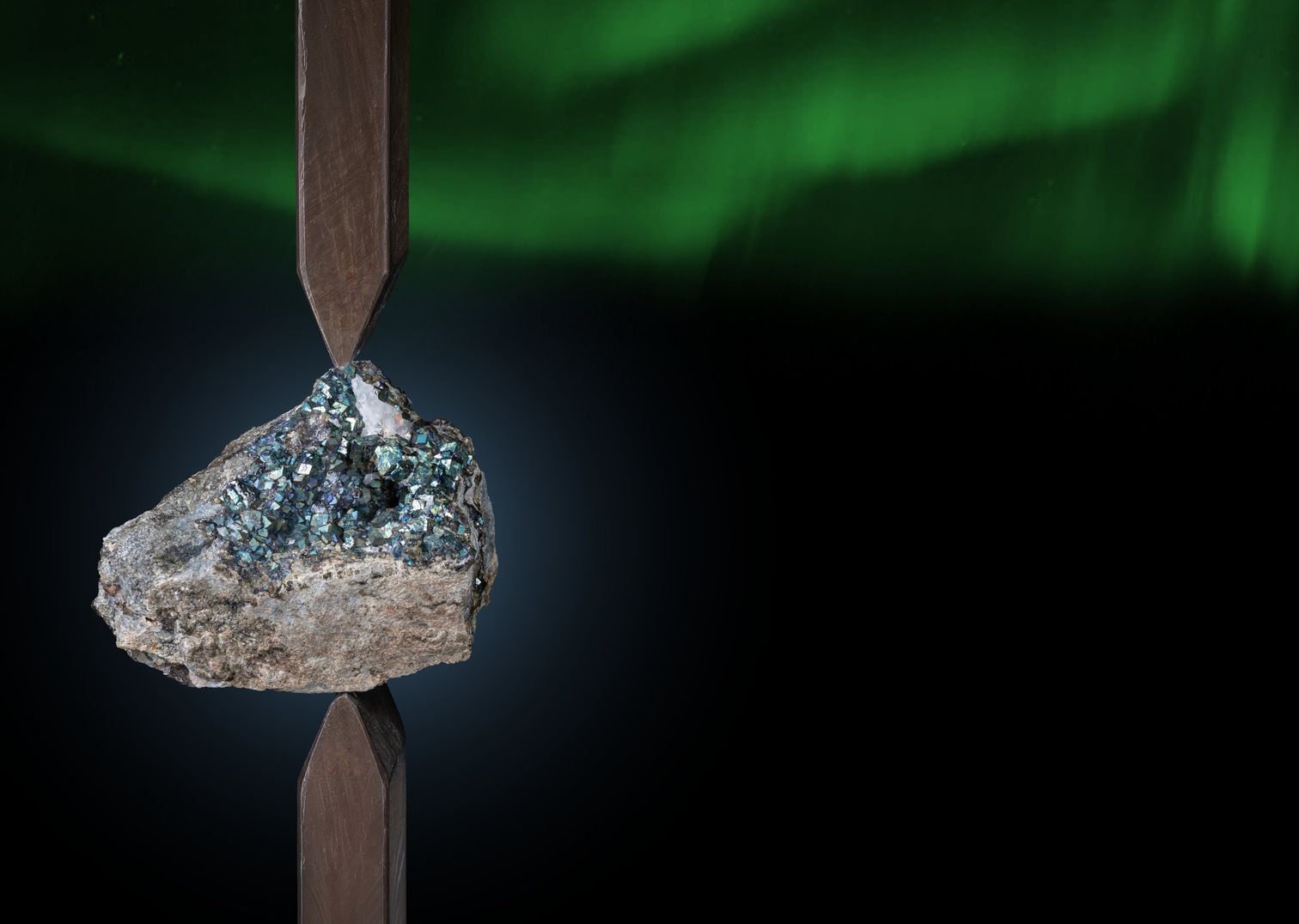
Recent field collecting in southern Norway has revealed a previously undocumented occurrence of iridescent andradite garnets near the town of Drammen. The crystals display unusually intense and colorful reflections, reminiscent of the northern lights of the Scandinavian sky. This is the first time rainbow garnet of this quality has been found in Norway and, above all, it’s the only confirmed European locality for this material.
All depicted specimens were found in 2025 by Máximo Alfonso Rojo.
Garnets are among the most widely distributed and chemically diverse mineral groups, occurring in igneous, metamorphic, and sedimentary environments worldwide. While many garnet varieties are valued for their colour, transparency, or crystal form, only a small subset displays pronounced optical effects. Among the rarest and most visually striking of these are the so-called rainbow garnets – iridescent andradite that exhibits vivid spectral colours across crystal faces when viewed under suitable lighting conditions.
Rainbow garnets are best known from a limited number of localities, most notably in Nara Prefecture, Japan, where their unusual optical behaviour has been studied in detail, and from discoveries in Mexico, Niger, China and a few sites in the United States. In Japan and probably in other occurrences, the iridescence is caused by extremely fine-scale internal zoning (e.g. Hainschwang and Notari, 2006). Variations in chemical composition and refractive index, arranged in periodic layers on the sub-micrometre scale, act collectively to interfere with and diffract visible light, producing the characteristic play of colour (more on this later).
Locality and Geological Setting
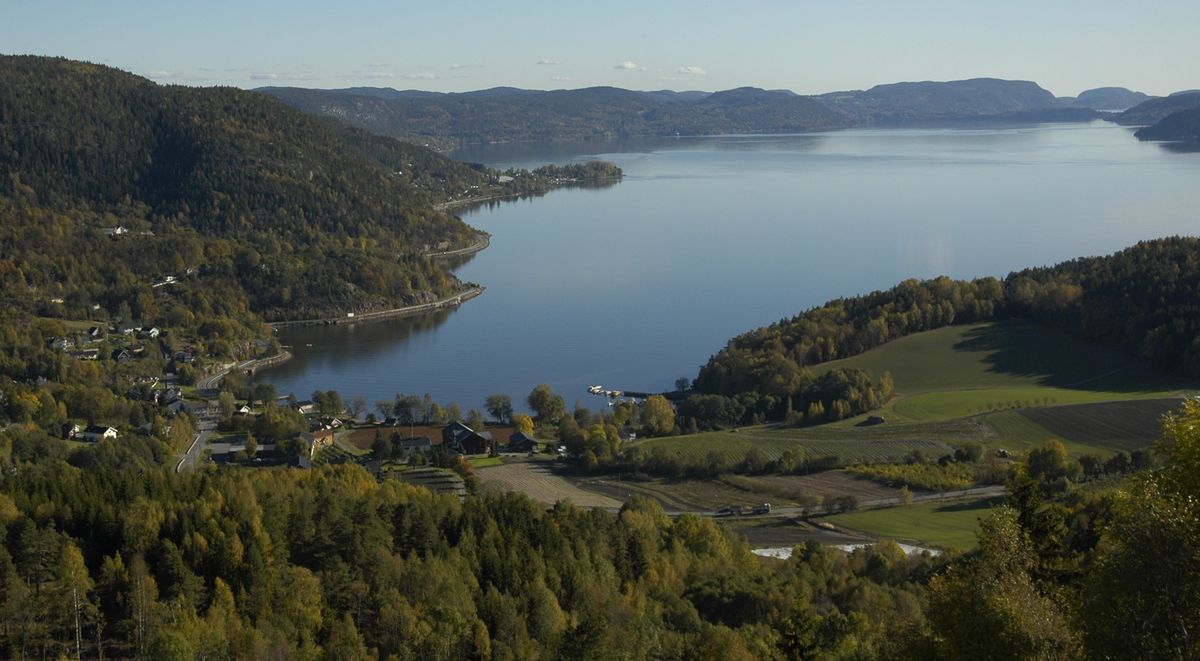
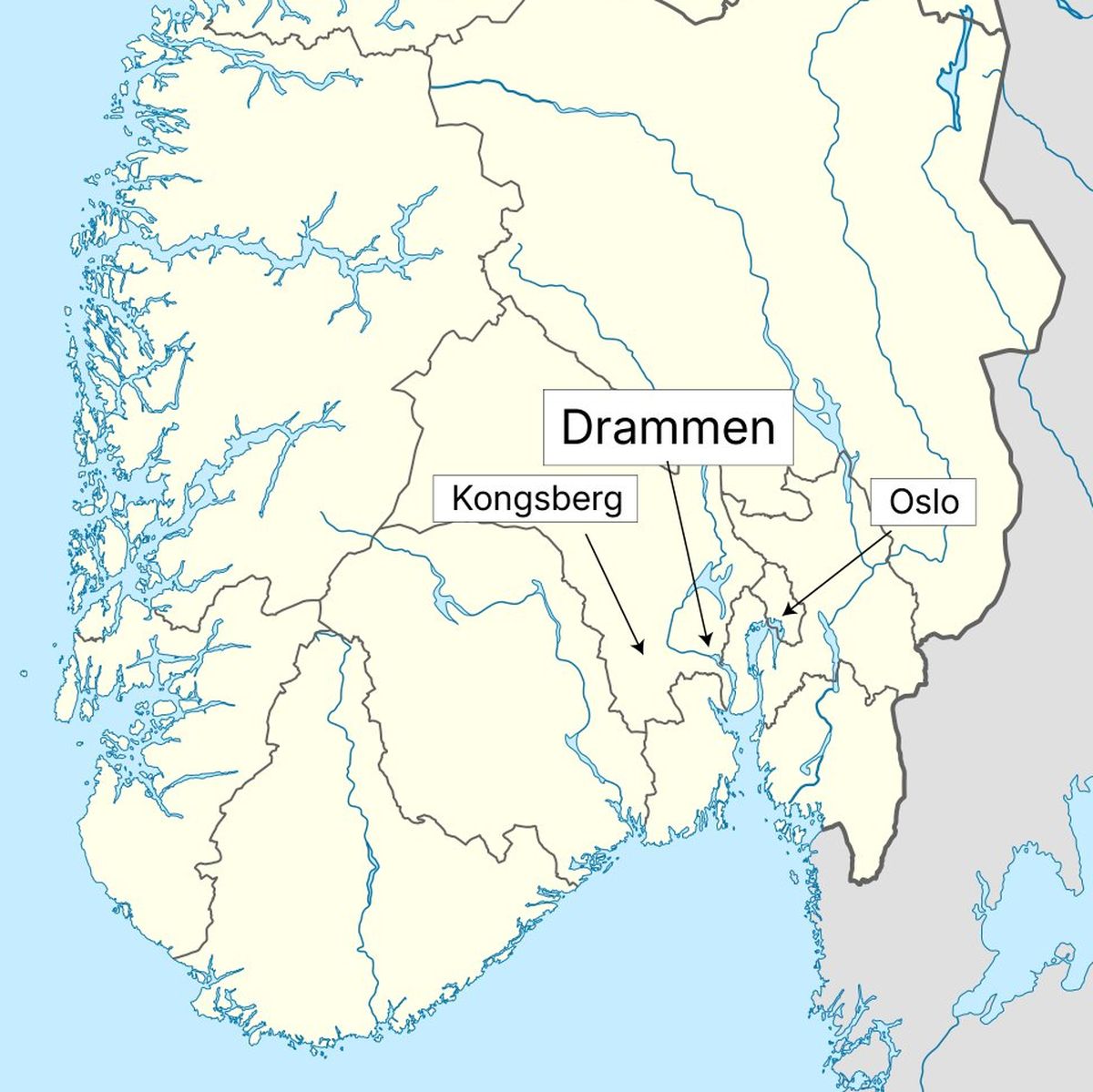
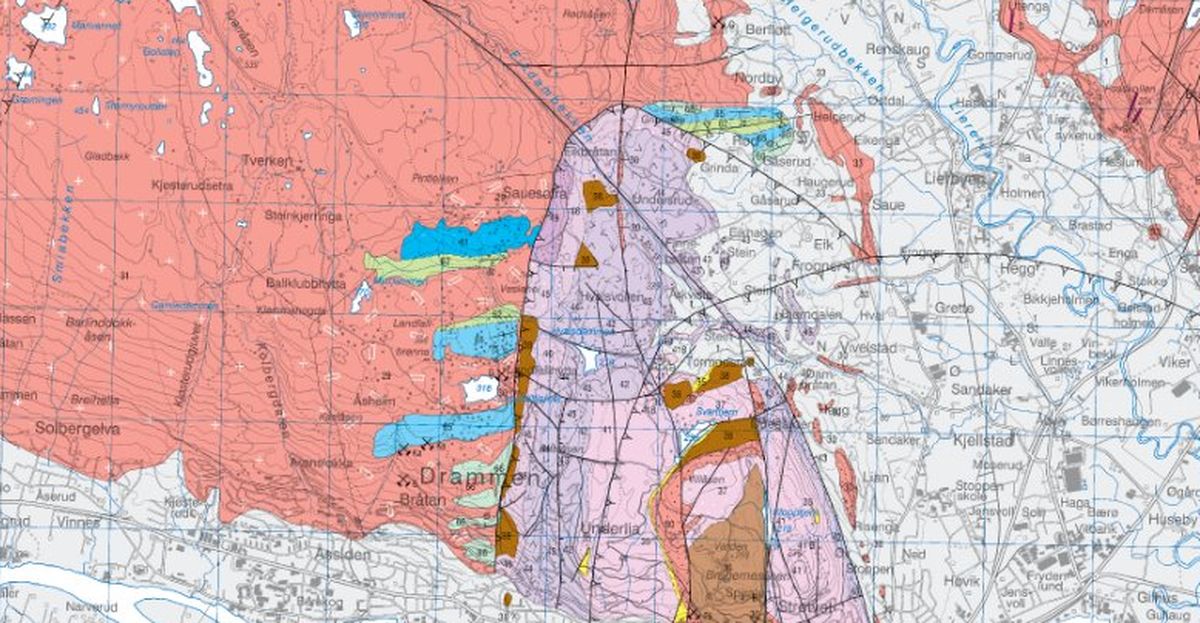
The new occurrence is located near the town of Drammen, Buskerud County, southern Norway, approximately 45 km south-west of Oslo and just west of the Oslofjord. The area lies within the Oslo Rift (Oslo Graben), a major Permian tectono-magmatic province that has long been famous for its diverse geology. This is not the first time Drammen has appeared on a collector’s map – the Drammen District has historical importance as the type locality for andradite.
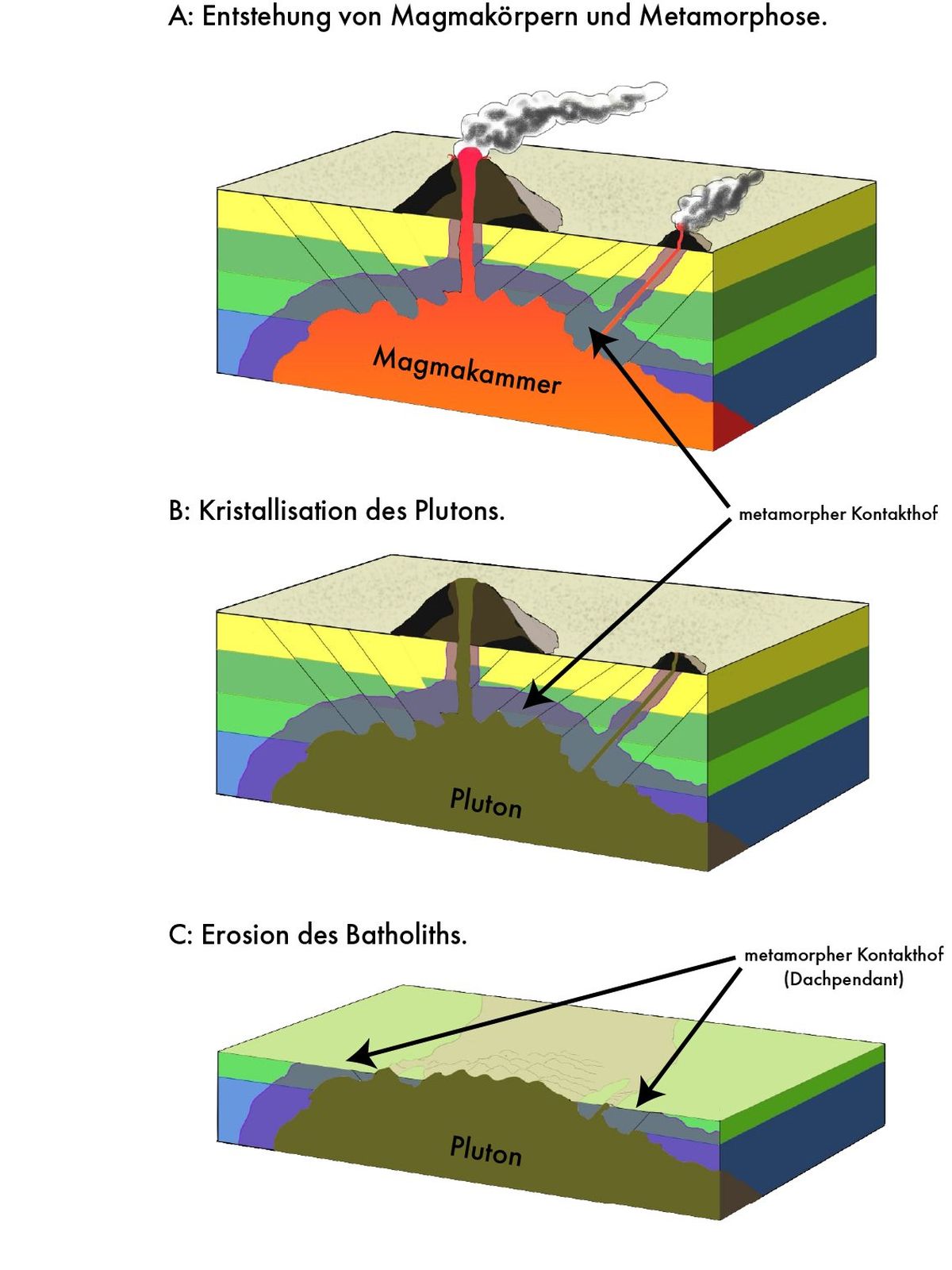
The geological setting of the region is shaped by the Oslo graben formation. Extension and lithospheric thinning during rifting promoted decompression melting and strong magmatic activity. Large bodies of syenitic and granitic magma intruded older sedimentary and precambrian basement rocks around Drammen (e.g. Trønnes and Brandon, 1992), producing widespread thermal metamorphism. In carbonate-rich sedimentary country rock, this contact metamorphism resulted in the formation of skarns containing assemblages (e.g. Goldschmidt, 1911) rich in quartz, garnet, vesuvianite, diopside, epidote, calcite, and related minerals.
At the locality described, the garnet-bearing skarn occurs in a thermally altered xenolithic roof pendant. This xenolith is made of remnants of sedimentary strata, including former limestones and fossil-bearing concretions, which recrystallised under high-temperature conditions adjacent to the intrusive body. The resulting rocks are fine-grained, locally porous, and mineralogically heterogeneous, reflecting variations in the original composition and degree of metasomatism (chemical alteration of rock by fluids). Garnets themselves occur in lenses of calcium-rich material within the contact zone with Drammen Granite.
The presence of this intrusive unit and hematite-bearing veins further attest to hydrothermal activity. The mineral assemblage observed at the new occurrence – dominated by calcium-bearing garnet with associated quartz and calcite – is consistent with classic skarn parageneses known elsewhere in the Drammen area.
Discovery and Field Observations
The rainbow garnet locality was identified by Máximo Alfonso Rojo in the summer of 2025 during renewed field investigations of skarns near the classic Fem-minutter’n area – a site long known to collectors but now largely exhausted. Attention was drawn to a small, previously overlooked skarn exposure situated only a short distance from this historic locality, where geological maps and surface features suggested favourable conditions for garnet mineralisation. The new site can be named Landfalltjern, after the lake south of Fem-minutter’n.
Initial examination of weathered material at the site revealed small, dark garnet crystals exhibiting an unusual metallic sheen. When illuminated at low angles, several crystals displayed vivid flashes of blue, green, violet, and gold, immediately suggesting true internal iridescence rather than superficial staining or alteration. Precise cleaning and microscopic inspection confirmed that the optical effect originated within the crystal itself.
Careful collecting with the land owner’s permission over the following months produced iridescent garnets within weathered blocks of the xenolith, where partial decomposition of the host rock has exposed crystal faces. In contrast, fresh, unweathered material is typically tightly cemented by calcite and proves extremely resistant to mechanical extraction. The host rock is noticeably porous in places, absorbing impact rather than fracturing cleanly, which further complicates collecting.
Description of the Northern Lights garnets
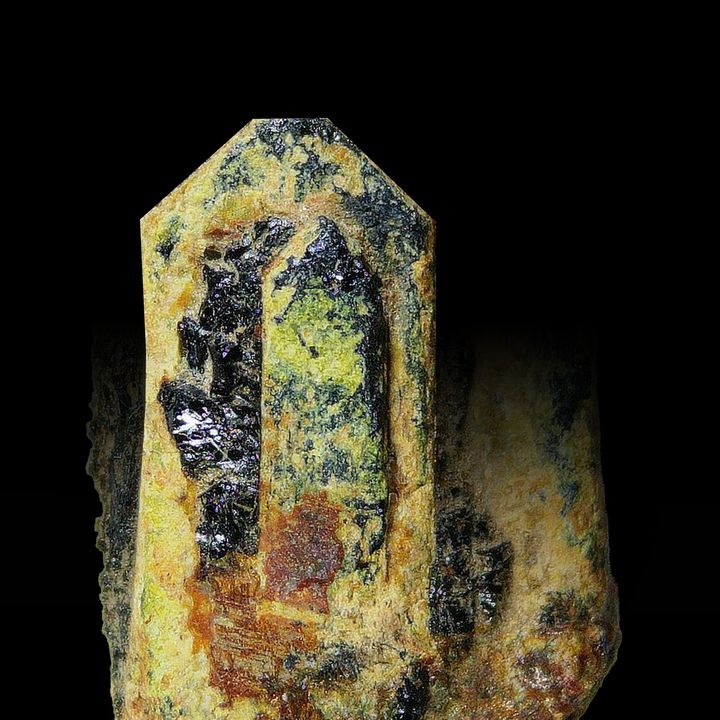
The garnets are unevenly distributed but locally abundant within certain layers of the metamorphosed xenolith, occurring both as isolated crystals and as small clusters. Although the total extent of the occurrence appears limited, the quality and strongly iridescent nature of the best specimens makes the find noteworthy. The garnets form small but striking crystals, typically rhombic dodecahedral and measuring a few mm, exceptionally up to 2 cm across in the case of a complex textured crystal (picture left). Some crystals are modified by the trapezohedron. Most smaller crystals have sharp edges and highly lustrous faces, while only some are translucent. Bigger crystals, usually those above 5 mm, show a textured surface, so-called hopper growth, with a metallic sheen. These flat surfaces display vivid iridescent reflections in shades of blue, green, violet, and gold, shifting with the angle of illumination. Quartz, both massive and in crystals ranging from a few mm to several cm, is the only notable associated mineral.
The intensity and colour of the iridescence are consistent within a given pocket, but varies or even fully disappears between pockets which are one centimetre or more apart. Similar variation is observed in the base colour of the crystal, iridescence apart: the shade of brown varies from yellow green to nearly black. As is common with andradite, the colour of the crystal appears greener or more brown depending on the light source. Finally, it should be noted that some small crystals are magnetic enough to be picked by a neodymium magnet.
Compared with other iridescent garnets, the Drammen specimens appear noticeably darker. If the Fem-minutter’n composition is representative of this find, the presence of detectable Ti (TiO₂ up to ~0.18%) could lead to a darker appearance, especially when compared with garnets which do not have significant titanium content: brown Nara garnets (Nakamura et al., 2017) or yellow-green-brown Stanley Butte, Arizona ones (Amthauer and Rossman, 1998). Even if Ti is not the primary cause of the dark colour, this difference in body colour affects how strongly the interference colours appear to the eye.
In addition to being darker, Landfalltjern garnets are distinct from other finds in iridescence colours in combination with crystal habit. Garnets from the new find are dominated by flat {110} faces at small sizes and hopper crystals at bigger sizes, with a metallic sheen close to the surface. While small crystals can resemble garnets from Japan, bigger ones are similar to those from the Huanggang deposit, Inner Mongolia, China. It should be noted that Fem-minutter’n crystals generally stand out more from the matrix and show flat faces at all sizes. Therefore, they can be visually distinguished from Landfalltjern samples in most cases, even if both sites produce iridescent material.
Interestingly, small fossil brachiopod shells that miraculously survived metamorphism and were replaced by brown garnet have also been found near iridescent crystals.
Mineralogy and the cause of iridescence
This new find of rainbow garnet at Landfalltjern has not yet been analysed, but it is reasonable to expect similarities both to nearby Drammen-area skarn garnets and to other iridescent andradites. Given the skarn setting and the iridescence, it is most likely a Ca-rich garnet in the andradite-grossular (grandite) series. Previous chemical analysis of garnets from the nearby Fem-minutter’n area found that both lighter and darker zones were dominated by andradite (Nordrum et al., 2006), which suggests the new material may also be andradite-rich. Chemical analysis of garnets from the Auvi Mine, which is about 8 km away, but associated with the same granite and similar sedimentary units, has shown andradite-rich rims growing epitaxially (as a new layer on an existing crystal) on more grossular-rich cores with repeated variation in composition, indicating at least five pulses of hydrothermal fluids during the formation of the andradite-rich periphery of the garnets (Jamtveit et al., 1993). Hopper crystals can be observed in both this find and garnets from the Auvi mine, where it was proposed that growth-face instabilities shift from {110}-dominated dodecahedral faces toward a rougher surface because of relatively high growth rates of andradites in comparison to grossular cores (Jamtveit and Andersen, 1992).
In well-studied iridescent andradites from other localities, the optical effect is linked to extremely fine, periodic internal lamellae – commonly parallel to {110} – that differ in composition, with alternating Fe- and Al-enriched layers. With a thickness oscillating between 100 and 300 nm, those lamellae can generate angle-dependent colours (e.g., Shimobayashi et al., 2005). The analysis of similar material from Stanley Butte, Arizona has showed compositional zoning of nearly pure cubic andradite and mixed tetragonal grandite (Adr53Grs47) with sharp boundaries, suggesting that the observed miscibility gap (mixing is not energetically favoured) in the andradite-grossular series (Xu et al., 2023) may be relevant to this find. Iridescent Nara garnets show a similar layered structure, but all layers are andradite-rich – they alternate between pure andradite and Adr80Grs20 at 100–200 nm intervals – scales relevant to iridescence (Igami et al., 2025).
Even though the cause of iridescence seems to be generally agreed upon, the mechanism that produces the lamellae is still debated and may vary depending on geological conditions. A leading hypothesis is that the layers form during growth (Jamtveit, 1991), rather than by exsolution (separation of two phases) during slow cooling, as seen in labradorite. Exsolution is considered an unlikely mechanism on realistic timescales because phase separation only becomes energetically favoured at low temperatures, where ion migration is sluggish (Becker and Pollok, 2002), unless other factors – potentially including water or fluid-assisted diffusion – significantly accelerate it, as observed in feldspar (suggested in discussion by Xu et al., 2023). Even if the exact mechanism is not confirmed, all iridescent andradites observed so far were associated with skarns, where formation conditions produce garnets more variable in composition compared to metamorphic ophiolite environments.
While detailed analytical work remains to be carried out, this new material can be placed with confidence within the growing group of iridescent calcium-bearing garnets known worldwide.


/mineralica-magazine/l7j7f1/p8-01.jpg)