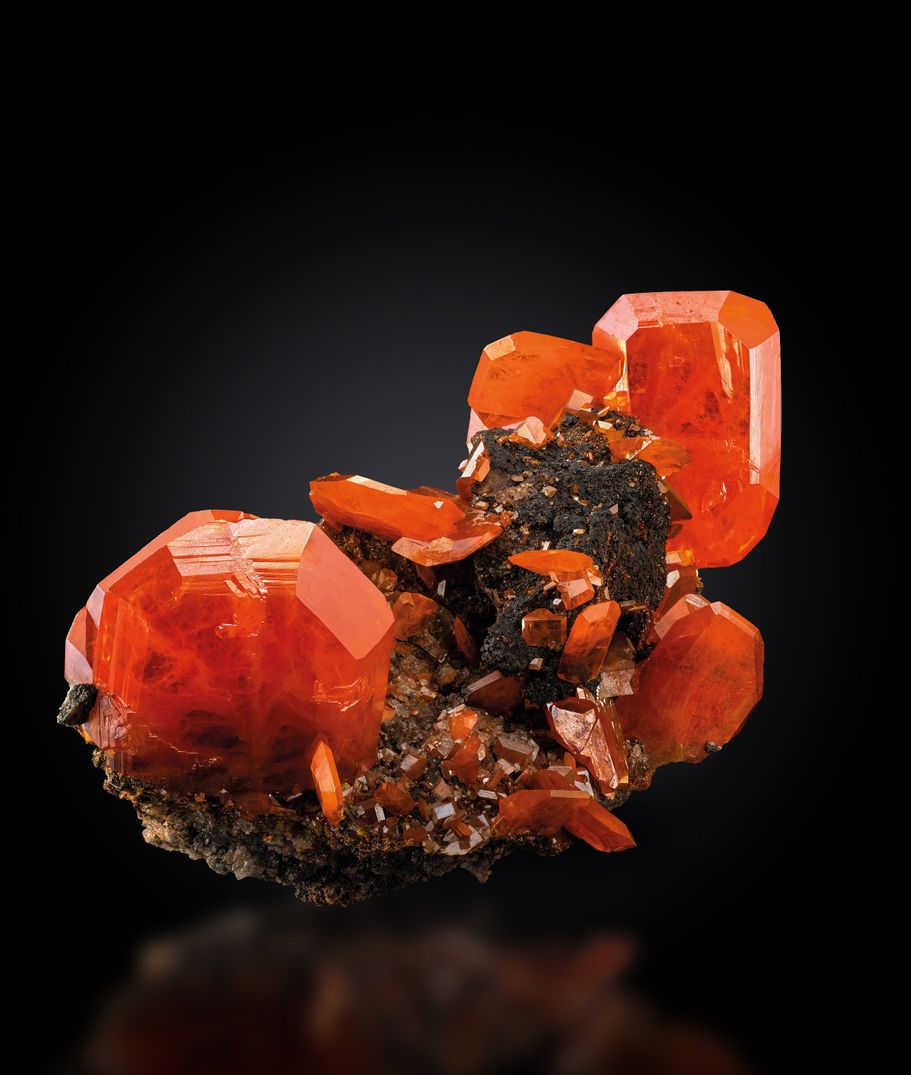
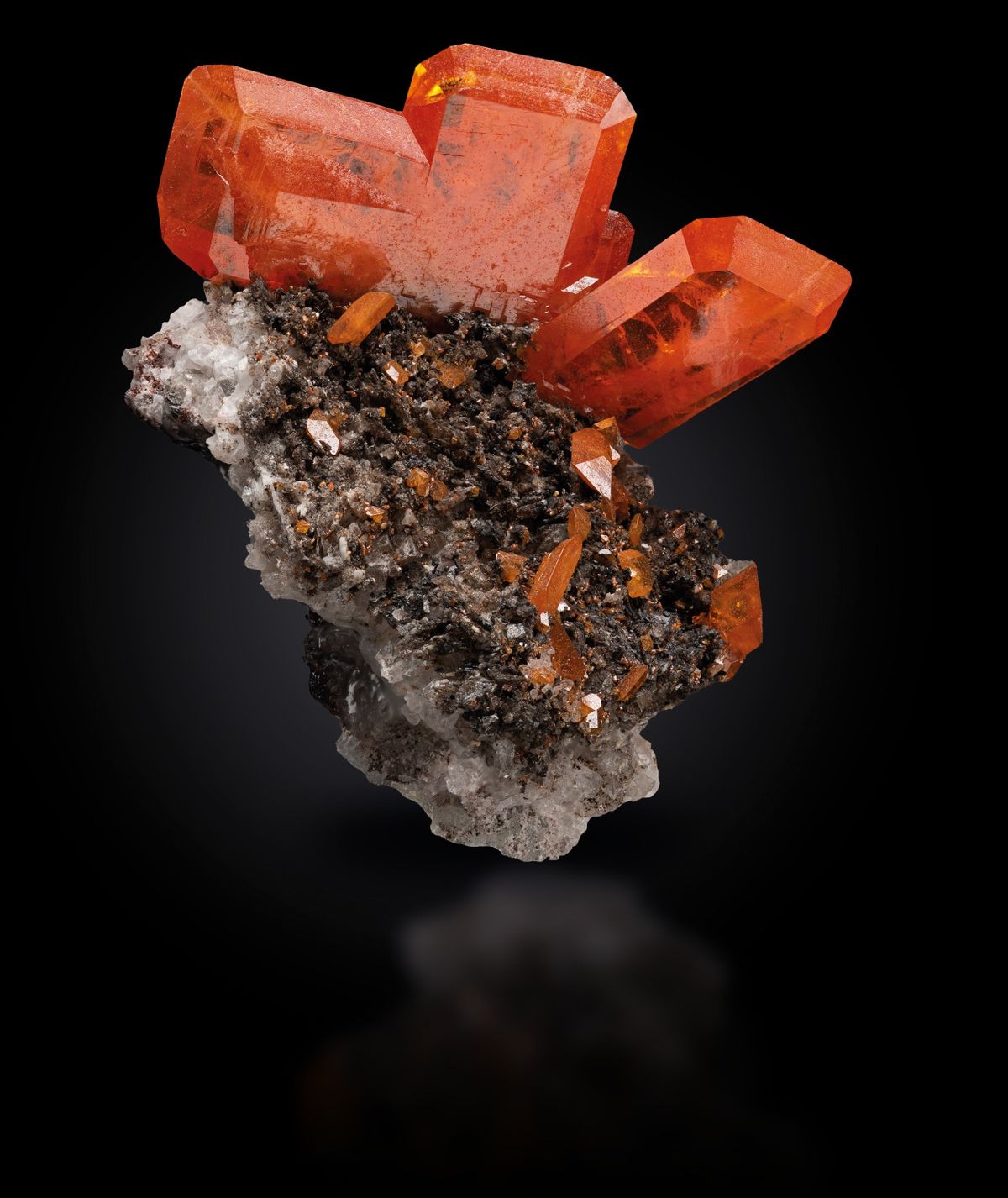
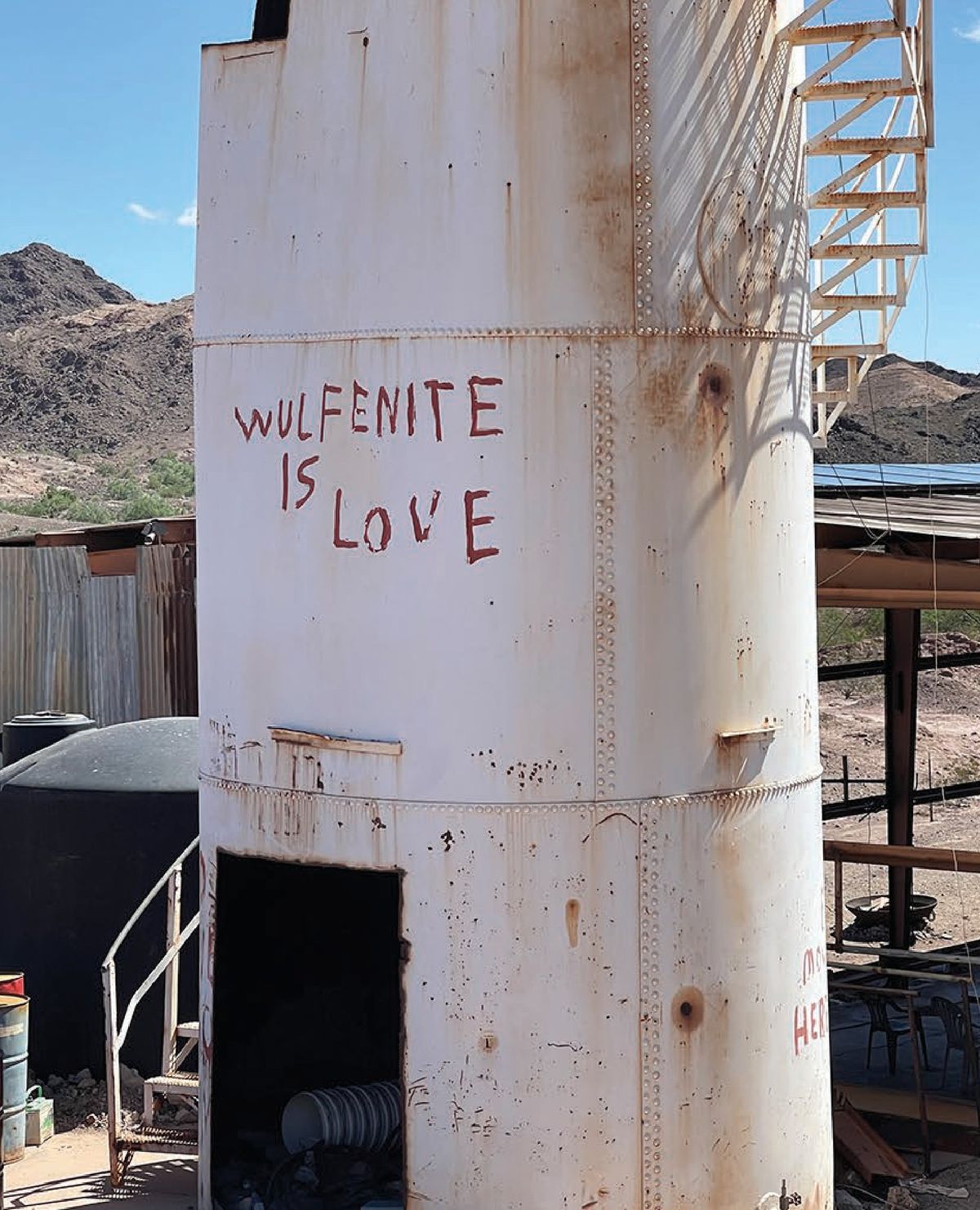
This slogan is famous to describe the minerals from the Red Cloud Mine in the Silver Mining District, Trigo Mountains, La Paz County, Arizona / USA. The Red Cloud Mine (RCM) produced the finest, deepred-orange Wulfenite xx world- wide. Bright crystals and floaters with crystal size up to > 5 cm including the famous „Window Panes“ made the RCM world-known. Wulfenite is a lead-molybdate (PbMoO4).
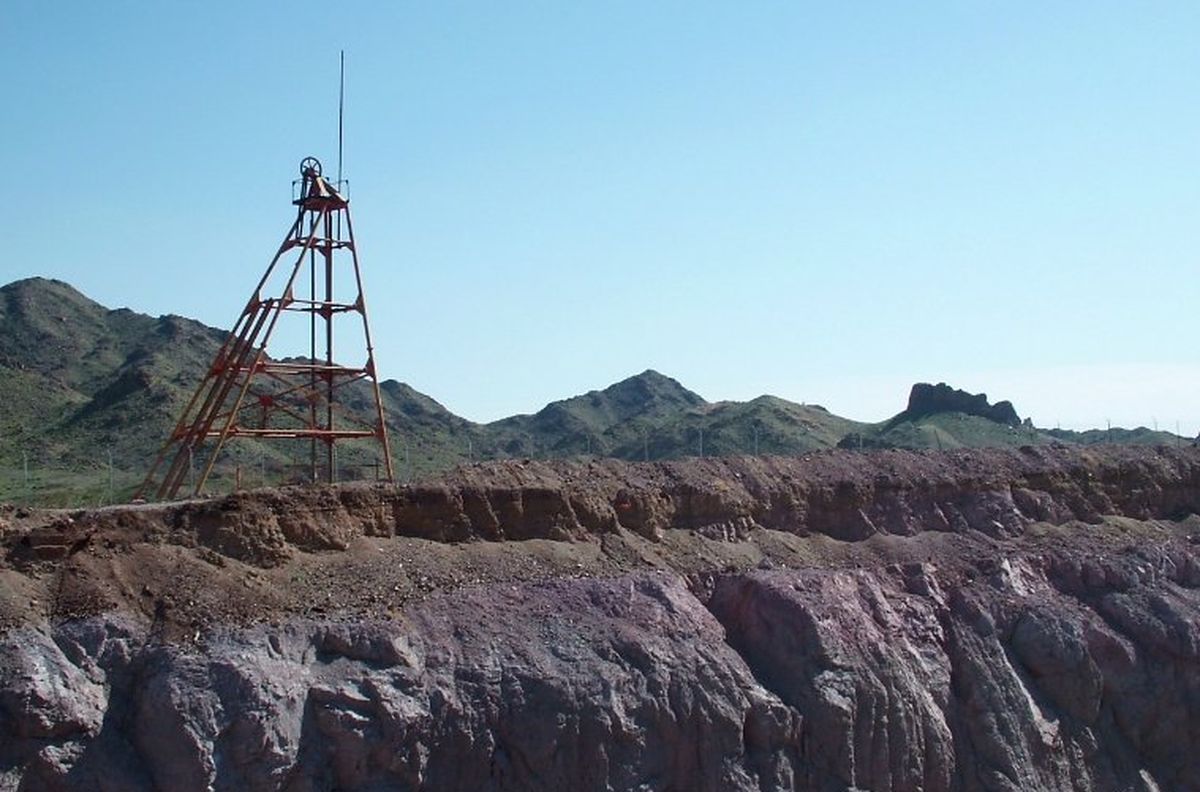
The oredeposite (Silver, Galena) was discovered by prospector Warren Hammond and the workings began immediately. In the 1880´s up to 100 people had been working at the RCM; in the early years first in outcrops at the surface, later the underground workings began. The maximum dephts was 163 meters under surface, this was under the groundwater level. A landmark of these ancient underground workings is the famous red headframe which is still present.
The first crystals and specimens reached the minerals market in the early 1880´s, but most of the specimens had been destroyed by blastings or the smelter.
Mr. F. Thomas was the first collector whith fine Wulfenite an Vanadinites specimens from the Red Cloud, Hamburg and Princess mines; all these mines are very close togehther in the Trigo Mountains. 1881 an article was released by Benjamin Silliman from the Yale University in the „American Journal of Science“ which described the Red Cloud Mine as a site with very fine Wulfenites. So the interest increased to the collectors and dealers; thousends of Wulfenite specimens found their way into private collections and museums. In early 1938 collector Edwin „Ed“ Over started collecting at the mine; and soon in February 9th 1938 he found a couple of pockets with fantastic Wulfenite xx up to 5 cm! These specimens became later world class status.
The mine managers changed from time to time to restart the ore production. The last ore production was from 1981 – 1984. Numerous collectors and dealers like Leigh Price, Bruce Barlow, George Godas or Wayne Thompson started specimen production. Wayne Thompson bought a license to the mine together with Hollywood componist James Horner (Titanic, Braveheart) for specimen production and started to dig out the mine and created the open pit. In 1996 they found a huge pocket ( 4 x 1 x 0,1 m) which produced Wulfenites xx up to 4 cm worth more than 1.000.000.- USD. During that time I bought my first Wulfenite specimens from Wayne and my „Wulfenite is Love“ time started.
In the late 1990´s Colorado dealer Bryan Lees (Rhodochrosite from Sweet Home Mine) got the lease on the RCM till 2003. He expanded the open pit and dug the mine up to 32 m under surface with huge excavators and the excavated material formed a huge dump nearby the mine, called „Mount Sutton“, named after chief geologist Graham Sutton. When Bryan Lees stopped the workings, the open pit had a size of 100 x 30 x 32 meters (L x W x D).
The most famous find from that period was the „Red Gem Pocket“ with deep red-orange crystals up to 3 cm. During that time I had the chance for several visits at the mine which I will describe here later.
Then the mine felt asleep for some years till 2011 some guys around Robert Bell overtook the mine and opened the site for mineral collectors – the entrance fee is actually $ 35.- person / day; collecting is allowed only in the open pit. Beside Wulfenite xx you can also find Fluorite, Willemite, Calcite and Cerussite and also fluorescent minerals. For further information contact www.redcloudmine.com.
Geology
The Red Cloud Mine is located in Arizona north of Yuma and east of the Colorado river at 326 m above sea-level.
The deeper underground is build by Granite which is overlead by vulcanic rocks (Andesite, breccias and tertiary tuff). Along a 30° incline NE vault there is a ca. 3 – 5 m wide mineralized zone (vein) which reaches ca. 130 m down where the vein disappears. The mineralisation shows beside silver rich galena ore (up to 17,1 kg Ag per ton) also Quarz, Limonite, Hämatite, Fluorite and Calcite; more rare are Vanadinite, Cerussite and others. Within the andesite breccia are the Wulfenite pockets with the wonderful red-orange crystals.
Mine visit
During the Tucson show in 2003 I asked Bryan Lees („Sweet Home Mine project“) to collect again in the mine. Bryan operated the mine since the late 1990´s and he gave me a written permit to show the on-site team (during that time there was no mobile signal at the mine). Two days later I started from Tucson to Yuma for overnight. Next morning I headed north till Lake Martinez then using the dirt road passing the US Army training area. I was happy to had a 4 WD car, because the road passes several washes.
The drive to the mine this year was something special because the desert occured in yellow, green, blue – overall colourful flowers! This happens only every 15 to 20 years.
From the distance a red headframe came in sight – that was the mine. The whole area was fenced and I showed my permit to the guys and they let me in. Suddenly a bulk of cars with whitehair drivers in cars remembering me to the „Mad Max“ movie came to the mine. They looked like rockers and wanted to get into the mine. The guys from the mine told them, thats a private property with no tresspass. The dicussion escalted a bit and the mineworkers showed the „Snowbirds“ (retired people moving with the sun from north to south) their pumpguns … And the discussion stopped and the old people left the area ... The guys showed me the mine and led me to the ramp leading into the open-pit and wished me good luck.
In the open-pit I recognized some old tunnels, some still showing the wooden timber. The old tunnels run just a few meters from the fault. East from the fault is the bright Andestite on the west side of the fault the dark ore-breccia and more west the Granite.
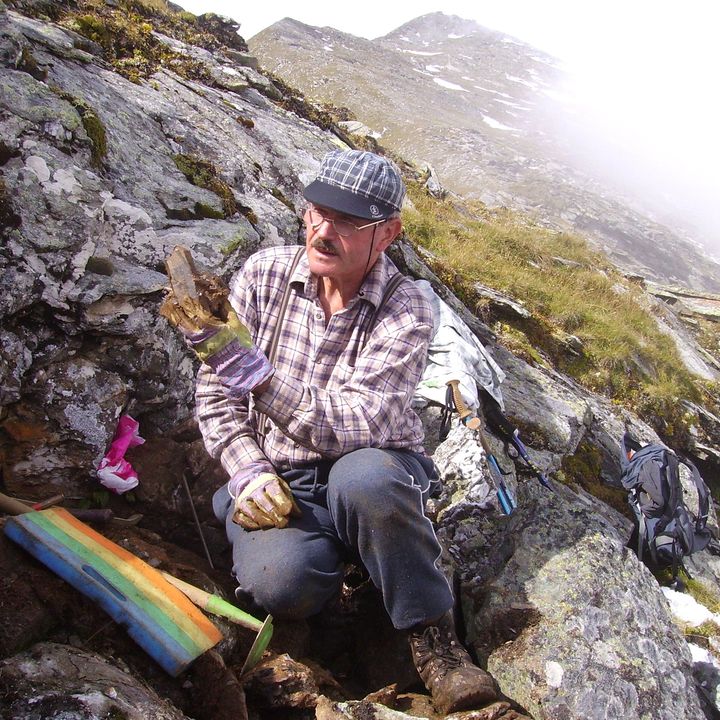
Just a few minutes after start looking for minerals I found the first specimens with Wulfenite on matrix with crystals from 1 to 1,5 cm! I didnt know where to dig - so many hints of minerals. I collected many miniatures from the loose ground with Wulfenite xx and Quarz xx or Calcite xx. In a small pocket (ca. 10 x 10 x 4 cm) I found little Wulfenites xx (till 7 mm) on blue Fluorite xx - what a surprise and I was very proud and happy! Time was running and it became late afternoon as I concentrated my work on an interesting orange little vein wich looked like a Wulfenite-vein. I started working with hammer and chisel and after a short time I was able to remove the rooftop of a pocket – my heart beating faster and faster. And – YES, it was a pocket (ca. 30 x 20 x 10 cm) full of orange-red Wulfenite xx. Overall in the pocket where the bright shining Wulfenite crystals up to 1,5 cm! The bottom of the pocket was built up of light green to light blue massiv Fluorite, in parts with crystals up to 8 mm. I found a 3,5 cm floater of little Quartz xx with a 1 cm freestanding orange-red Wulfenite x. Wow – I was overwhelmed – how did Ed Over felt when he found his big 5 cm crystals?
Sunset got closer and carefully I collected and wrapped the specimens. The team invited me for BBQ and the cool beer was very tasty after that sunny, dusty day. In the same year, Bryan Lees stopped the workings at the Red Cloud Mine, but my love for Wulfenite still exists – Wulfenite is love!