The Siegerland region in Germany looks back on more than 2,000 years of mining history. Early extraction took place through primitive open pits and adits; with the onset of industrialization, deep mining began, resulting in shafts that exceeded depths of 1,000 m. The mined ore consisted predominantly of iron ore, with lead, zinc, nickel, copper and cobalt recovered as by-products.
By the time the last two mines, Grube Füsseberg near Biersdorf-Daaden and Grube Georg near Willroth, closed in 1965, a total of 175 million tonnes of iron ore had been extracted from the Siegerland–Wieder Ore District.
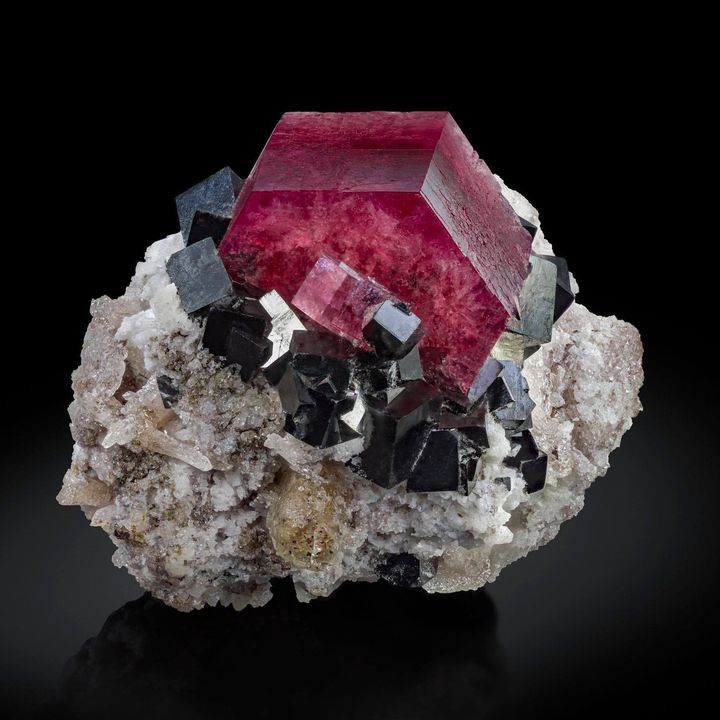
During the active mining period, numerous beautiful and rare minerals were brought to light. Many specimens found their way into private collections or into museums in Germany and abroad. Striking specimens, such as rhodochrosite, malachite, lepidocrocite, millerite, and galena, were highly sought-after collector’s pieces due to their size and aesthetic appeal.
Today, many old dumps and former mining structures have disappeared, having either been demolished, overbuilt or reclaimed. In recent years, however, local collectors have rediscovered specific sites using historic maps and modern digital resources. Although the chances of finding noteworthy specimens are generally modest, careful research and perseverance still yield occasional discoveries—including entirely new ones.
In this and the following articles, recent finds from the past years are presented to the interested reader.
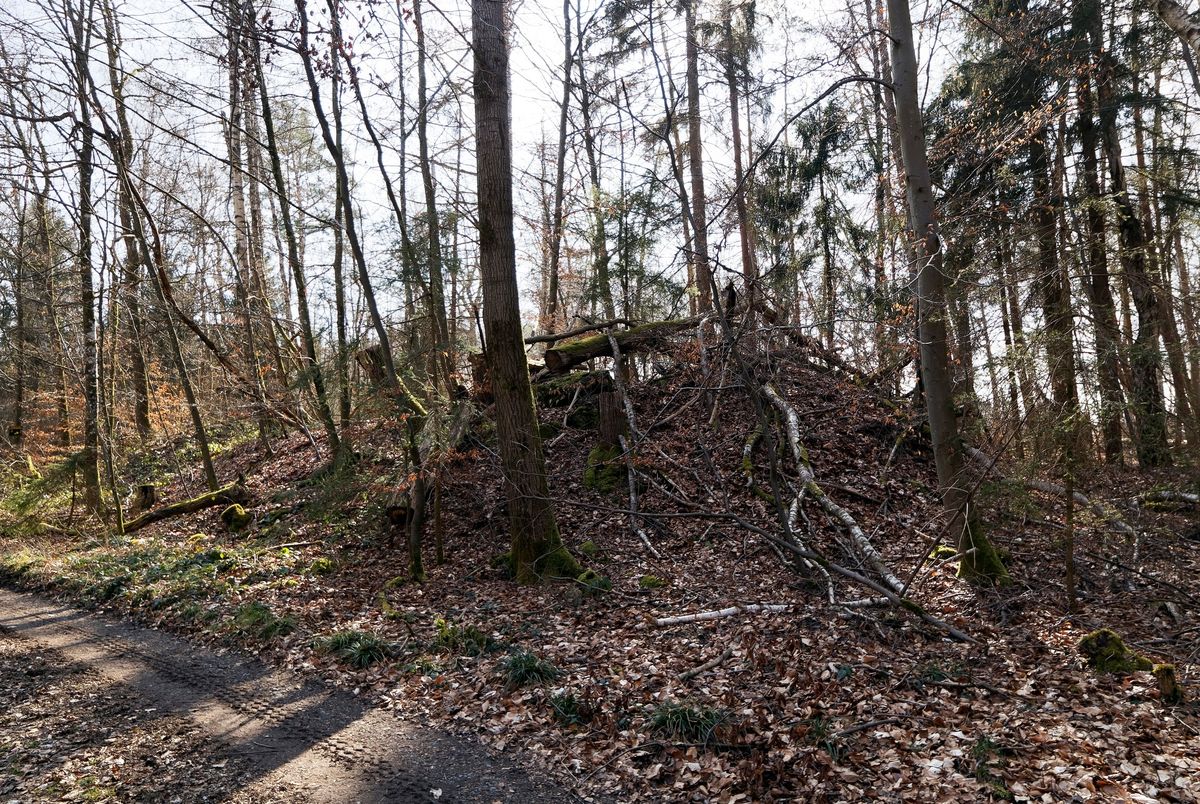
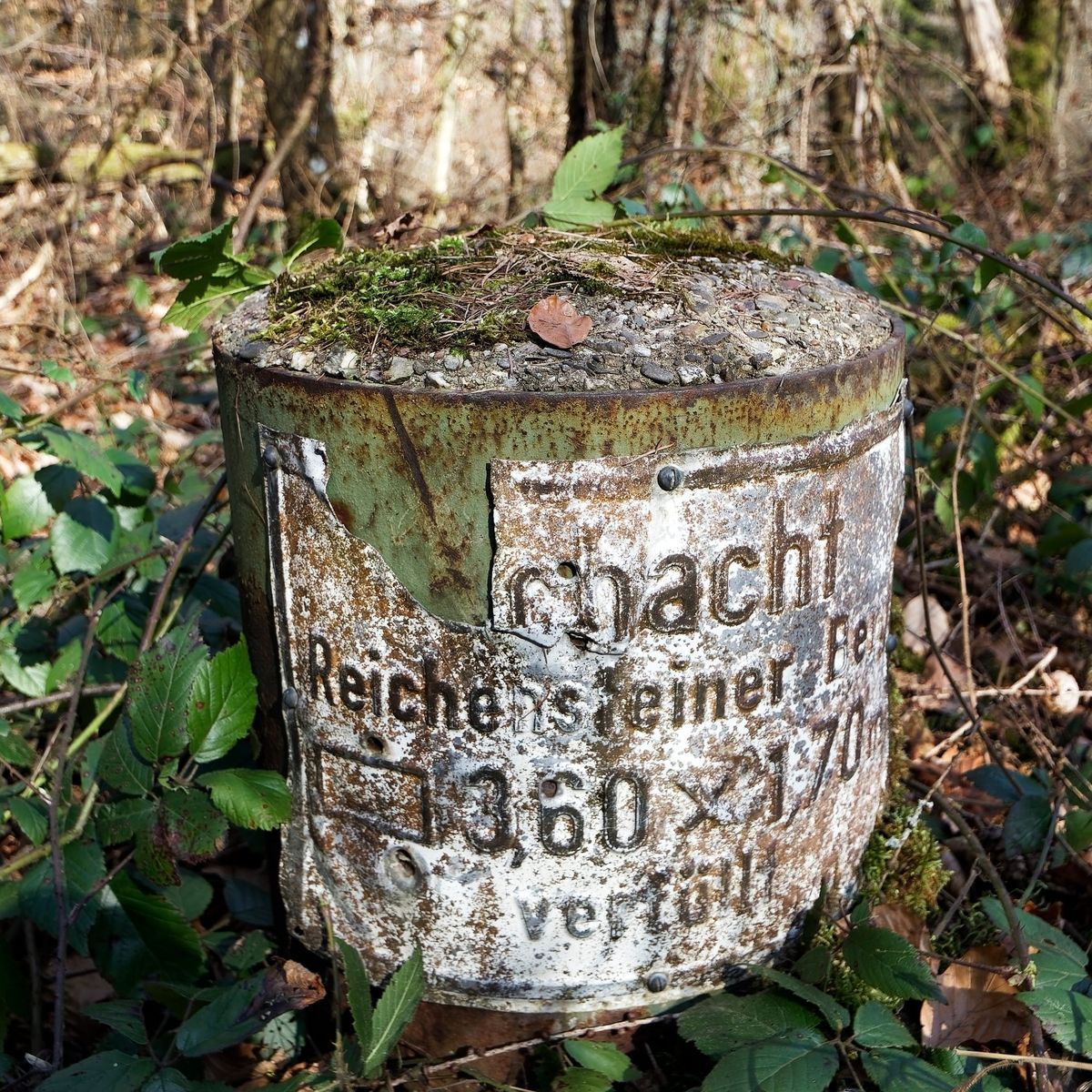
Reichensteiner Berg Mine, Reichenstein
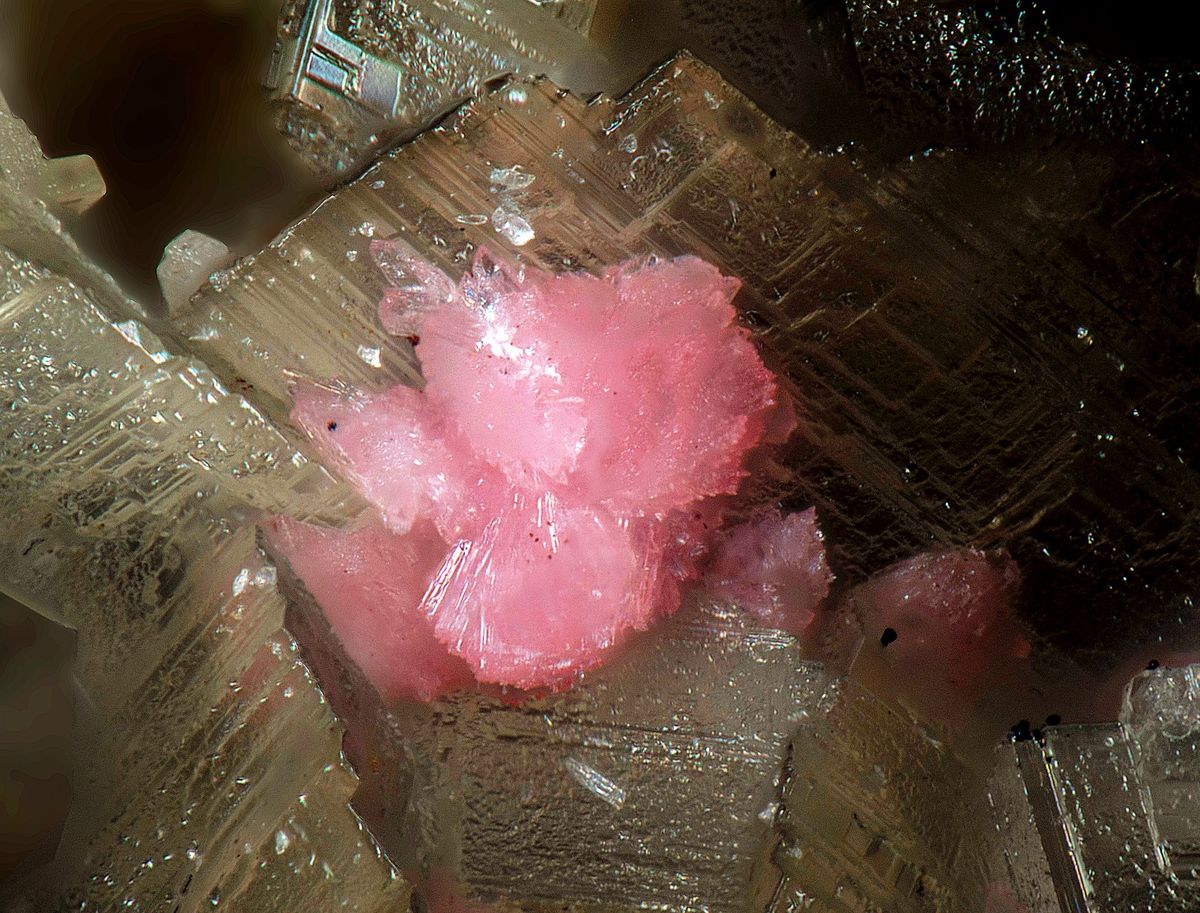
Erythrite forms small, pink rosettes up to 0.2 mm across, delicately perched on pale yellow siderite crystals. Alloclase was observed as very finely disseminated silvery-grey grains included in quartz, giving the latter a subtly speckled appearance. In siderite vugs, chalcocite occurs alongside malachite, appearing as blue, rather indistinct, dull crystals up to 0.2 mm in size. These crystals are often slightly rounded and display the characteristic longitudinal striation typical for chalcocite. Stibiconite, identified as yellowish-white masses within the siderite, represents an alteration product of ullmannite.
Rhodochrosite, a member of the calcite group, is relatively common in Siegerland due to the frequent presence of manganese in local siderite. In the dump material of the Reichensteiner Berg mine, orange, botryoidal rhodochrosite crystals up to 0.3 mm occur within siderite vugs together with malachite, pyrite, and chalcopyrite, forming small but visually appealing micro-aggregates.
Chalcophanite was found on a single occasion as tiny reddish-brown tabular crystals in vugs of limonite, completely lining the cavities and showing a faint bluish sheen under magnification. Cerussite is invariably present as an associated mineral. In limonite, coronadite appears together with pyrolusite, forming small, black, needle-like sprays reaching sizes of up to 0.5 mm.
Fürst Moritz MIne, Niederndorf
In May 2024, a small but notably well-defined silver-ore paragenesis was discovered in the “Neuer Bleiberg” mine workings, specifically in the old pits situated above the historic Bleiberg adit. Although modest in size, the assemblage provides an interesting glimpse into the secondary mineralization processes of this part of the district.
Acanthite occurs as small, sharply pointed crystals perched on native silver within siderite–quartz vugs, where the contrasting metallic lustres make the association particularly striking under the microscope. Polybasite is also present and appears as thin, metallic, hexagonally shaped plates, commonly forming compact aggregates.
Glanzenberg Mine, Silberg
In spring 2023, interesting new discoveries were made on the dumps of the Goldberger adit and in the “Silberstern” field.
Asbolane, associated with erythrite and hörnesite, forms black, lustrous spheres or nodules showing characteristic shrinkage cracks.
In graywacke/quartz, covellite forms blue, metallic aggregates up to 1 mm in size, accompanied by massive brown sphalerite and green crusts of malachite.
A particularly surprising find was dundasite. In one part of the Goldberger dump, a layer of reddish-brown, limonitized graywacke was uncovered. The coloration indicated sphalerite weathering and suggested the possible presence of secondary zinc minerals. When breaking the material, numerous white spheres were found alongside needle-like and prismatic cerussite crystals. Hydrozincite was suspected initially.
However, EDX analysis unequivocally identified the mineral as dundasite. It forms white, finely fibrous, radiating balls up to 0.5 mm in diameter. One specimen approximately 14 cm wide is richly coated with this zinc carbonate. Smithsonite also occurs as an associated mineral. Smithsonite in Siegerland is otherwise known only from Grube Marie near Wilnsdorf and Grube Grüne Hoffnung near Burbach.
Golze et al. (2012) described dundasite from these localities as white, tufted needles up to 0.5 mm associated with cerussite. The quality and abundance of the new dundasite spheres are unparalleled for the Siegerland.
Hydrocerussite is much rarer than cerussite in the Grube Glanzenberg dump material. It forms thin, platy crystals of whitish-yellow color, often poorly developed, sometimes showing transparency and a trigonal habit.
Linarite forms elongated, dark blue crystals up to 0.3 mm in limonite cavities. On lustrous, pointed cerussite crystals, the blue linarite provides a striking color contrast.
Mimetite occurs in the pits of the Silberstern field as white, needle-like sprays on limonite/quartz matrix, overgrown by sugary yellow segnitite. Bundles rarely exceed 1 mm.
Minium, a lead oxide, forms red crusts and coatings on limonite, associated with cerussite and smithsonite.
Oxyplumboroméite occurs with malachite, linarite and cerussite, forming canary-yellow masses and botryoidal crusts.
In one siderite vein sample, a vug lined with former siderite crystals was observed—now pseudomorphed to rhodochrosite. Under higher magnification, numerous small yellowish to slightly pink scalenohedra become visible.
Segnitite forms small, bright yellow crystals with strong lustre, coating mimetite sprays.
Smithsonite, together with dundasite and cerussite, forms white to colorless botryoidal aggregates on limonite and coats cerussite crystals.
Bohlszeche Mine, Brachbach
In the upper Wernsberg valley lies a small adit leading directly into a narrow iron-bearing vein field.
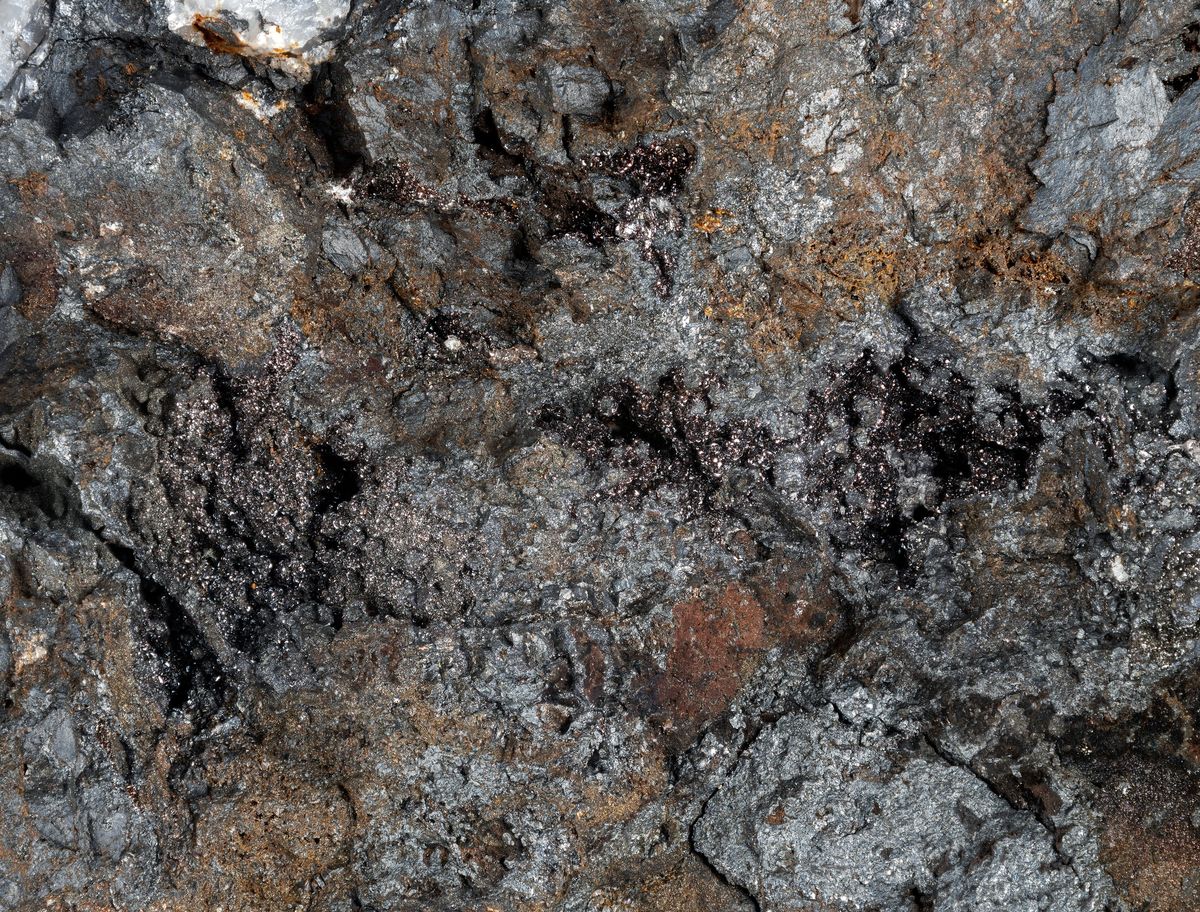
In summer 2025, several fine “glaskopf” (botryoidal hematite/limonite) specimens and unusually good examples of lithiophorite—rare in Siegerland—were discovered.
Glaskopf forms shiny black botryoidal aggregates covering surfaces and vugs several centimetres across. The fractures reveal a brown, radiating internal structure.
Lithiophorite also forms botryoidal structures. Its color is bluish-grey, sometimes showing a silvery sheen on fresh surfaces.
On limonite/glaskopf matrix, hydrohematite forms small, lustrous black beads.
Vereinigte Henriette Mine, Niederschelden
In spring and summer of 2022, an exceptionally rare copper phosphate—ludjibaite—was discovered in the Knorrenberg pits. This find was remarkable not only by Siegerland standards but also in a global context, as the mineral is known from only a handful of occurrences worldwide. In 1995, ludjibaite was first identified in Siegerland by Blaß, Graf and Reinhardt at the Käusersteimel Mine in Kausen, marking the third confirmed locality for this species. Their study was published in Mineralien-Welt (Blaß, G.; Graf, H.W.; Reinhardt, M., 1995).
Ludjibaite was originally discovered at its type locality—the Ludjiba deposit on the Ludjiba River and in the similarly named mountain range in the Haut-Katanga Province of the Democratic Republic of the Congo, near Shinkolobwe. The first description, published in 1988 by the Belgian crystallographer Paul Piret and mineralogist Michel Deliens, formally named the species after this locality.
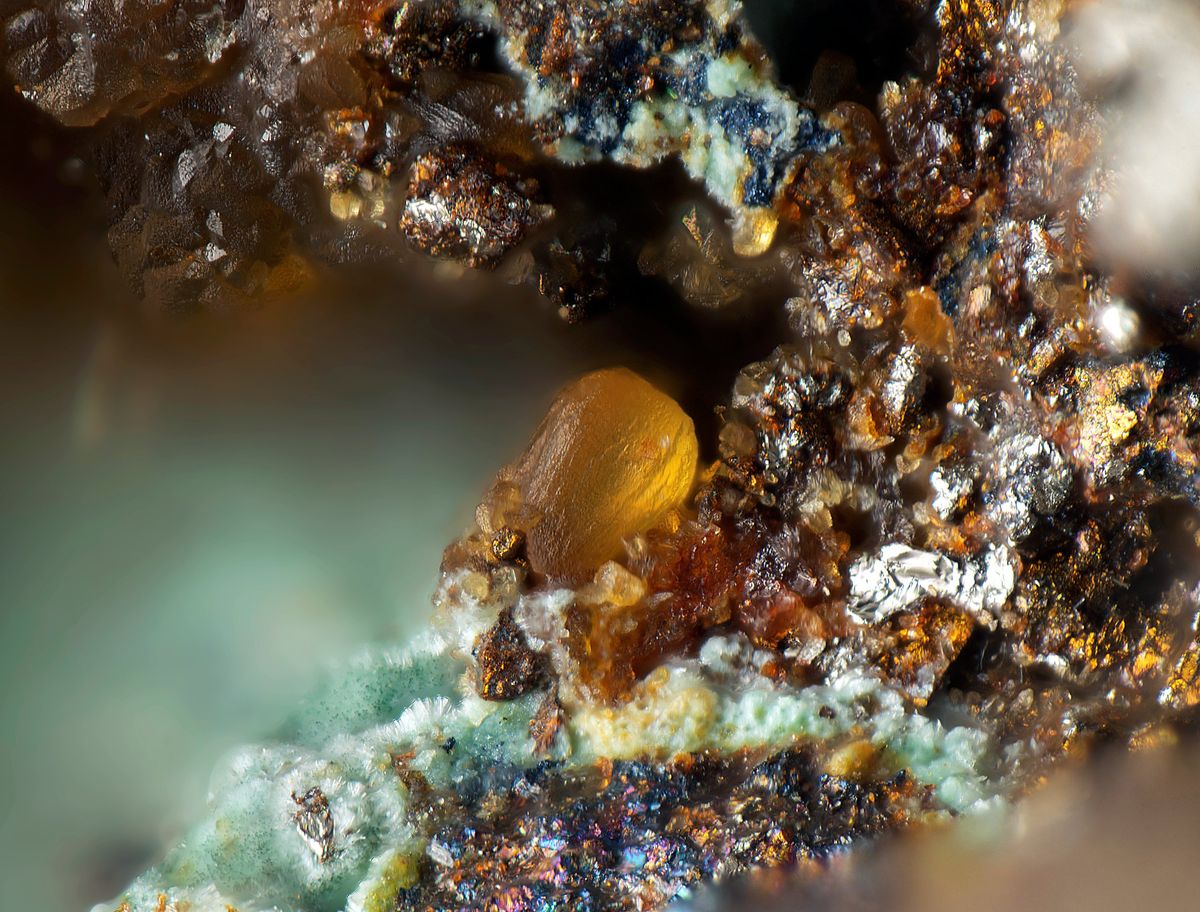
Up to now, only iron and manganese minerals had been found in the Knorrenberg pits. The appearance of small green spheres embedded in limonite was therefore unexpected and immediately noteworthy. “Not everything green is malachite,” the author thought, and carefully packed the piece to examine it later at home. Under the microscope, it quickly became clear that malachite could be ruled out: the green spheres, reaching up to 0.5 mm and displaying a distinct bluish tint, showed surface structures inconsistent with typical malachite habits. Pseudomalachite was briefly considered as an alternative.
An EDX and SEM analysis carried out by Günter Frenz in Cologne suggested that the material might indeed be ludjibait. To verify this, an XRD analysis was subsequently performed by Joy Desor in Wehrheim. This examination confirmed the identification beyond doubt, conclusively establishing that the mineral was really ludjibaite.
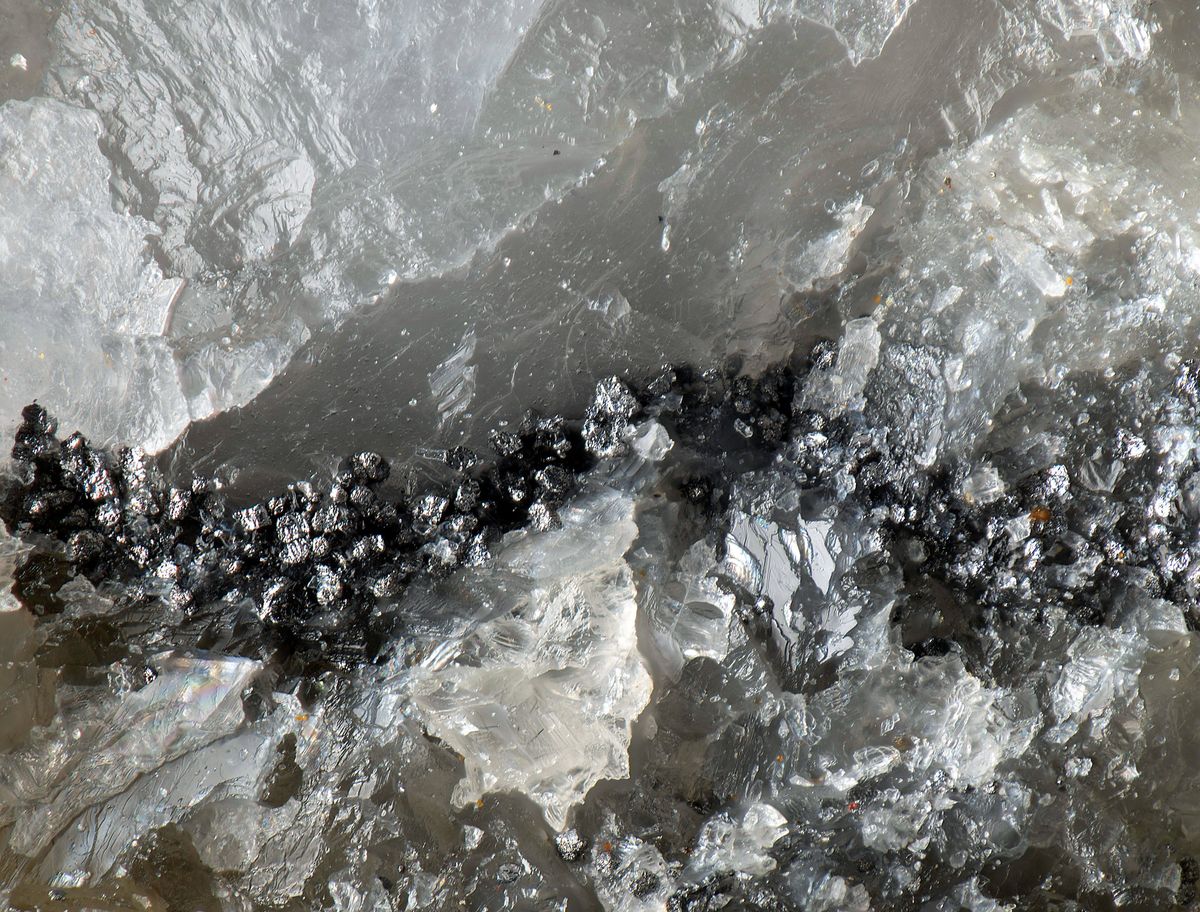
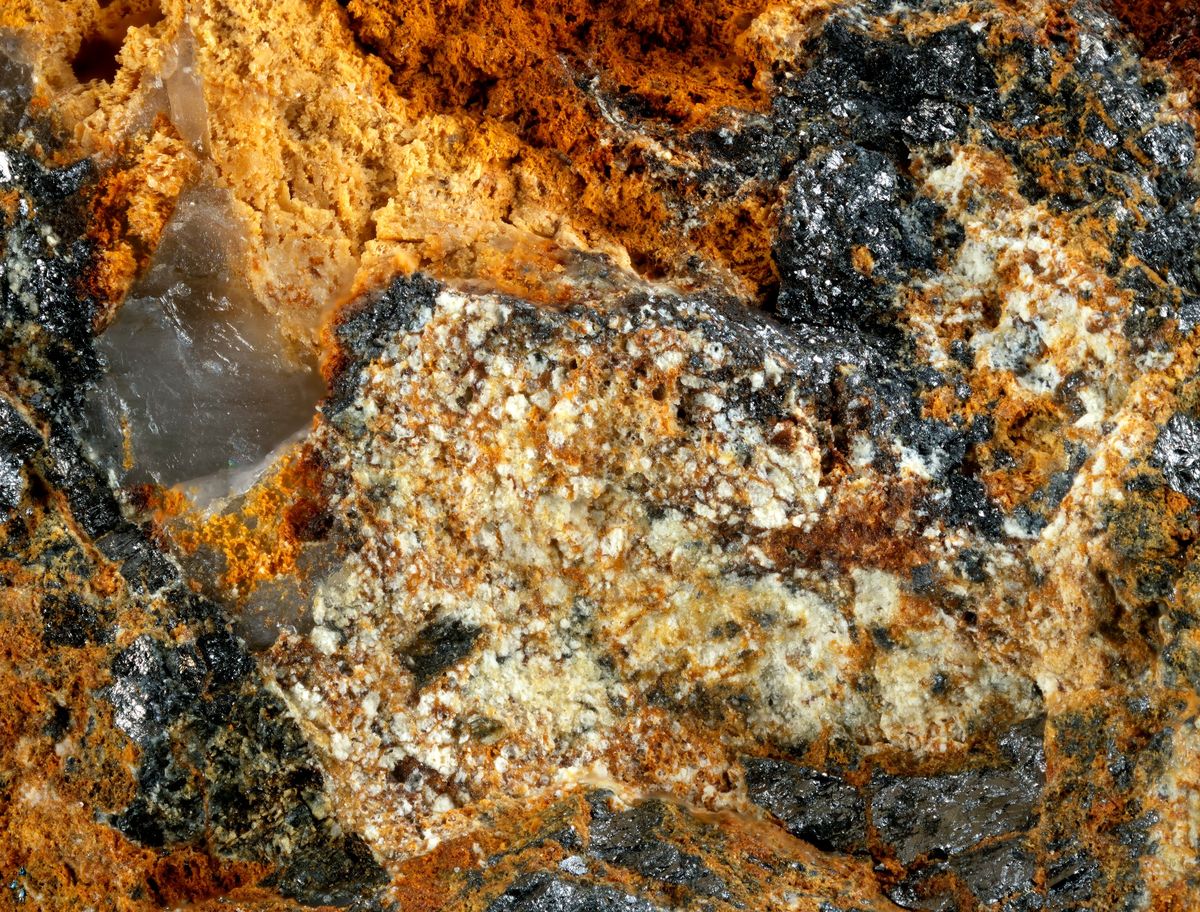
Another unexpected discovery from the same area involved native bismuth. When a piece of quartz was broken open, striking yellowish-green crusts and metallic grains became visible. Further investigation showed that the crusts consisted of bismutite, while the metallic phase was unequivocally identified as native bismuth through EDX analysis. It forms idiomorphic, embedded crystals within the quartz, exhibiting a metallic yellow colour and rarely exceeding 0.2 mm in size. Elongated inclusions represent intergrowths between the native bismuth and an as-yet unidentified mineral.
Acknowledgements
My sincere thanks go to Renate Dreier (Herdorf) for reviewing and correcting the manuscript. I also thank Günter Frenz (Cologne) and Joy Desor (Wehrheim) for carrying out numerous analyses of my samples. Without their support, this article would not have been possible in its present form.

/mineralica-magazine/0b9n5b/p40-01.jpg)