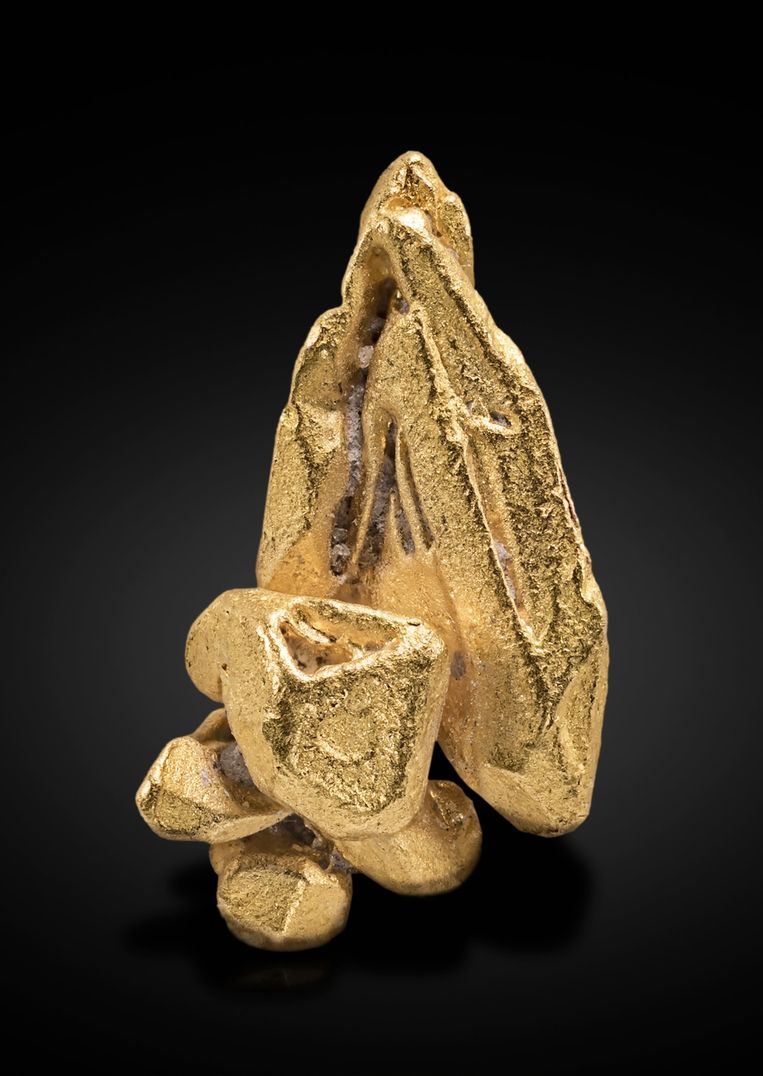
Many collectors accumulate minerals specimens according to whatever catches their eye, whereas others have a specific goal in mind for their collection. One of the authors (OW) has dedicated much effort and resources to building a collection of gold specimens that exemplify the forms, which crystals of this species can exhibit, but especially examples that display a single, simple form. The objective of such a collection is to be able to, in a real rather than a theoretical or idealized manner, illustrate the forms in which gold occurs. This article documents this extraordinary crystallographic collection of gold crystals.
Gold
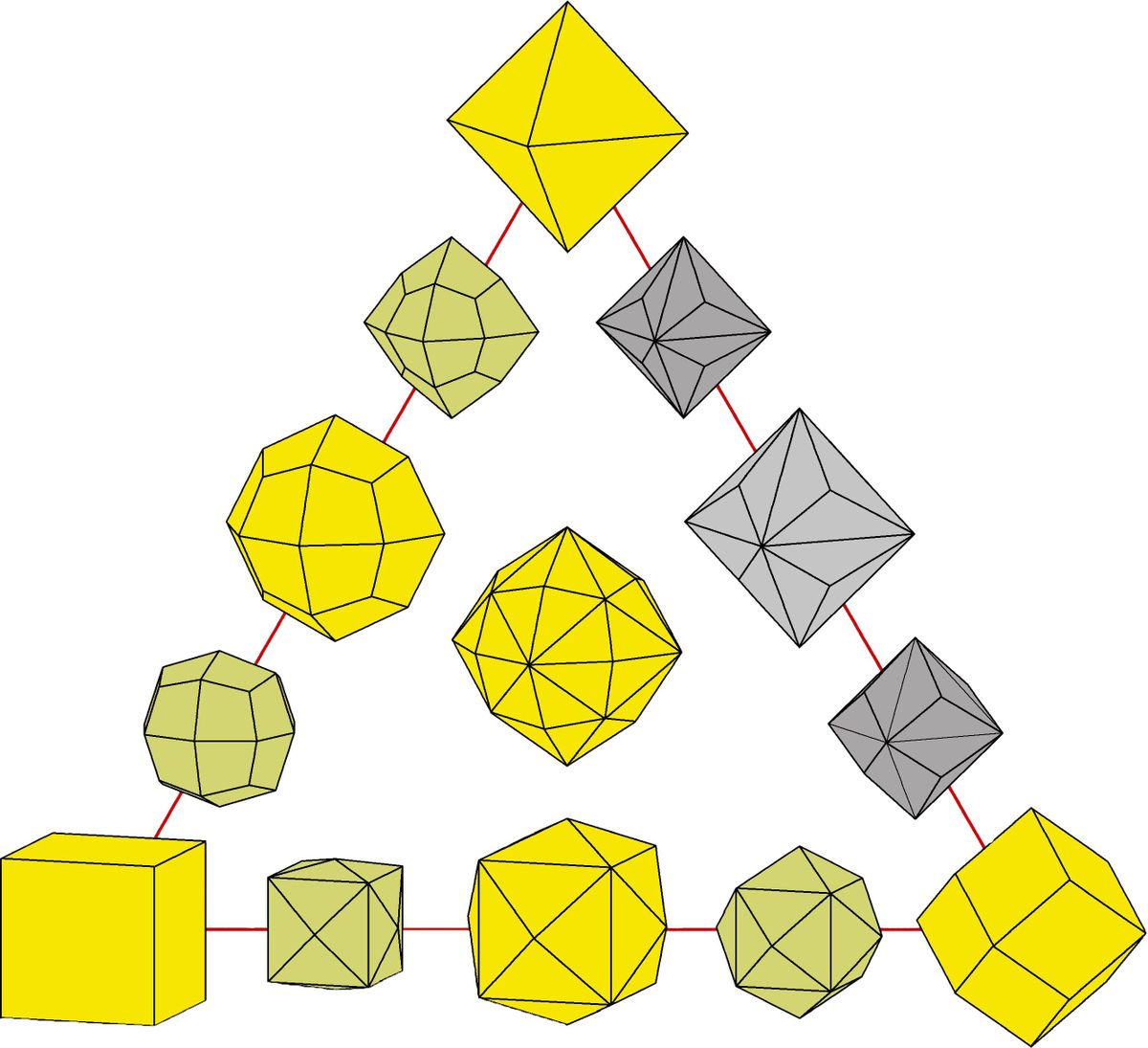
The row and columns of the Periodic Table are not accidental. While each element does indeed have a unique set of properties, it may have some of its individual properties in common with other elements, and those shared properties are reflected in the arrangement of the periodic table. Gold, along with copper, silver and lead, belongs to the copper group of metallic elements because they share the same crystal structure (internal atomic arrangement). They crystallize in what mineralogists call the holohedral class (having the highest level of symmetry) of the isometric system: the hexoctahedral class. In crystallographic shorthand this class is noted as 4/m3̅2/m, or just m3̅m, which summarizes the symmetry elements contained: 4-fold axes with perpendicular mirror planes, inversion 3-fold axes, and 2-fold axes with perpendicular mirror planes. Sixteen crystallographic forms have been observed on gold crystals, which can be grouped into seven kinds of forms: the hexahedron (cube), octahedron, rhombic dodecahedron, tetrahexahedron, trapezohedron, trisoctahedron and hexoctahedron. Of the sixteen, only six can be considered common: a{100}, o{111}, d{011}, e{012}, m{113} and x{1.10.18} (c.f. Francis, 2004). Simple crystals, where only one form exists, are rather uncommon; most gold crystals exhibit two or more forms in combination.
The accompanying crystal line drawings are adapted from the early 1900s “Atlas of Crystal Forms”, by Victor Goldschmidt, a German mineralogist who compiled the 9-volume set of crystal drawings of most species known up to that point (Goldschmidt 1918). One must understand that until the first decade and a half of the 20th century, one of the primary methods of identifying mineral crystals was by measuring their interfacial angles using a goniometer. The application of x-ray diffraction (XRD) to study the internal structure of crystals, prevalent today, was only nascent as Goldschmidt (1918) produced his monumental work, which includes not only the crystals drawings themselves, but text volumes indicating the source, references and accompanying tables of the interfacial angles, and represents the sum total of data to date for this analytical method; a reference library to compare future angle measurements against.
Gold crystals can be very complex and confusing. Hopefully, this summation can be an aid to the proper identification of the forms present on a given specimen.
The names for crystal forms originate mainly from Greek and often include the number of faces, the shape, and usually end with the syllables -hedron (“base” or “seat”).
In this work, simple form designations are preferred. Nevertheless, extended variations should not go unmentioned. For example, in the literature, the trisoctahedron is also known as the triakisoctahedron.
1 Simple Forms
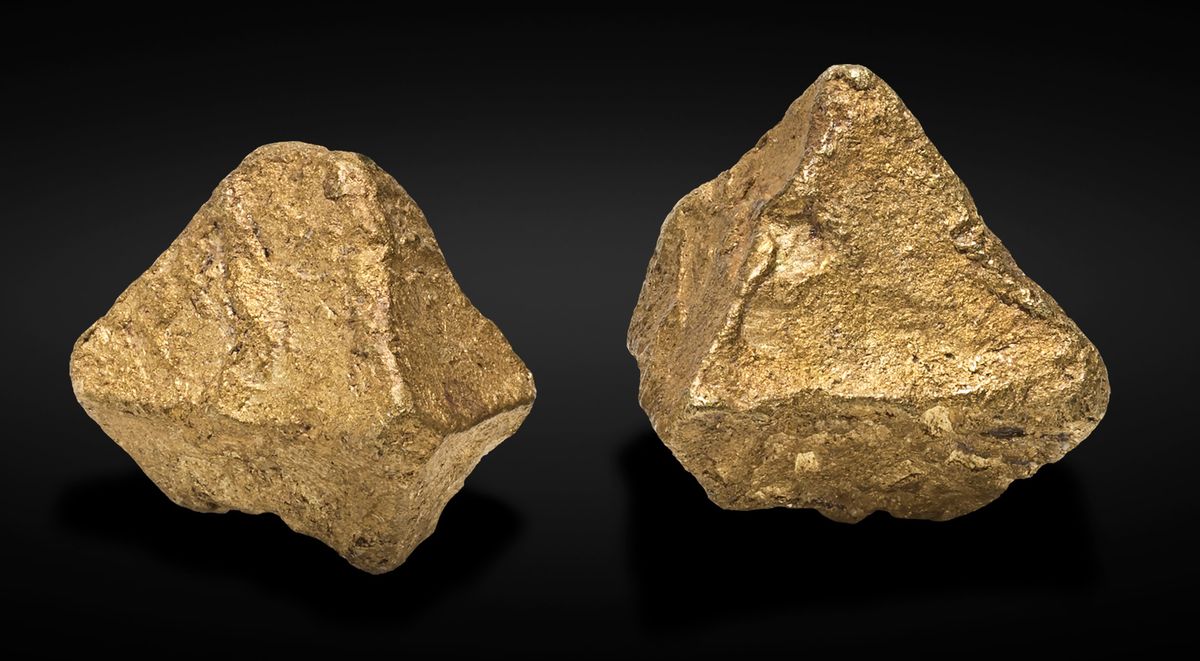
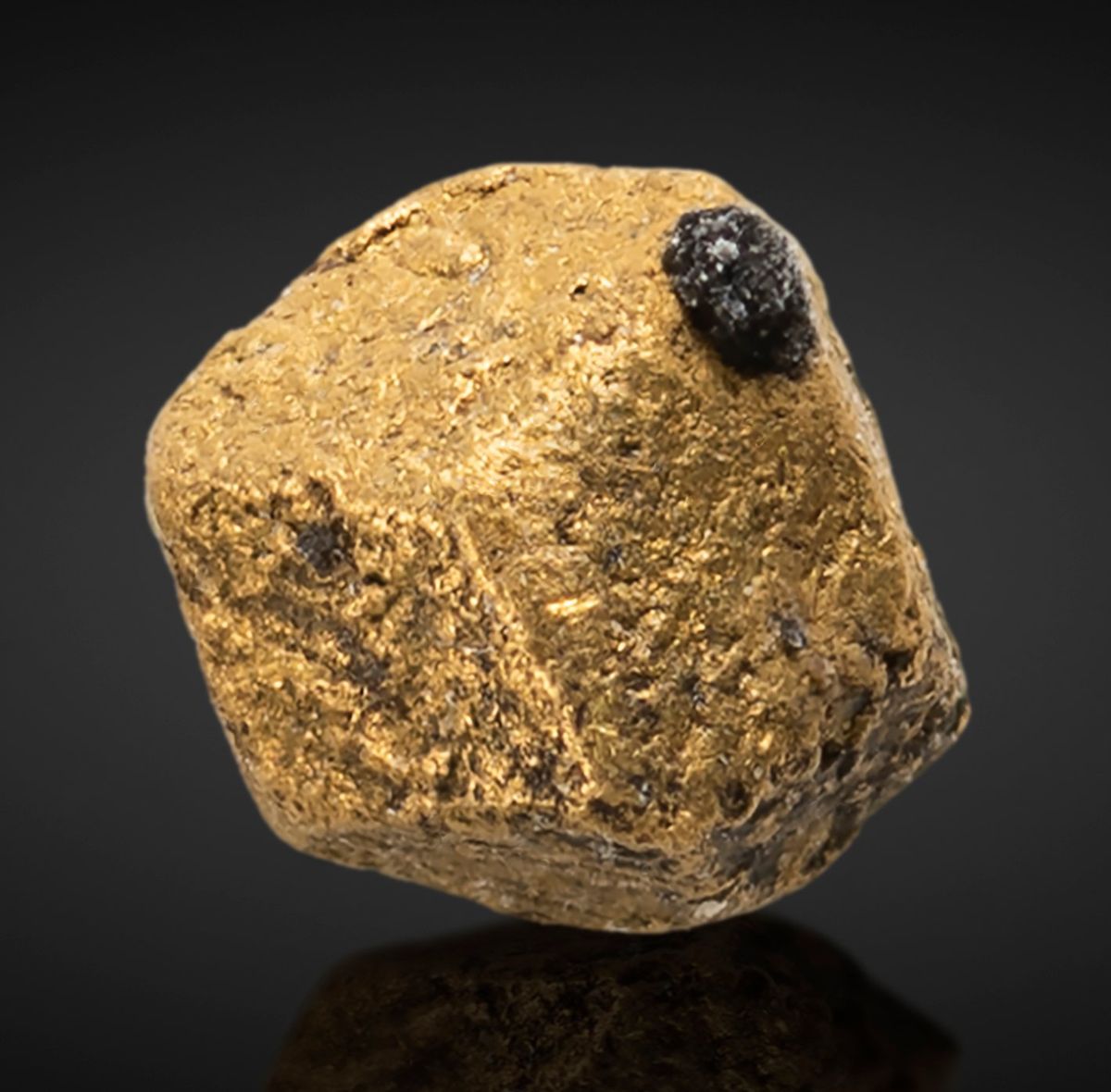
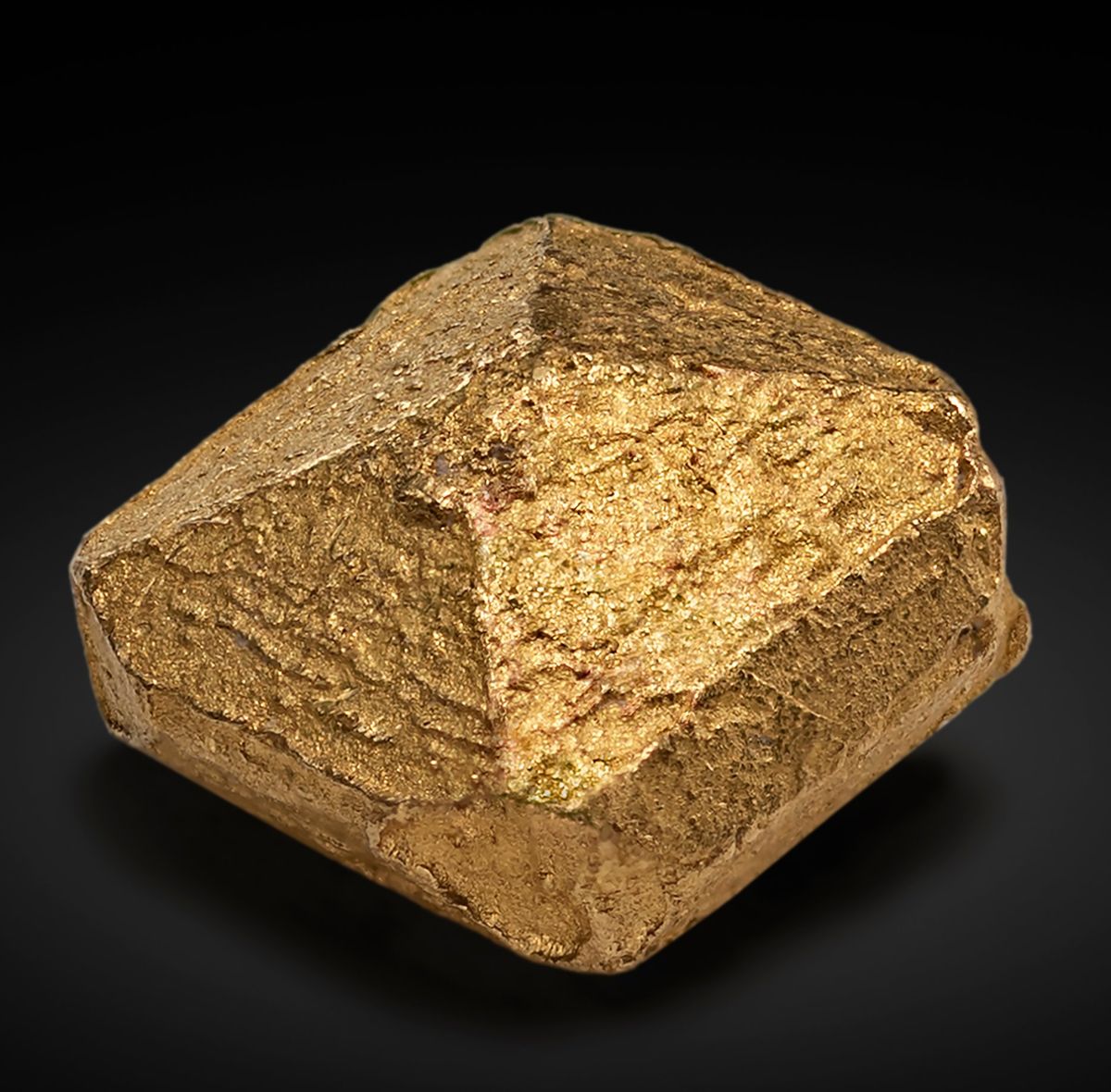
1.1 Octahedron – o{111}
The most common form of well-crystallized gold is the eight-sided octahedron. Simple octahedra are rare on a worldwide scale. Flat, leafy aggregates are commonly the result of parallel growth, recognized by the many faces that show some sort of triangularity and reflect at the same time as the specimen is tilted. Much of the thin, flat “sheet” gold is the result of extremely developed octahedral faces, evidenced by the triangular growth hillocks commonly observed on them. Some seemingly smooth sheets transition progressively into clearly developed parallel octahedra near their margins.
Octahedral crystals are commonly hoppered, a feature discussed further later in this article.
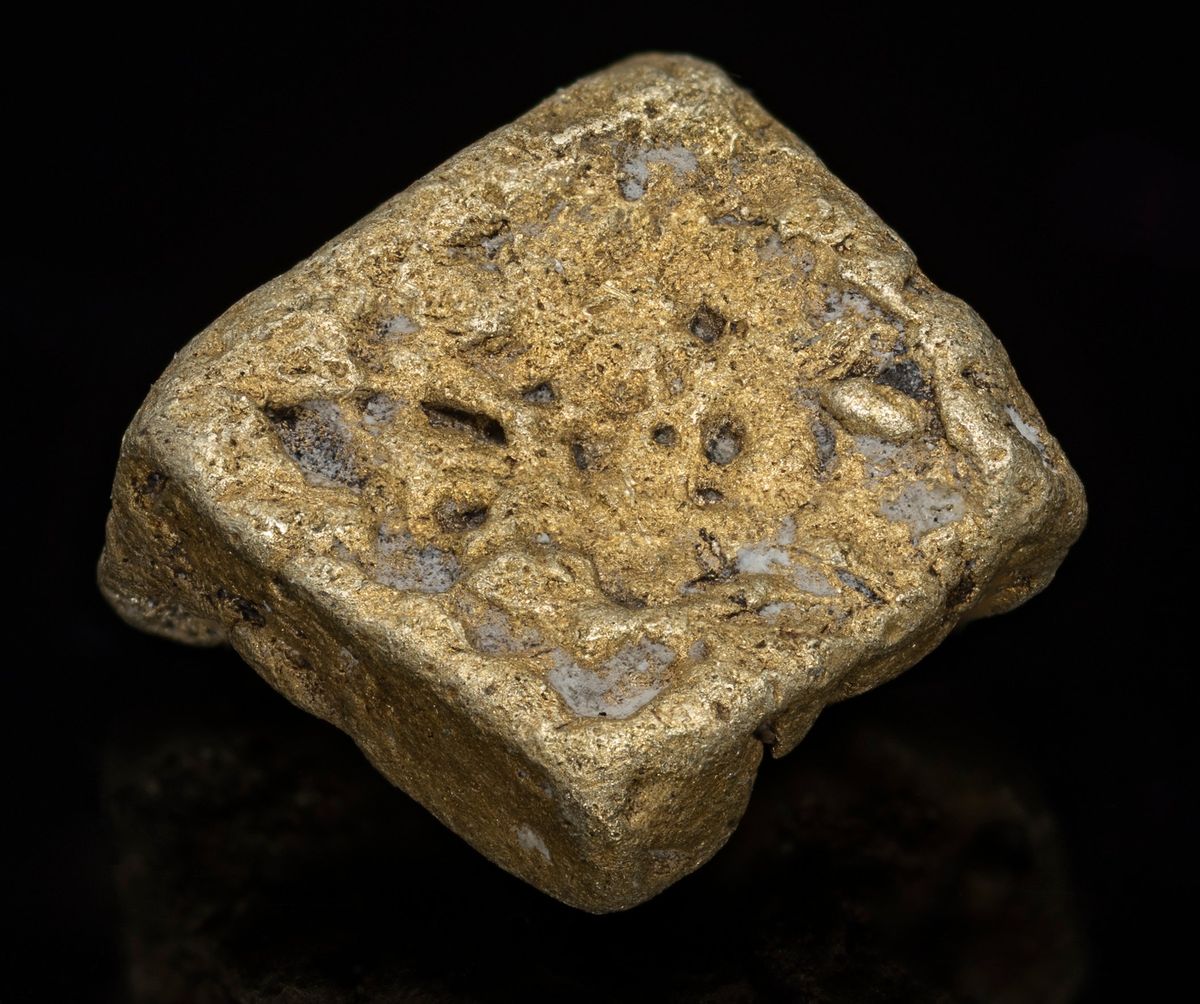
1.2 Hexahedron (Cube) - a{100}
As the name implies, the hexahedron, more commonly known as a cube, has six identical faces. Like the octahedron, simple cubes are rather rare in nature, and the form is most commonly found in combination with others, notably the octahedron.
1.3 Dodecahedron - d{011}
The dodecahedron has twelve rhombic faces and is very rare as simple crystals. Dodecahedral faces are more likely found in complex twins, commonly producing tooth-like crystals that are all too often erroneously described as “elongate octahedra”, as elaborate “herringbone” sheets, or as thin, “pseudo-wires” (which see below).
1.4 Tetrahexahedron – {0kl}
Tetrahexahedra are an example of a form in which the Miller indices can vary. This form is essentially a cube where each of the six faces is replaced by a four-sided pyramid and the variability in k and l reflects the “steepness” of those pyramids. There are four variations listed in Goldschmidt (1918), these being e{012}, f{013}, h{014} and k{025}. The only common one is e{012}. The tetrahexahedral form is commonly difficult to make out, especially when crystals are not equantly grown or are made complex by twinning. A good example of this is seen in Figure 1a at the beginning of the article. It shows a complex group of tetrahexahedral crystals, which require careful examination to get oriented.
1.5 Deltoidal icositetrahedron (Trapezohedron) – {hhl}
Like the tetrahexahedron, the trapezohedron is a twenty-four-sided form with variation in angles. Gold is only known to exhibit the m{113} form, whereas the n{112} is very common to garnet; a detail useful in determining whether a “crystal” has been cast from a garnet model. This form is also (historically) known as a tetragonal trisoctahedron.
At first glance, the name deltoidal icositetrahedron may be misleading for some. The term ikositetra, which from Greek, translates as 24 faces, where ikosi means 20 and tetra means 4 – thus together meaning 24. The shape of the crystal therefore has nothing to do with a classic four-sided tetrahedron shape.
Crystallography is a complex subject that requires intensive study for a thorough understanding. An additional complication is the varying development of the names given to individual crystal forms throughout history. In American English, for example, the same crystal form has different names than those used in European British English and German. The crystal form described in this section is referred to as a deltoidal icositetrahedron in European English and as a trapezohedron in American literature.
It all started around 300 BC when Euclid came up with a precise classification of quadrilaterals (Euclid: Elements, Book I, 22). In his work, he distinguished between “special shapes” such as the square, the rectangle, and the rhombus (diamond), which is equilateral but not rectilinear, and mentioned a rhomboid (parallelogram), whose opposite sides and angles are equal, but which is neither equilateral nor rectilinear.
Euclid called every other four-sided figure a trapezoid, including the parallel trapezoid with a pair of parallel sides, which he did not consider separately. Euclid also did not mention the deltoid, also known as a kite, even though the adjacent sides are equal in length and the diagonals intersect at right angles, with one diagonal bisecting the other and thus making the figure symmetrical.
1.6 Hexoctaedron - {hkl}
The forty-eight-sided hexoctahedron is only known to exist as modifications on other forms such as the octahedron or cube. Four variations are listed in Goldschmidt (1918): s{123}, t{124}, x{1.10.18} and z{345}.
1.7 Trisoctahedron – {hll}
No examples of the trisoctahedron have been identified or are known by the authors. The form is also (historically) known as a trigonal trisoctahedron.
2 Combinations of simple forms
Gold crystals very commonly exhibit two or more forms in combination with resultant habits ranging from fairly simple to very complex looking crystals and groups. Examples from both extremes in this collection are represented by cubo-octahedral crystals as simpler examples, and a near perfect sphere at the other end of the scale.
2.1 Cuboctahedron (cube-octahedron)
Cuboctahedra are, as the name implies, a combination of hexahedral (cube) and octahedral faces. When one form is dominant, one commonly refers to that form being modified by the lesser form. For example, a cube modified by octahedral faces, or vice versa, as the case may be. Sensu stricto, mathematically, it is only when both forms are equally represented that it is known as a cuboctahedron., but mineralogists commonly use the term for this combination more loosely.
2.2 “Pseudo“ Sphere
A “pseudo” spherical habit can be regarded as the end point of a sequence in which an increasing number of different crystal shapes and their surfaces come together and thus approximate a spherical shape. This process can be further “optimized” by mechanical influences, e.g., by rolling in streams.
3 Twinned Crystals
Gold twins are twinned according to the spinel law, in which the twin plane is the octahedral (111) plane. However, the resulting habit depends on which crystal forms are present.
3.1 Twinned Octahedron
3.2 Twinned Cuboctahedron
See Images.
3.3 Twinned Tetrahexahedra
All too often, steep, four-sided, “spear-shaped” terminations are described as “elongated octahedra”. This is false. As with all interfacial angles, those between octahedral faces are constant. This is known as the law of constancy of interfacial angles, or Steno’s Law. Examples like those shown in figures 18 and 19, were studied by vom Rath (1877) and shown to be twinned tetrahexahedra stacked along a dodecahedral axis (see figure 20). The rhombic prism is made up of very closely spaced edges of the tetrahexahedra to form essentially hexahedral (cube) faces. The termination and the prism, in cases where this habit has formed an elongate prism, have a rhombic cross section, not square as one would expect in an octahedron.
The above is by no means the only habit in which tetrahexahedral twins occur. The twinned form also occurs as discoidal (“UFO”-shaped), as round equant (“golfball”) and as part of flat, leaf-like crystals.
3.4 “Fiveling” Twins
Gustav Rose (1831) first documented apparent fivefold symmetry in gold. To date, at least six localities known to the authors to produce gold specimens exhibiting such “fiveling” twinning have been recorded (Kvasnitsa 1981, Mauthner 2024 and references therein). The extraordinary “fivelings” consist of five individuals that are repeatedly spinel-law twinned on four octahedral planes. The remaining 7°20’ “gap” between the first and fifth members is filled in by simple contact growth.
One “fiveling” is now in the Wallenta collection: the Russian specimen first recorded by Schäfer (2023) and further described by Mauthner (2024). Although it is somewhat rounded by placer activity, it clearly has apparent fivefold bipyramidal terminations similar to those reported by Rose (1831), and short prism {100} faces like those described by vom Rath (see figure 23a,b). The prism faces are sharp enough to show the {111} reentrants.
3.5 “Cruciform” Tree-like Habits
3.5.1 Simple “Cruciform” Tree-like
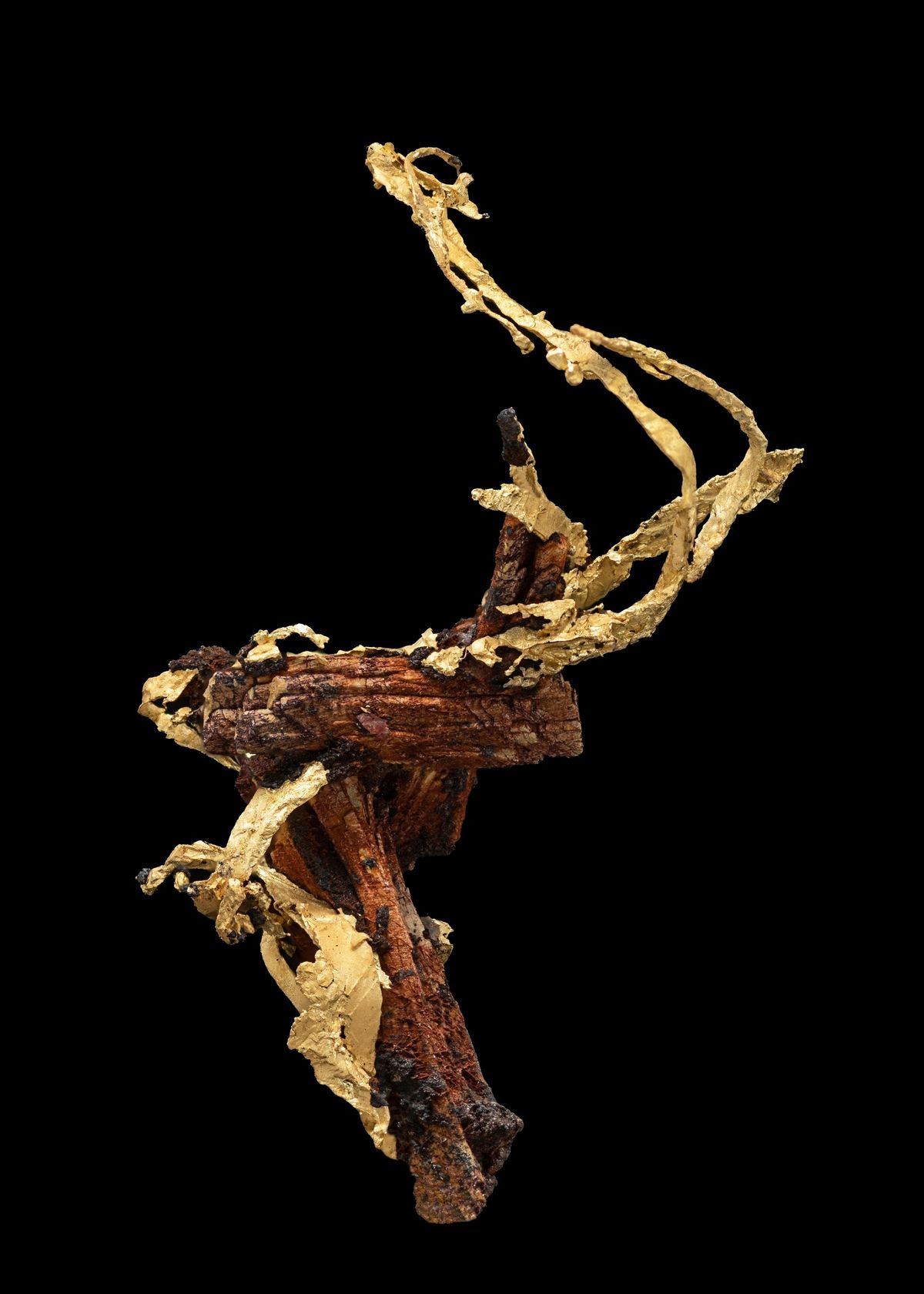
One habit whose specific crystallographic nature remains a mystery is a type of arborescent growth consisting of a trunk with orthogonally extended branches. The crystals tend to be tapered, giving them the tree-like appearance. When viewed down the “trunk”, there are always branches in four directions at almost 90° to one another, and what is interesting is that three are of equal length and the fourth is roughly twice as long. All known examples are sharp enough to be recognized as crystals, rather than irregularly formed nuggets, yet frustratingly tumbled enough that goniometric measurements are not possible. This habit has been found on specimens from several creeks in the Klondike River Drainage, Yukon, Canada. One is illustrated here (Fig. 25a), and another in Mauthner (2004, p. 108, Fig. 14). This habit is not yet known to the authors to occur elsewhere, and we would be grateful to know of other localities.
3.5.2 Threefold “Cruciform” Tree-like
Another version of the above exhibits three such arborescent individuals stemming from a common point in three directions, approximately at right angles to one another.
4 Special Habits
There are many fanciful terms used to classify gold habits. Some, such as animal likenesses, apply only to a single specimen, or very few, and are useless for classification purposes or understanding the piece. Other expressions, such as “herringbone”, “mosaic”, “feather”, or “pavement” at least give a sense to the appearance and can guide thoughts as to the underlying crystallography. Here we attempt to divide the more complex habits into four groupings and explain some of the variations in each.
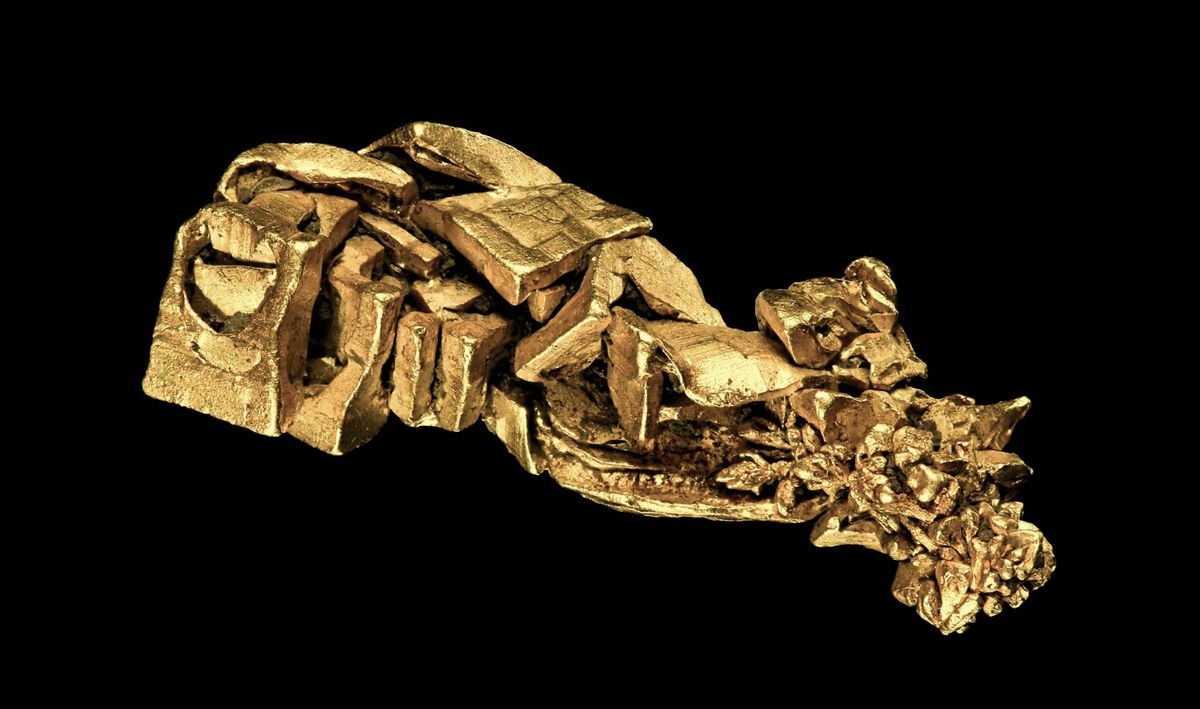
4.1 Thin, leaf-like aggregates
As mentioned, gold rarely forms as simple, single crystals, even the occurrence of fairly simple combinations is uncommon. Well-crystallized gold is most commonly found in thin plates or “leaf-gold”. These may consist of an extremely thin single crystal exhibiting a single form to complex parallel growths exhibiting network-like patterns, multiple forms and twinning. It is important to note that the twin plane is parallel to the plane of the “leaf”, and not in the “branching”, which is due to extended growth along dodecahedral axes lying within to the octahedral twin plane. See also under “Arborescent/Dendritic Aggregates.”
4.2 Hoppered Crystals
Some crystals exhibit funnel or hopper-like depressions that are lined by parallel ridges or step-like patterns. These habits are the result of rapid growth of the crystal as the highest potential for growth is along crystal edges. The ridges inside the “hopper” are the crystal’s repeated attempts to grow out the full face. All forms of gold may occur with hopper-like features.
4.2.1 Octahedron
In some cases subtle, in others very pronounced, octahedral surfaces with a funnel shape occur relatively often.
4.2.2 Hexahedron (Cube)
Hoppered hexahedral faces are less common than octahedral ones.
4.2.3 Dodecahedron
Hoppered dodecahedral faces seem to be fairly rare and hard to recognize. No confirmed examples exist in the Wallenta collection but one of the authors (MM) has observed complex, elongated crystals he suspects to have hoppered dodecahedral faces.
4.2.4 Tetrahexahedron
Hoppered tetrahexahedral faces can sometimes be difficult to differentiate from hoppered octahedral faces. However, the former is made up of isosceles triangles, whereas equilateral triangles constitute the latter.
4.2.5 Deltoidal icositetrahedron (Trapezohedron)
Hoppered trapezohedral faces can be recognized by the kite-shaped cavity. Figure 9 under section 1.5 shows an excellent example.
4.3 Arborescent and Dendritic Aggregates
Arborescent and dendritic literally both mean “treelike” --- from the Latin arbor and the Greek dendron. However, common usage (e.g., Sinkankas 1964) tends to suggest that the word arborescent describes aggregates with fairly straight trunks and branches, whereas dendritic is taken to mean branching in a less regulated looking way, more like deciduous trees rather than evergreen conifers.
Arborescent/dendritic habits in gold specimens result from twinning and/or parallel/extended growth. Arborescent gold crystals have “branches” that are either orthogonally attached to the “trunk” or at an angle of 60°. “Dendritic” gold specimens follow the same set of rules as “arborescent” but lack the extensive elongation in any direction, therefore the more apparent regularity.
Some authors have vaguely attributed arborescent forms to “repeated twinning on {111}” (e.g. Russell 1929). A much more detailed analysis is provided by vom Rath (1877) who observed that the leaf-like aggregates consisted of twinning and parallel growth. As mentioned under section 4.1, the octahedral twin plane is parallel to the flat dimension of the “leaves”, but the 60° branching is not due to twinning, but extended growth along dodecahedral axes parallel to the twin plane. In all cases of orthogonal (90°) branching observed by one of the authors (MM), it is due to extended growth, or “stacking” along octahedral axes, though not necessarily with twinning present (Mauthner 2004, p. 105, figs 11a,b).
4.4 Wire vs. Pseudowire (or wirelike)
4.4.1 Wire
Only a few mineral species occur with a wire habit. This rare form is most seen in silver, gypsum, gold, malachite and ice, and is characterized by slightly to extremely curving, elongated growths with subparallel to parallel longitudinal striations (Mauthner 2004; Anderson and Rakovan 2020). Such wires usually have a flared base and either divide to terminate as several curled or twisted, stout to fine tendrils, or taper to a point. Silver and gypsum provide the best and certainly most common examples of this habit; gold wires are much rarer than either of these two species.
Wires grow differently than other elongated forms. While the exact mechanism is some of the above species is not known, what they all have in common is that, unlike a “normal” crystal which grows on its surface, wires seem to grow only at their bases, much like a human hair. This was observed by one of the authors (MM) on suddenly very cold winter days as ice wires grew out of the ground, some of them taking bits of dirt with them as they grew. Given the very, very low humidity in the air and a not yet frozen ground, with a very likely gradient between the two, the only reasonable explanation seemed that the wires were being “fed” by rising vadose water.
Anderson et al. (2019) indicated that wire habit in silver is caused by “solid-state ion conduction of Ag+ ions through a laterally constrained phase transformation in Ag2S“. Anderson and Rakovan (2020) suggest that an analogous solid-state ion-conduction of Au+ through a Ag/Au telluride phase may be responsible for some gold wires. One of the specimens they analyzed was from the same general locality as the specimen in this collection: Choco, Colombia.
4.4.2 Pseudowire (wirelike)
Much of the gold exhibiting elongate crystal forms are called wires, but these are better described as wirelike or as pseudowires, as these are usually octahedral, cubic or other forms elongated along [100] or [111] (Mauthner 2004), or detached trunks and/or branches from flat aggregates, which as explained in that section, are twinned on {111} and elongated along [110]. Pseudowires usually exhibit some of the crystal faces of these forms. True wires exhibit no crystal faces.
5 Acknowledgements & Epilogue
The authors thank Michael Reicht, Klaus Schäfer and R. Peter Richards for the use of photographs and drawings, and Carl Francis, John Rakovan for reviewing the article.
MM thanks Otmar Wallenta for the opportunity to help build his collection and for suggesting writing this article. He also thanks Carl Francis, John Rakovan and Pete Richards for interesting discussions in the past regarding gold morphology and twinning.
OW would like to thank his wife Edith for her active support in writing this article and Heimo Urban for providing him with literature. He would also like to thank Dr. Michael Götzinger for discussions on the term “deltoidicositetraeder” and Mag. Gabriele Gebeshuber for her research on this topic.
Otmar Wallenta has always aimed to ensure that the collections he has assembled over decades remain intact after he stops collecting. He therefore placed his, the only publicly accessible regional mineralogical collection, covering his home state of Upper Austria, in the Kremsmünster Abbey of Upper Austria. A second part of his gold collection also has historical documentation and personal information in diary form. He is actively seeking a museum or a reputable private collector to take over his gold collection during his lifetime so that his work can be preserved for posterity.

/mineralica-magazine/0b9n5b/p40-01.jpg)