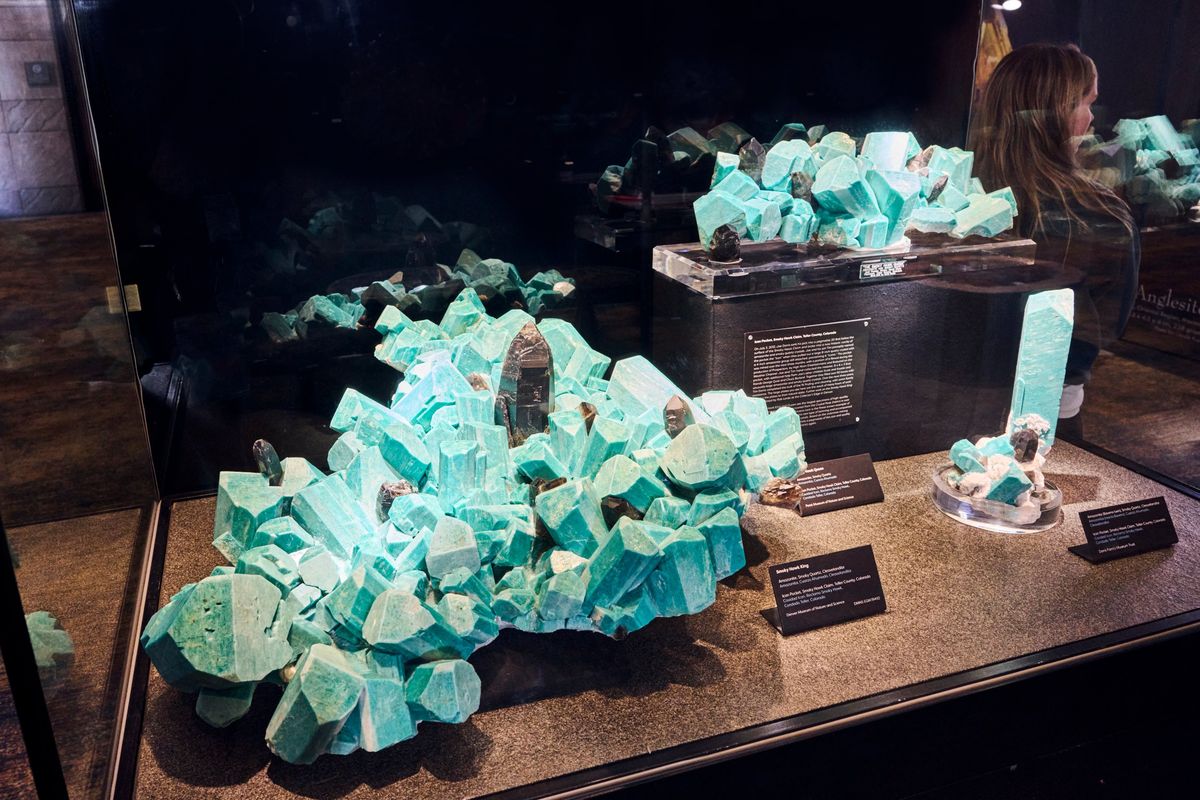
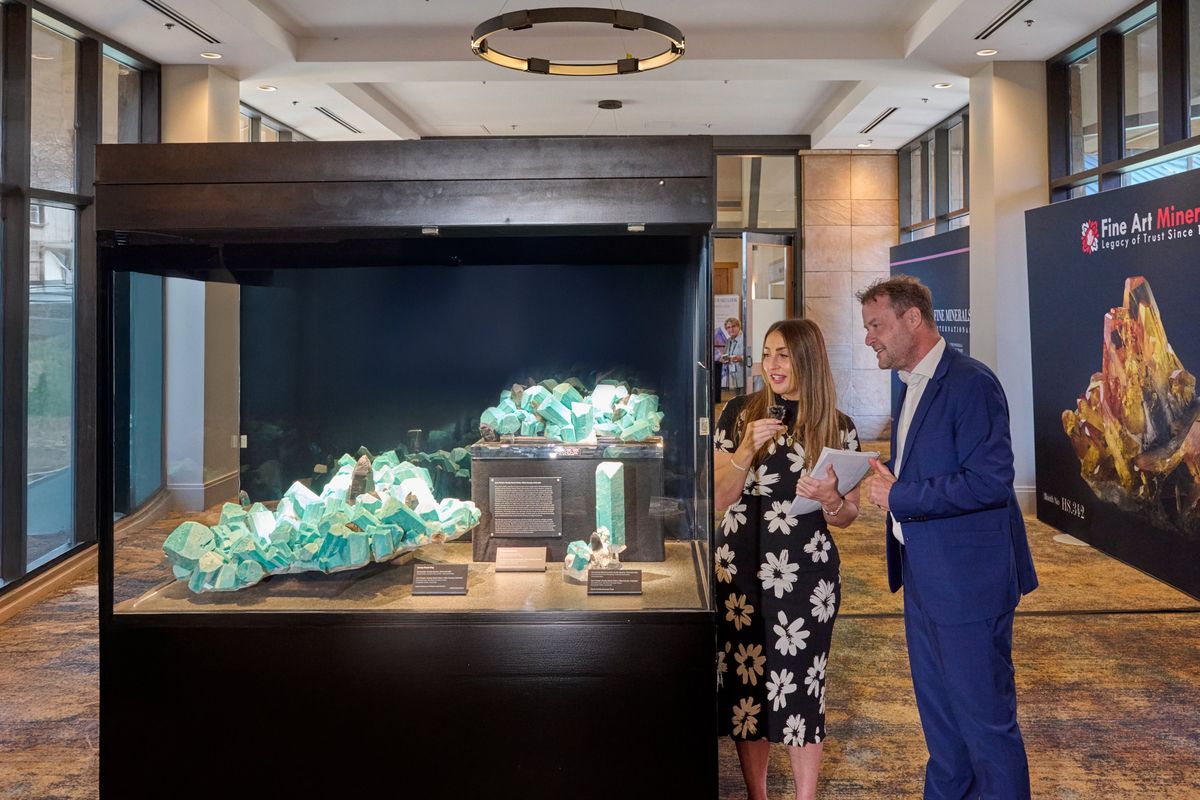
At the Hardrock Summit 2025 in Denver, three of the most significant amazonite–smoky quartz specimens from the Crystal Peak District were reunited for the first time since their discovery on the Smoky Hawk Claim in 2012.
Under the title “Stunning Reunion of Colorado Mineral Treasures,” the special exhibition brought together The King, The Queen, and the Icon Baveno Twin from the Icon Pocket, a presentation that had previously been impossible because the pieces now belong to three different collections. The idea for the display originated with Dave Waisman, who also curated the 2021 exhibition of the “Alma” rhodochrosite specimens.
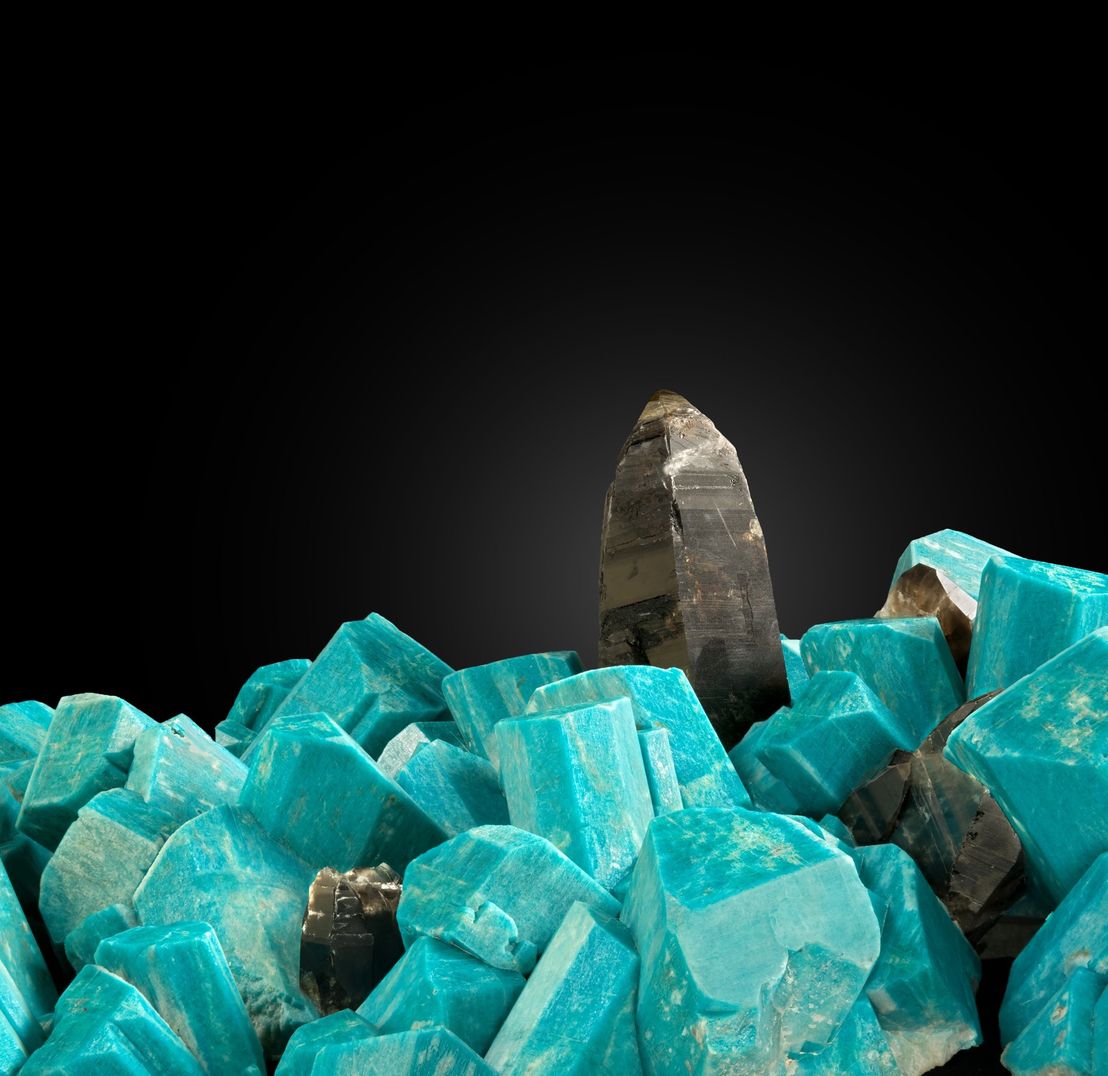
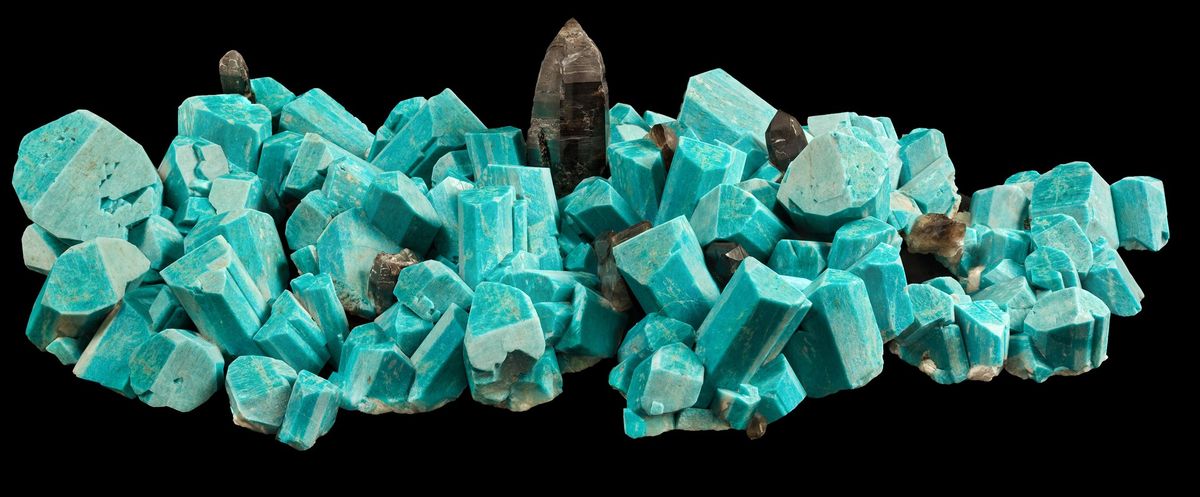
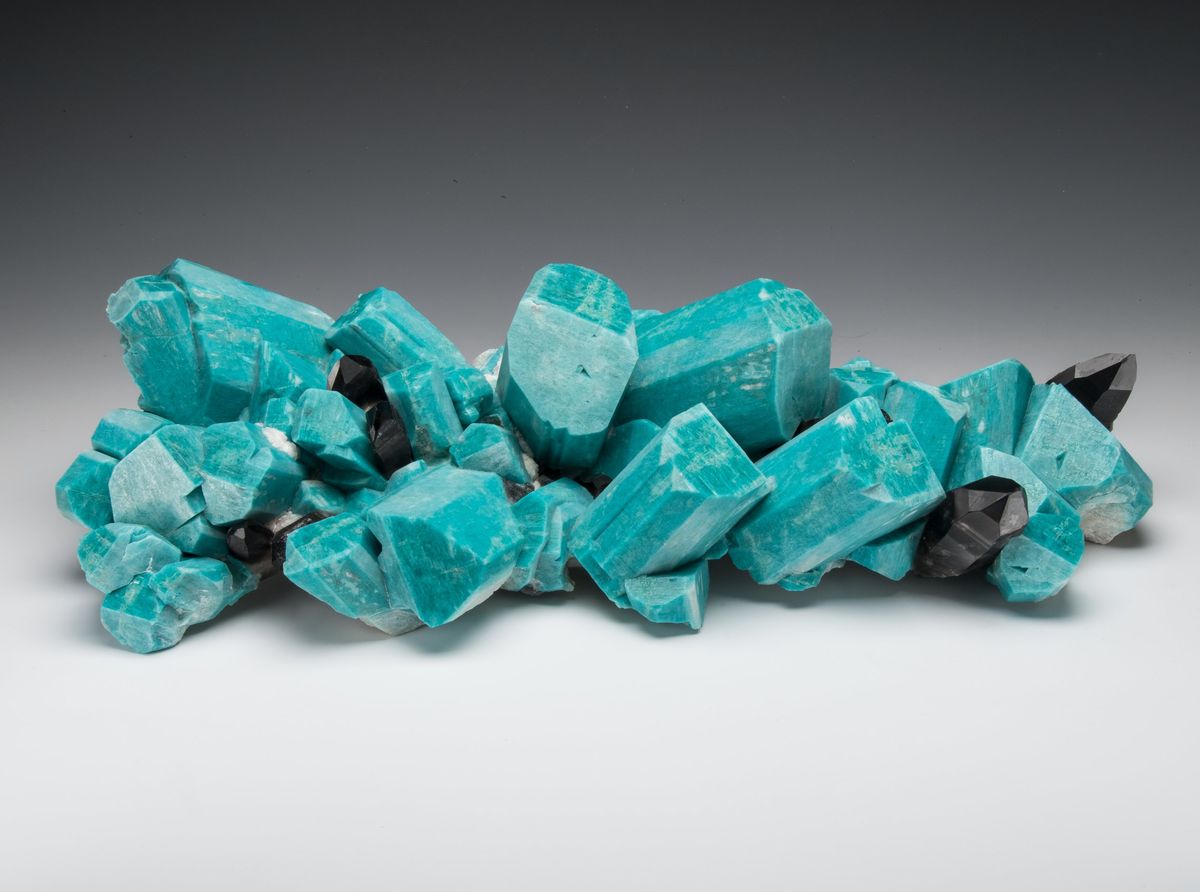
The specimen known as “The King” is the largest and best-known piece from the 2012 Icon Pocket. It was restored from more than forty separate crystals and fragments and reassembled over a period of two years. The group features well-developed, medium-rich blue-green amazonite crystals with contrasting smoky quartz, and it is regarded as the largest naturally occurring plate of amazonite–smoky quartz associations ever recovered in Colorado. The King is currently at the Denver Museum of Nature and Science, where it has become a centerpiece of the mineral collection.
“The Queen” was discovered in the same pocket, formed by several of the pocket’s largest amazonite crystals that could be reassembled. This plate has a unique architectural quality with its predominant amazonite crystals, balanced with some cleavelandite and smoky quartz. The Queen is now currently on temporary display at the Perot Museum of Nature and Science in Dallas, Texas.
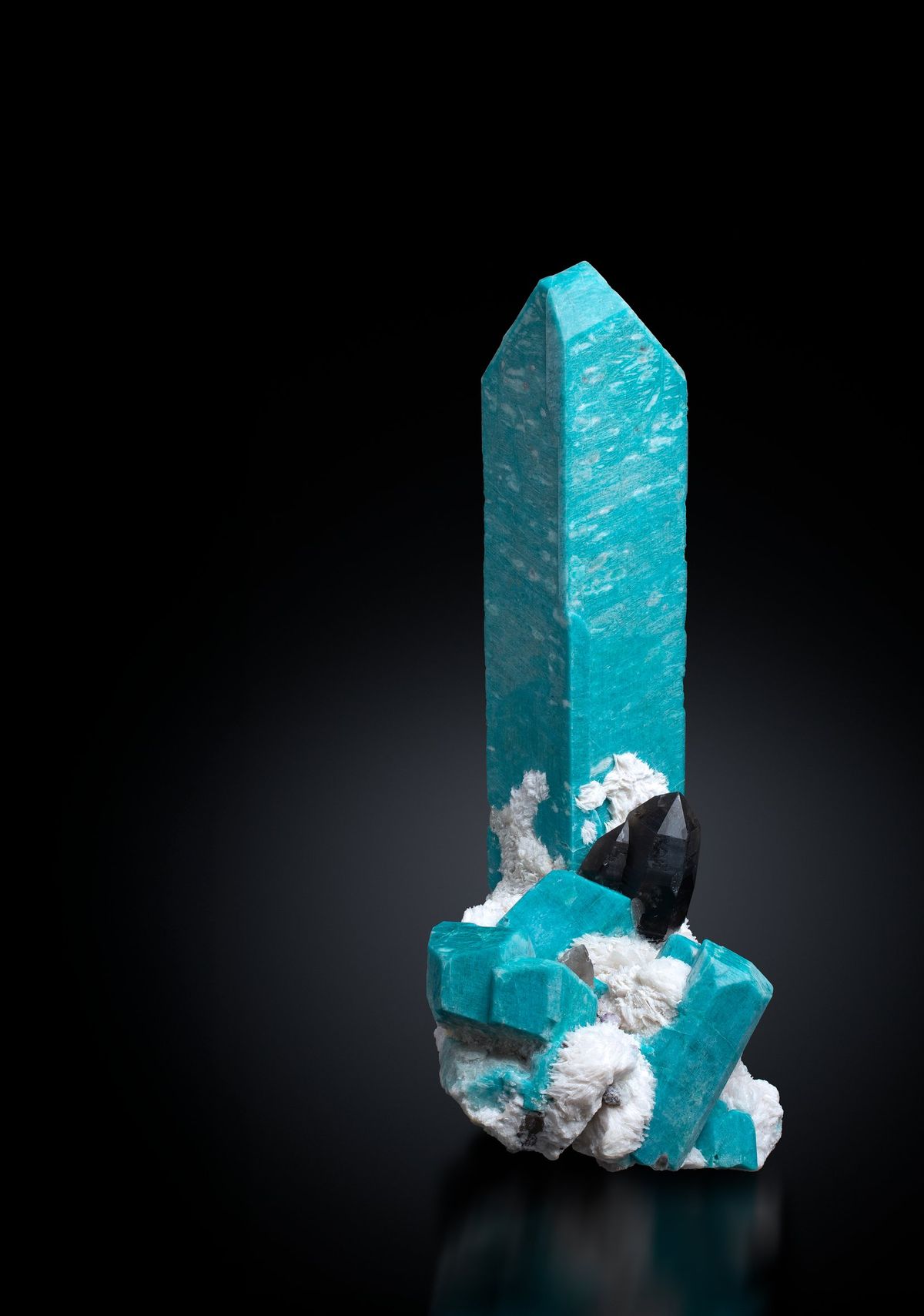
The third major specimen, the “Icon Baveno Twin,” exhibits a rare twin formation of amazonite across the c-axis. This crystal habit is only occasionally encountered within the Pikes Peak region (batholith) and most of the Baveno twins are subhedral without associations. This twin, measuring 25 cm (10 inches) in height and occurring in rare association with smoky quartz and cleavelandite, is considered the finest example discovered to date. It remains in the Dorris Family Trust Collection.
About the Smoky Hawk Claim
All three specimens originated from the same cavity, named the Icon Pocket, uncovered at the Smoky Hawk Claim during the summer of 2012. It was exposed on the northeastern side of the claim where it occurred 6 m (20 feet) below the surface at the base of a large pegmatite body where the structure abruptly flattened.
The Smoky Hawk Claim is situated in the Crystal Peak District, Teller County, Colorado, approximately 6 km northeast of Lake George. It lies within the Pikes Peak Batholith, a region known since the nineteenth century for its amazonite–smoky quartz pegmatites. The Smoky Hawk Claim lies on the north central side of the Lake George Ring Dike complex within a northwest trending pegmatite swarm that extends about 1.45 km (0.9 miles) and includes several productive mining claims. The current site on the Smoky Hawk is approximately 1.6 ha (4 acres) and is currently being reclaimed.
When first opened, the Icon Pocket measured about 1.8 × 2.4 × 0.9 m (6 × 8 × 3 ft) and eventually produced 90 flats of material including large amazonite and smoky quartz groups, single crystals, and minor cleavelandite. The host rock is a light-gray monzonitic granitoid. The pegmatite hosting the pocket varied from 0.3 m to 0.9 m thick and locally swelled to about 1.5 m where the cavity formed, before continuing toward the northwest where it connects with the Legacy Pegmatite. It is the largest cavity of amazonite and smoky quartz found on the Smoky Hawk Claim, both in physical size and quantity of collectible specimens.
When the cavity was discovered it had considerable clay and rubble infill. The ceiling plates had largely disintegrated and settled to the floor, creating a jumble of loose crystals and fragments. The natural collapse damaged some of the lower crystals but likely protected them from more severe mechanical breakage. The upper zone of the cavity was best preserved and contained the most intact amazonite–smoky quartz groups, while crystals near the floor were more fragmented and corroded. As in all Pikes Peak pegmatite pockets, continued decomposition post-crystallization caused the amazonite and smoky quartz crystals to separate from one another, resulting in mostly single crystals or small groups. These required individual recovery and reassembly into the original crystallized groups, which became The King and The Queen among other produced specimens.
Mining and recovery of the Icon Pocket took about two weeks. Many specimens—particularly the large combination pieces—were recovered in numerous single crystals and fragments. Overall preparation, cleaning, and stabilization of the material extended over several years. The Queen was not completed until 2019. The King was essentially completed in 2015, but additional work was conducted by Collectors Edge lab to finalize the specimen for public museum display in 2025. Lengthy time is required to find the original crystal fits and to clean each crystal and fragment. All specimens were heavily stained by iron oxides and required extensive chemical treatment. According to Tim Dorris, who supervised the bulk of preparation, amazonite is among the most difficult minerals to clean due to coatings and time required to chemically remove them to reveal their original color.
Mineralogy
Mineralogically, the pocket displayed a zoned structure with a 15–18 cm thick rind of graphic granite along the ceiling, less distinct along the sides and base. The amazonite crystals averaged 5 × 7 cm, reaching up to 10 × 15 cm, with a strong bluish-green coloration and thin white mottling, likely perthitic intergrowths (intergrowths of two feldspar minerals). The smoky quartz crystals measured 5–30 cm in length, deep black to dark brown, and exhibited a satin luster with simple, unmodified terminations. The ratio of amazonite to smoky quartz was approximately 3 : 1, resulting in groups where amazonite crystals supported prominent smoky quartz prisms. Cleavelandite formed white cushions up to 5 cm thick, commonly on the floor of the cavity. The pocket’s preservation was exceptional, producing minimal crystal damage and enabling the recovery and reassembly of large, naturally competent groups. These factors have all combined to result in arguably some of the best amazonite and smoky quartz specimens.
Typical mineral assemblages at the claim comprise microcline (amazonite variety) and smoky quartz, commonly accompanied by cleavelandite, fluorite and goethite. The vivid bluish-green amazonite, contrasting with the dark smoky quartz, produces the striking visual character for which this locality is known. Of the productive localities for amazonite-smoky quartz specimens within the Lake George Ring Dike complex, the Smoky Hawk Pegmatite Group, during the past 20 years, has produced the bulk of the finest color amazonite with smoky quartz specimens, including the Icon pocket.
Discovered in 2012, the Icon Pocket remains the largest and best-documented amazonite–smoky quartz cavities from the Crystal Peak District. The reunion of its three principal specimens at the Hardrock Summit 2025 offered a rare opportunity to view the most significant amazonite and smoky quartz specimens from this historic find in one place in a museum worthy setting.

/mineralica-magazine/6w4z3a/p50-01.jpg)
/mineralica-magazine/0b9n5b/p40-01.jpg)