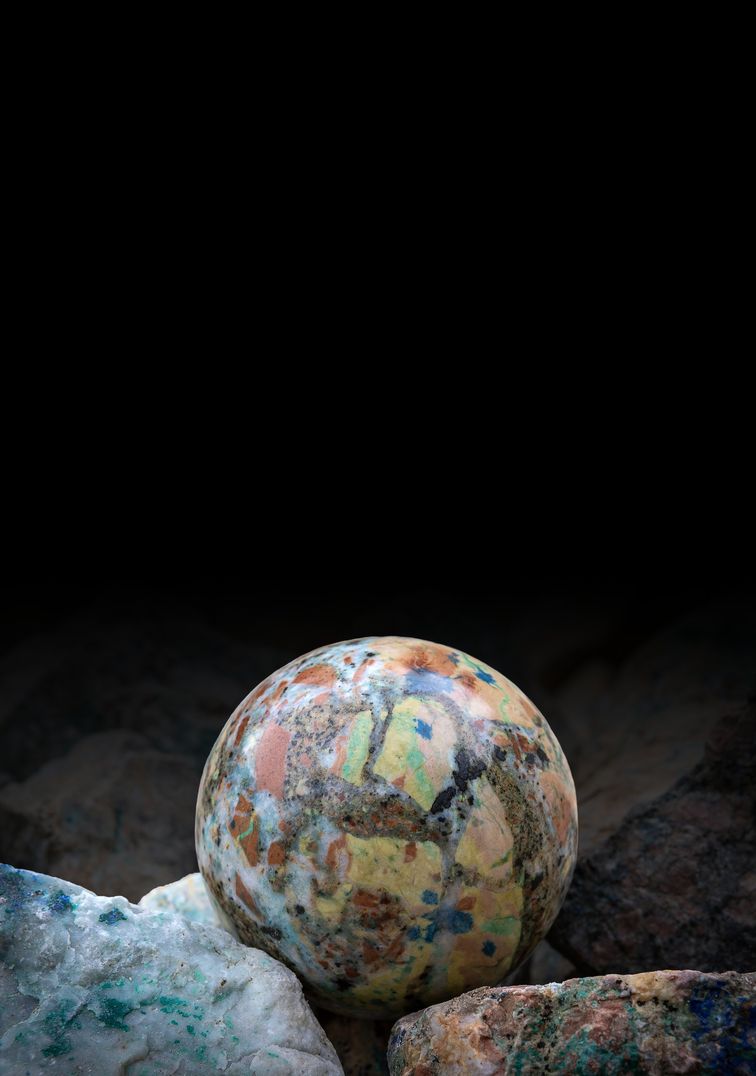
I first became aware of the Kaiserbründl locality in the Austrian federal state of Tyrol while searching for the colorful limestone conglomerates from the Kundler Klamm that are highly prized by stone cutters. Yellowish-reddish and, in part, snow-white rock fragments with green and blue patches immediately caught my attention. A fellow collector told me that this material supposedly originated from the Holzalm located above. Research in the Mineralienatlas confirmed that the material came from the Kaiserbründl locality on the northeastern side of the Gratlspitz.
Kaiserbründl lies within the Rattenberg mining district, formerly also known as the Thierberg district. The ore deposits occur here in the Schwaz Dolomite of the Lower Devonian. This dolomite unit runs roughly parallel to the Inn Valley, from the Eiblschrofen near Schwaz to the Hösljoch southeast of the Gratlspitz. Archaeological finds of stone tools, food remains in the form of bones, and pottery attest to Bronze Age mining activities, extending from the Holzalm up into the summit area of the Gratlspitz. The first written reference to medieval mining dates back to the year 1416. The extracted ores were used primarily for the production of copper and silver.
Starting from Brixlegg, the locality is reached after a drive of just over 7 km, initially on paved roads and later on gravel tracks, leading to just below the Holzalm. Depending on the season, it is advisable to arrive early in order to secure one of the few parking spaces directly at the cattle gate. From the parking area, the Holzalm can be reached within a few minutes. Even along this path, stones with intense green and blue coloration are noticeable. The Holzalm (1,450 m) is a privately operated mountain inn situated at the foot of the striking Gratlspitz. From behind the Holzalm, follow the signposts toward “Kaiserbrünnl – Hösljoch” and continue along this trail for 1.1 km until reaching the sign at Kaiserbründl.
The mine dumps extend for approximately 200 m both above and below the path. My initial interest focused on finding suitable lapidary material for my projects. Spheres, freeform cuts, and cabochons were intended to be produced from the colorful rock material. During my first visit to the locality in October 2013, together with two friends from the stone-cutting section of the Munich Mineralogical Society, I experienced not only a blue-green miracle but also a white one: just below the parking area beneath the Holzalm, it began to snow! This, however, did not deter us from searching for the sought-after raw material. The dump was only moderately covered with snow, and the colorful rock fragments shone brightly with their intense hues.
On subsequent visits to the dumps on the northeastern side of the Gratlspitz, many compact and vividly colored stones found their way into my backpack. These were either processed into the objects mentioned above or temporarily stored in the garden for later use. Over time, however, my interests relating to rocks and minerals began to expand.
As early as 2001, I had made contact with the mineral collector Hans Huber from Mittenwald. I had just begun collecting minerals and had come across his name. Without hesitation, I simply called Hans, introduced myself, and explained my interest in mineral collecting. He immediately invited me to visit his collection in Mittenwald. It was there that I looked through a microscope for the first time and discovered the fascination of perfect crystals in miniature and microminiature form.
Through my membership in the Munich Mineralogical Society, I later came into contact with the local micromounters’ specialist group. Hannes Osterhammer became my main point of contact, introducing me to the world of micromounts as well as to multilayer (focus-stacked) photography. I had always enjoyed photography, but this was something entirely new. Fascinated by the idea of being able to photograph tiny minerals that are barely or not at all visible to the naked eye, I eagerly embraced this new challenge.
At first, I worked with simple equipment such as a copy stand, a manually operated macro rail, and a macro lens combined with extension tubes and a close-up lens. Eventually, I progressed to a motorized rail and a microscope objective mounted on a tube system. Image widths of approximately 3.5 mm now became possible.
At this point, I recognized the potential of the Kaiserbründl locality for my interests. Whereas I had previously ignored porous stones or fragments with cavities during my searches on the dumps—sometimes even clearing them aside—these now became the material I was actively seeking. With this in mind, I revisited the dump in autumn 2024. This time, a wide variety of rock fragments went into my backpack. Both the lapidary, the micromounter, and the photographer were well served.
The preparation of the raw material indeed yielded my first micromounts from Kaiserbründl. After trimming and cleaning, the specimens were photographed and identified. The results of my collecting and lapidary work with the rocks from the Kaiserbründl dump are presented in the photographs accompanying this article.
Some of the minerals illustrated here are my own finds, while others were provided to me by Gert Schöneborn. Alongside Hans Huber and Hannes Osterhammer, it was primarily Gert Schöneborn who introduced me more deeply to the field of micromounts and helped establish a solid foundation for my collection through the many specimens he generously shared.