Agates from the province of Mendoza in central western Argentina have been available on the market in large quantities since the mid-1990s and remain among the most sought-after agates worldwide. This article aims to provide a closer look at these colorful cryptocrystalline quartz varieties, including their interesting discovery history and the current collecting situation.
Location, climate, and economy
The province of Mendoza, known throughout Europe and the USA primarily for its excellent wines, is located in central Argentina and borders Chile to the west. Much of the landscape consists of typical dry steppe, occasionally interspersed with small sandy deserts. In the western part, the rugged mountain landscape of the Andes is impressive, with the most famous and highest peak in America, the 6,961 m high Aconcagua (a former volcano), towering majestically near the border with Chile.
The province of Mendoza, divided into 18 departments, has a dry, continental climate with large differences between day and night, fairly warm summer months, cold winter months, and rather low rainfall.
The most important cities were mostly built around the former oases near Mendoza City, Guaymallén, Las Heras, and Godoy Cruz. The small town of Malargüe, also known among collectors for its sedimentary agate deposits (“Puma agates”), is located in the sparsely populated south of the province.
As already mentioned, wine, with Malbec as its most important variety, is Mendoza's most significant export. In addition, agriculture is practiced and some oil is produced. The province is particularly important from a transport perspective as the “gateway to Chile.”
The city of San Rafael is located in the central south of the province at the foot of the Andes and near the Rio Atuel, which is impressive for its emerald green waters. In the wider vicinity of San Rafael, there are numerous agate deposits that still provide excellent agates in relatively large quantities.
Geological situation
The province of Mendoza can be divided into three major geological zones: the Precordillera-Cordillera Frontal, the Cordillera Principal, and the Coastal Cordillera. The Precordillera-Cordillera Frontal zone (also known as the San Rafael Block) is particularly important for the agate deposits around San Rafael. It is mainly composed of early to late Paleozoic sediments, some of which were brought back to the surface during subduction and uplift processes in the late Miocene and Pliocene. The western part of these sediments was severely deformed in the Devonian period. In addition, there are Precambrian to early Paleozoic metamorphic rocks. These ancient rocks are overlaid by andesitic-rhyolitic volcanic layers of the Choiyoi/Cochicó Group, which are mainly exposed in the San Rafael Block. Carboniferous and Triassic granites occur in between in all locations. The San Rafael block is known for particularly violent and prolonged tectonic and volcanic activity (Mogessie et al., 1999). Andesitic lava, rhyolitic tuffs and ignimbrites, as well as trachytes and keratophyric lavas, are particularly prevalent, lying on top of older layers from the Carboniferous and Early Permian periods. These are themselves partially overlaid by sediments from the Middle and Late Permian periods. South of the Rio Atuel, a series of different sedimentary and volcanic rocks from the Tertiary and Quaternary periods can be observed (Cingolani & Ramos, 2017).
The exciting history of the discovery
No other agate deposit in the world has caused such intense discussion and conflict among collectors as that of San Rafael. The reason for this is incorrect information about the location of the deposit, which unfortunately can still be found in some relevant publications today.
The well-known gemstone company Ruppenthal in Idar-Oberstein has been offering rough agates from Argentina, clearly originating from the San Rafael region, for sale in large quantities since the late 1970s. The German-Argentine mineral dealer Diego Weber first brought agates from San Rafael to the Munich Mineral Show as merchandise in the early 1980s – with the correct location information. An accurate account of the chronology of the interesting discovery history of the San Rafael agates can be found in Mayer (2015).
In 1993, agates from San Rafael were offered for sale in the USA for the first time by Luis de los Santos, a former Argentine actor who now lives in the USA. He gave these agates the trade name “Condor agates” (after the mighty ruler of the skies in the Andes region, the South American condor), which is still popular today, especially among Anglo-American collectors. In the years that followed, he brought and continues to bring large quantities of these agates to the USA. For unknown reasons, however, he originally stated that the site of discovery was the Argentine province of Chubut, almost 1000 km (!) further south. In addition, he still refers to himself as the first discoverer of all agate sites in the region, which he claims to have stumbled upon thanks to an old German prospector. Some articles in American collector magazines such as Rock & Gem (Jones, 1995; Strong 1998) or the Lapidary Journal (Frazier, 1996) unfortunately adopted at least part of this incorrect location designation, thus perpetuating an imprecise indication of origin that in some cases is still used today (including on the Internet).
It was German collector and agate dealer Peter Jeckel from Worms who finally brought order to the chaos surrounding the discovery site, clearly identifying San Rafael in the province of Mendoza as the correct location in a number of publications in German mineralogical journals. Unfortunately, this led to intense conflicts with the self-proclaimed “first finder,” which culminated in some rather strange disruptive actions by Luis de los Santos during the book presentation of Achate I / Agates I in Tucson in 2006 and continue to be a topic of discussion among collectors to this day. In summary, it can be said that the question of the location of discovery seems to be of much greater importance to European collectors than to their American counterparts, which is probably also a question of their respective collecting philosophies. For American collectors and dealers, it is often much more important to give an agate an appealing trade name than to specify a location that is at least reasonably accurate. In some cases, this may be due to a legitimate fear of unauthorized exploitation of the site by other collectors and prospectors.
Peter Jeckel, who sadly passed away far too early, imported large quantities of rough agate from Argentina to Germany from the late 1990s onwards and visited the sites around San Rafael several times over the years. One of his sources in San Rafael was Marta Vandemandier and her then partner Roberto Douglas, who bought rough material from the surrounding area on a large scale and distributed them further. Jorge Dascal, a dealer who was active at mineral shows around the world and who has also sadly passed away, repeatedly offered beautiful agates from San Rafael. For several years, the Argentine dealer couple Ricardo and Claudia Birnie brought excellent agates from San Rafael to market. The American Levy Haywood lived near San Rafael for some time and sold large quantities of agates, mainly to the USA. His former partner Christopher Jones is still active in the online agate trade in Argentina and regularly organizes live sales on social media with Sergio Nievas. Currently, there are several other local dealers, such as Gabriel Farias, Fabian Vitaloni, Leandro Salazar, Carlos Santiago Flores, and Leandro Narambuena, who sell their rough material and sawn agates mainly via the Internet and also directly to international buyers on site. Ana, the former wife of Luis de Los Santos, has been successfully running her own agate business in the USA for years with her company Del Sur Agates and continues to regularly bring excellent agates from Argentina to the American market, among other things.
The sites
The individual sites, most of which are rather small, are located in an area that is difficult to reach, about 40 km from the city of San Rafael, in the immediate vicinity of the Cañon del Atuel and the Valle Grande. The rugged landscape around the sites is truly impressive: bizarre rock formations and partially weathered lava flows leave a lasting impression on visitors, even without agates. Millions of years of erosion have exposed numerous agates from the somewhat softer host rock, presenting themselves on the surface to the first finders. Now, however, it takes a great deal of effort, long walks, and a lot of physical stamina to extract agates from the tough rock. In most cases, the terrain makes it impossible to use heavy machinery. Holzmann (2021) describes quite vividly the difficult local conditions under which agates are sought in the San Rafael region.
Visiting the sites on your own is strongly discouraged. Most of them are located on private property and may not be entered without the prior consent of the landowner. The rugged landscape makes the sites dangerous in themselves, and it is very easy to get completely lost in the rugged mountain landscape, which is characterized by deep valleys and mostly looks quite similar.
The aforementioned Peter Jeckel was the first to provide more precise location descriptions for the agates found around San Rafael. This subsequently became common practice, with the result that a large number of different location details are now circulating in collections. However, some of these are likely to provide only absolute insiders with precise local knowledge with conclusions about the actual finding area and are probably also linked to individual experiences (for example, the finding area El Resbalon = “The Misstep”). In some cases, it is possible to assign agates to specific finding areas, for example, based on the adhering host rock or the shapes.
The names of the sites observed so far are Cerro Negro, Cerro Victoria, Los Leones, Los Nogales, Los Noqui(o)s, Sierra Pintada (this is probably where the first agates from this region came onto the market), Rio Colorado, India Muerta, Los Arenas, Los Noquios, Los Toldos, Los Condores, Piedra Partida, Tierra Blanca, Olvera Castana, River Crossing/Rio Azul, Valle Escondido, Valle Grande, and El Fondo.
In recent months, agates from “new” sites have been offered under the names Bajo de las Cabras (“Under the Goats”) and Agua Poca. There is currently a lively discussion on social media about the correct classification of these agates to their respective discovery areas, with some claiming that these two new discovery site names belong to the already known discovery area of El Resbalon. In some cases, the same areas are likely to be referred to by different names, as they have just been given different names by different dealers, such as River Crossing and Rio Azul.
There is currently still some confusion surrounding the beautiful thunderegg agates, which are now mostly offered under the location name Rio Colorado from the San Rafael region. Originally, however, the same pieces were also labeled with the location name Province of Neuquen, which was most likely another misnomer. Very similar material, now labeled as Rio Colorado, has been found in at least one of the gravel pits near San Rafael, with a slightly rounded outer shell due to the transport route. These agates are therefore unlikely to have been transported naturally from the province of Neuquen, which borders Mendoza to the south, to the San Rafael region.
Special features of the agates from San Rafael
Why are agates from the San Rafael region so sought after among collectors?
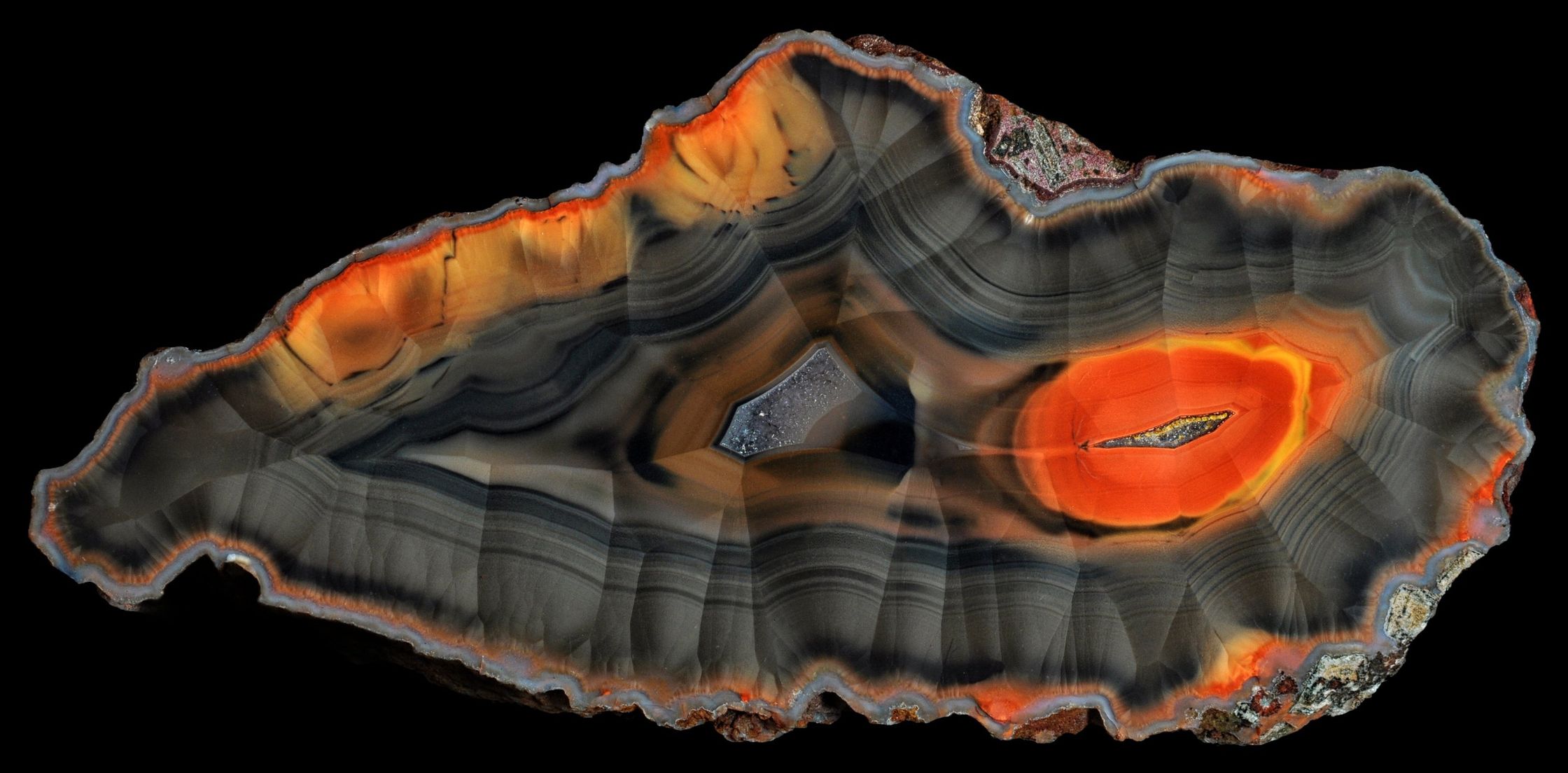
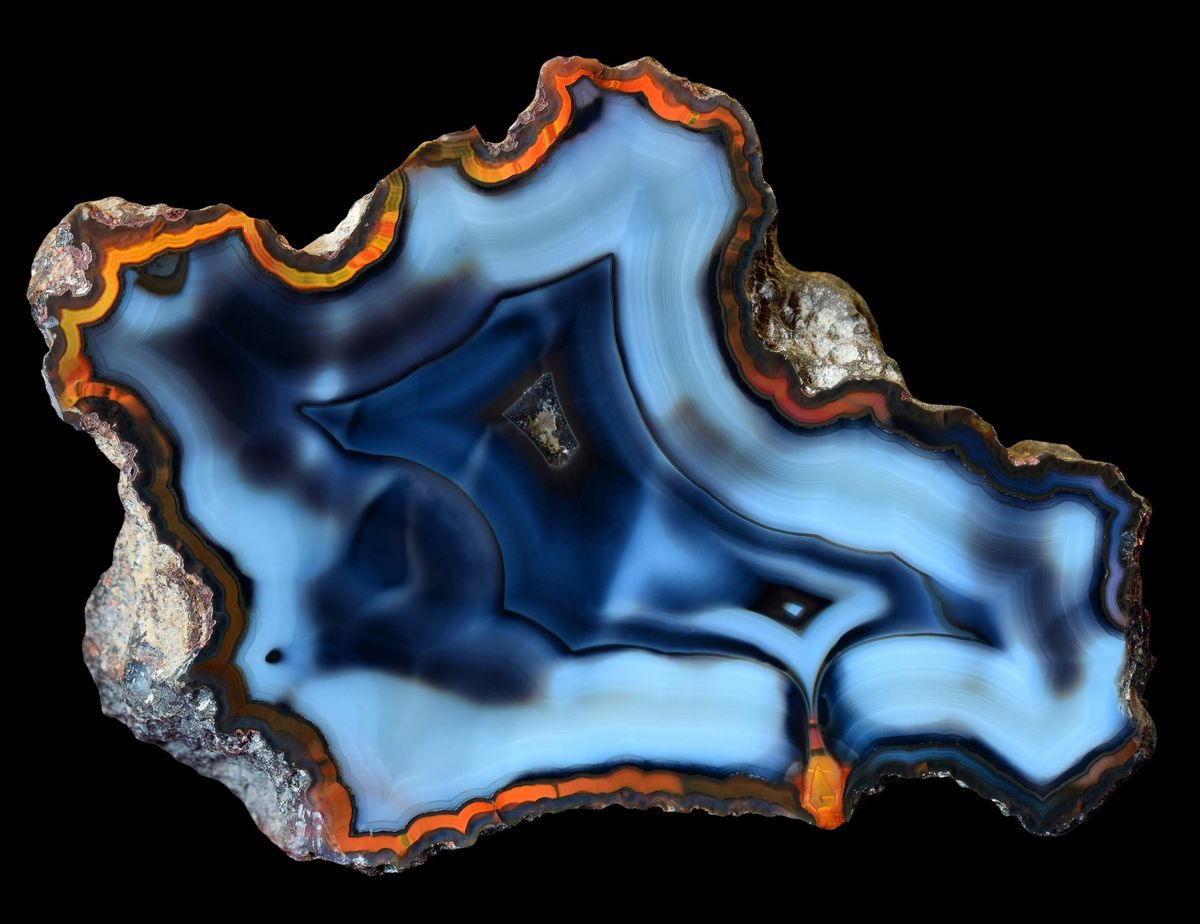
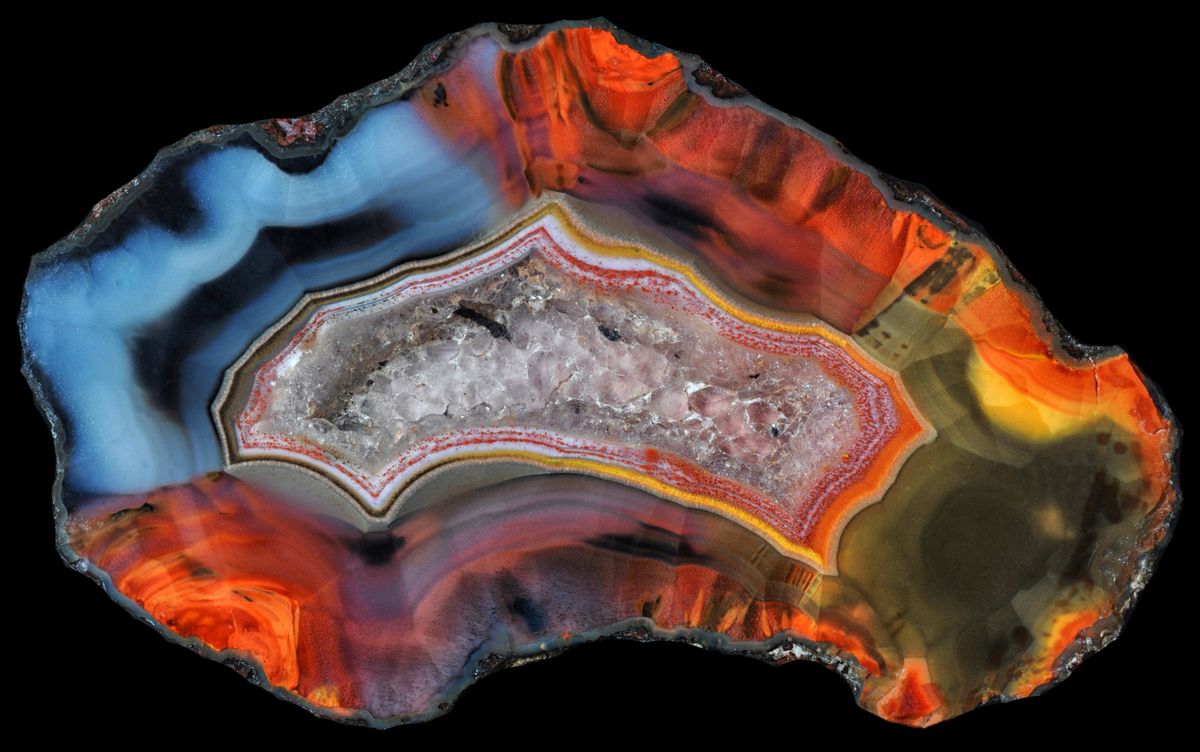
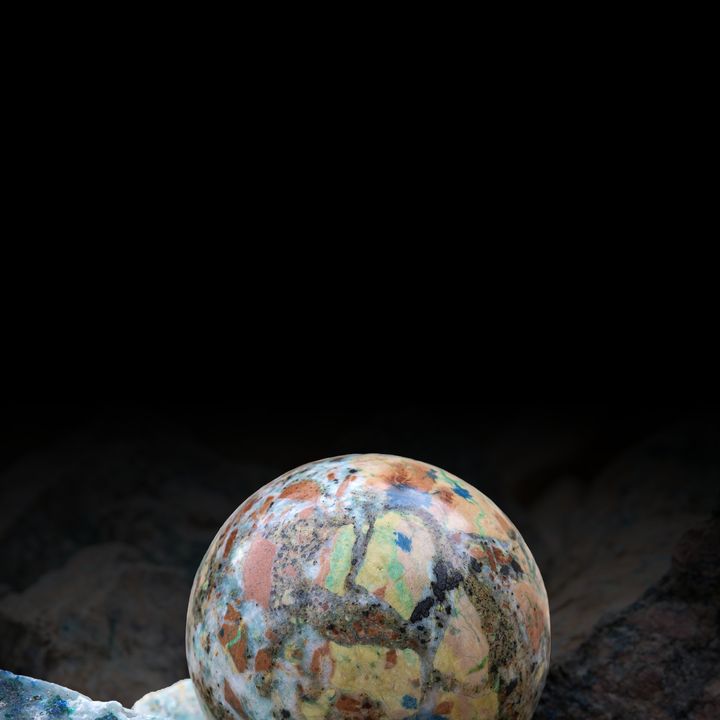
In addition to their continued abundant availability and still reasonably acceptable prices, they impress above all with their incredible variety of colors, shapes, and patterns. The predominant colors are shades of brown, yellow, and orange, often appearing in contrasting combinations. The best pieces also display intense red, pink, blue, black or white hues.
The phenomenon of chromatography is quite typical and widespread in agates from Mendoza. This refers to sudden color changes within a band system in the agate, which apparently can be caused by thin, separating membranes in the chalcedony itself, but sometimes also by leaching.
Most agates are nodule-shaped and, in rare cases, can reach considerable sizes of up to 30 cm and more. Depending on the respective find area, the outer crusts are limonitic brown or gray-green, rather smooth chalcedony. The overall shape can vary from spherical to elongated and fissured. Some sites have yielded agates with quite thick iron carbonate-rich outer shells, which often frame a colorful, finely banded agate system. Agates from the newer Agua Poca site are often partially covered with white-brownish carbonate crusts.
The cross-section often shows sharp-edged fortification agate textures, while other agates have a more gently rounded agate change. The well-known phenomenon of shadow agate (Parallax) occurs comparatively rarely in agates from San Rafael, and the so-called gravitational banding (onyx banding) with its plane-parallel layers has so far only been found in very few pieces. Inclusions in the form of pseudomorphs and perimorphs are more common, often consisting of various calcite or other carbonate formations. Eye patterns can also occasionally occur when cutting a rough agate nodule.
Agates from Mendoza extremely rarely contain plume structures (tree/bush-like growth textures), which are highly sought after among collectors.
Clear quartz crystals, very rarely light amethyst crystals, and sometimes quite well-formed lustrous white calcite crystals can crystallize in cavities in the center of the nodules.
Vein agates are also found in the area around San Rafael. The Sierra Pintada deposit, which has been known for a relatively long time, has probably yielded the best specimens of this kind to date. Some agates of this deposit originated as intermediate space fillings in the host rock.
In addition, the rhyolitic rocks found around San Rafael contain magnificent thunderegg agates in the color shades typical of “condor agates” (Rio Colorado).
Collections
Agates from San Rafael have been enriching the international market for more than 30 years now. It is therefore not particularly surprising that most of the world's most important agate collections contain at least one large suite of agates from this deposit. Leading collectors in Europe with magnificent Argentine collections include Hannes Holzmann from Austria, Thorsten Jakob, Tino Mauksch, and Uwe Reier from Germany, and Fady Kamar from the Netherlands. The former world-class agate collection of Dietrich Mayer from Germany was recently sold to Polish dealer Tomek Praszkier and American high-end mineral dealer Daniel Trinchillo and will probably soon reach new collections via these sources. In the USA itself, among many others, the collections of Fred Frelinghuysen from Tucson, Arizona, and the well-known author and collector Pat McMahan from Cottonwood, Arizona, are particularly significant. A rather short-lived but extraordinary collection of agates from San Rafael was presented by the recently deceased American mineral dealer Dave Wilber at the special agate exhibition at the Munich Mineral Show 2005, among other places. The outstanding pieces all originally came from Luis de los Santos and attracted a great deal of attention, partly because of a packed lunch that Wilber accidentally left behind in the display case while setting it up on the day of the exhibition...
Price development and outlook
Even when they first appeared on the market, the higher-quality San Rafael agates could never really be described as inexpensive.
The author recalls a room at the Denver Gem & Mineral Show in 1995, where the aforementioned Luis de los Santos had prepared countless cut Argentine agates for sale, which was quite a sensation at the time. Prices of several hundred US dollars for the more beautiful halves were already commonplace at that time. Currently, excellent pieces of agate from Mendoza can fetch five-figure sums in euros or dollars. The author of this article was present when a relatively large agate from San Rafael changed hands for US$ 12,000 at the Tucson Mineral Show without any complications.
It is therefore not surprising that many collectors who have the appropriate machinery have preferred to purchase the rough material, which has long been much cheaper, in order to cut one or two top-quality pieces that make the effort worthwhile. However, the percentage of poor and average material is usually relatively high.
Both rough material and cut and polished specimens are currently still available on the market in comparatively large quantities. So today, with some expertise, perseverance, and, above all, the necessary financial resources, it is still possible to build up an excellent collection of agates from the Argentine province of Mendoza, as the supply of suitable rough stones is likely to continue for at least the next few years.
Acknowledgements
The author is very grateful to Hannes Holzmann, Thorsten Jacob, Fady Kamar, Holger Quellmalz, Albert Russ, Dietrich Mayer, and Pat McMahan for providing information and images.