Paul Gruber (2024): Mineralogy simply explained: Galena from Wölsendorf. Mineralica online, March 3, 2024. https://mineralica.com/a/xp22s7 (accessed October 13, 2026)
The series “Mineralogy simply explained” connects collector's specimens with science. Paul Gruber uses galena from the Wölsendorf fluorite district in Bavaria to explain key technical terms.
Maximilian Schiller photo.
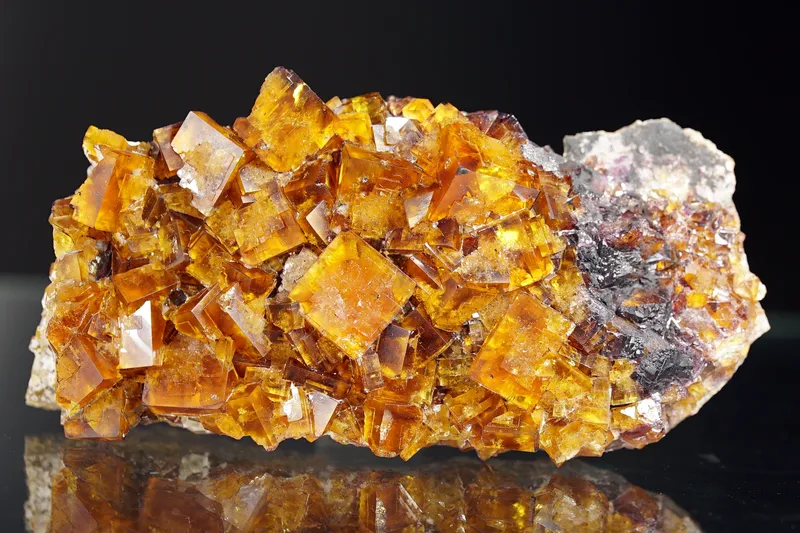
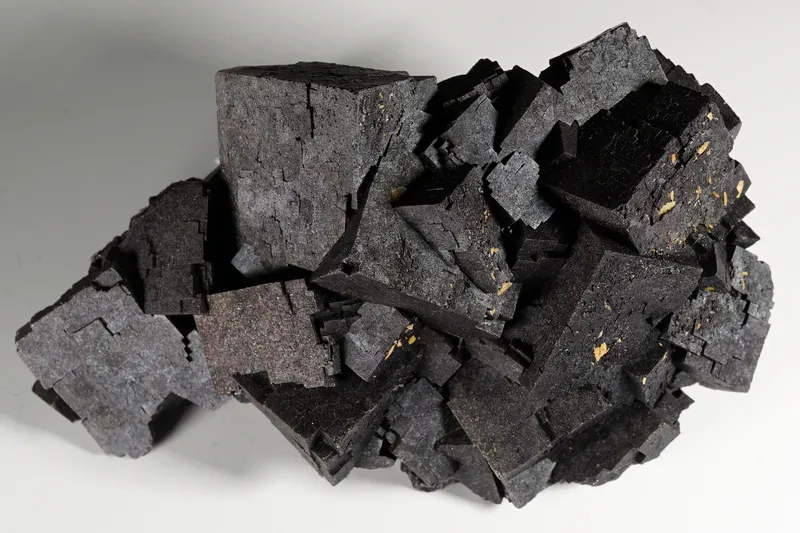
Many collectors immediately associate the locality "Wölsendorf" in Germany with some common minerals. They think of "stinkspar1" and "honey spar", which lie in attractive specimens in museum collections, on exhibitors' stands at mineral fairs or perhaps in a more modest form in the own collection at home. Fig. 1 and 2 show two rather small specimen specimens2.
Fig. 1: Honey-yellow fluorite, so-called honey spar from the Marienschacht, Wölsendorf district. Picture width 15 cm Maximilian Schiller photo.Fig. 2: Black fluorite, so-called stinkspar from Marienschcht, Wölsendorf district. Image width 12 cm Maximilian Schiller photo.
The Wölsendorf fluorspar district is located approx. 50 km north of Regensburg between Schwandorf and Nabburg. The district measures around 15 km by 5 km. The Hermine mine was the last in the district to be closed in 1987. There are no visitor mines.
In its almost hundred-year history, the mines have yielded many collector's items. The site is known in Central Europe as "Andreasberg"3, "Grube Clara"4, "Habachtal"5, "Erzgebirge"6 or "Minas Gerais"7.
There are many photos of Wölsendorf fluorite on the internet. The old German name "Flussspat" (fluorspar) refers to its use as an additive in smelting processes, where it ensures a better flow of the molten material. Fluorite says that the stone contains fluorine; fluorine that forms a compound with calcium called calcium fluoride.
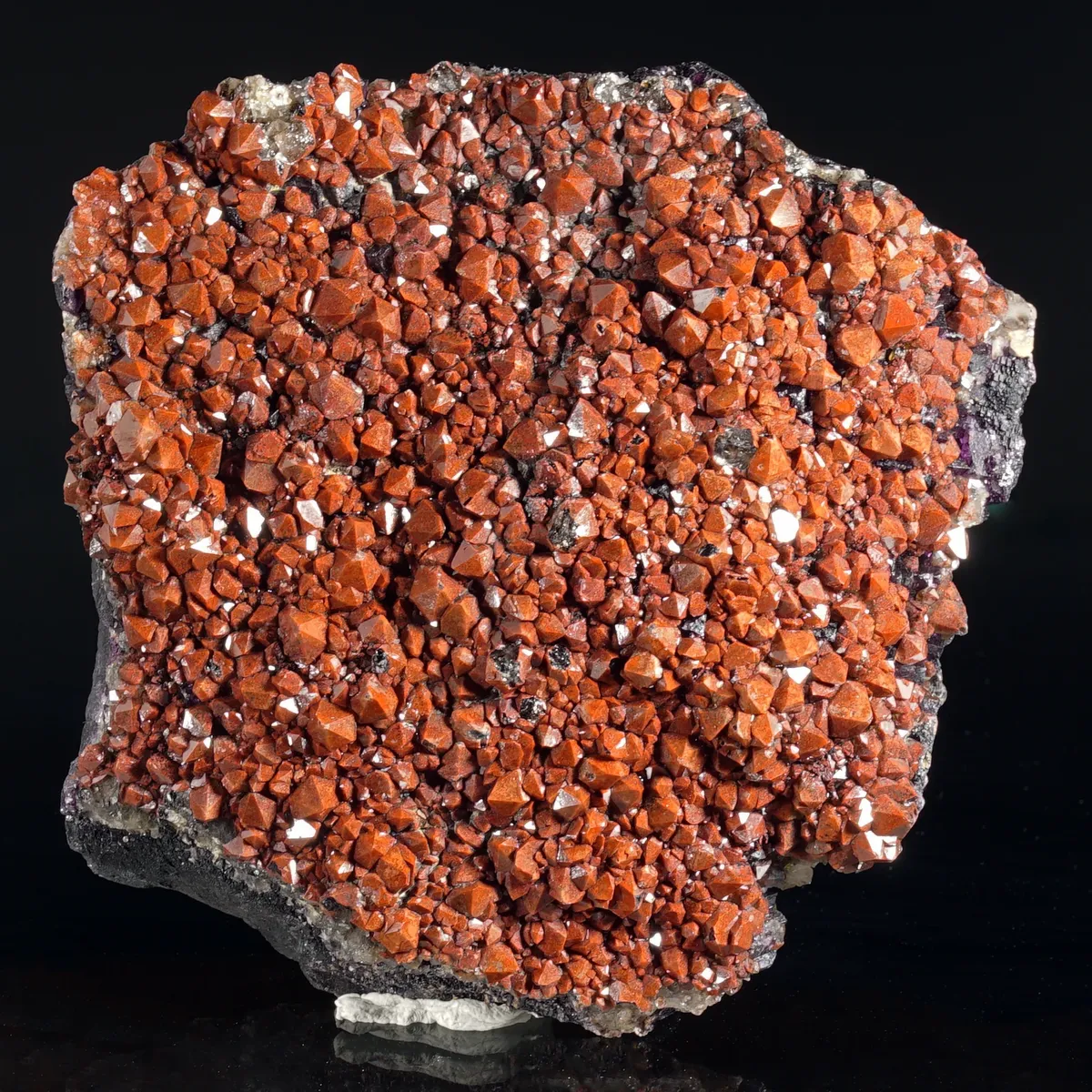
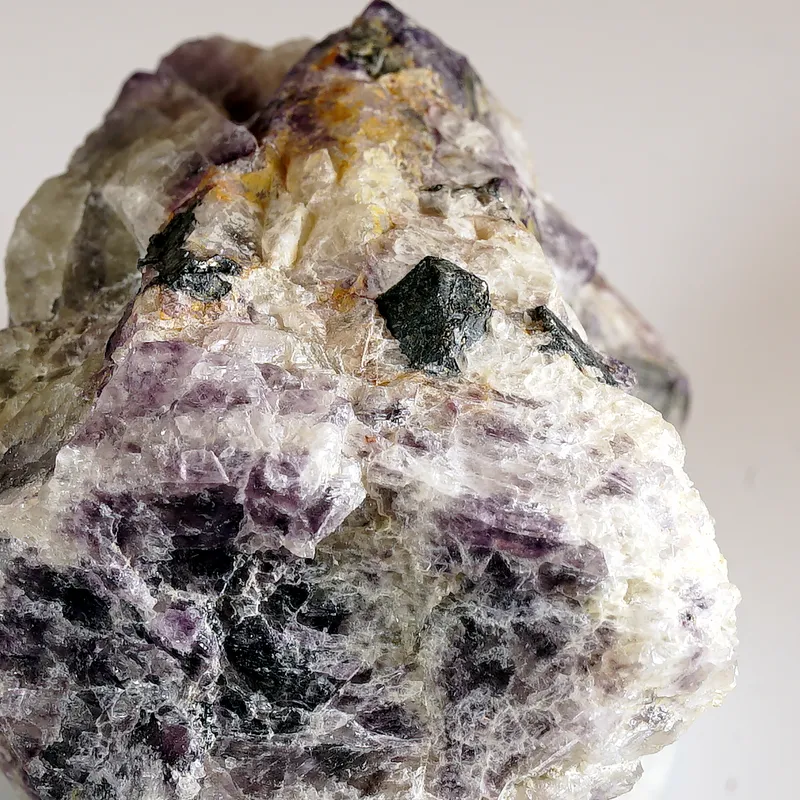
Fluorite in Wölsendorf is often accompanied by baryte and quartz. The surface is often coated with bright red iron oxide. These mm-sized quartz crystals are called "Eisenkiesel" in german. Fig. 3 shows a piece from the Marienschacht.
Fig. 3: Eisenkiesel from the Marienschacht, Wölsendorf mining district. Image width 12 cm Maximilian Schiller photo.
This article is about galena, which was found in Wölsendorf but is less well known from there. This may be because it was not common or because it was not in demand by collectors and was therefore not taken away by the miners. In any case, the galena deposits were not so extensive that they would have been exploited in the course of fluorspar mining.
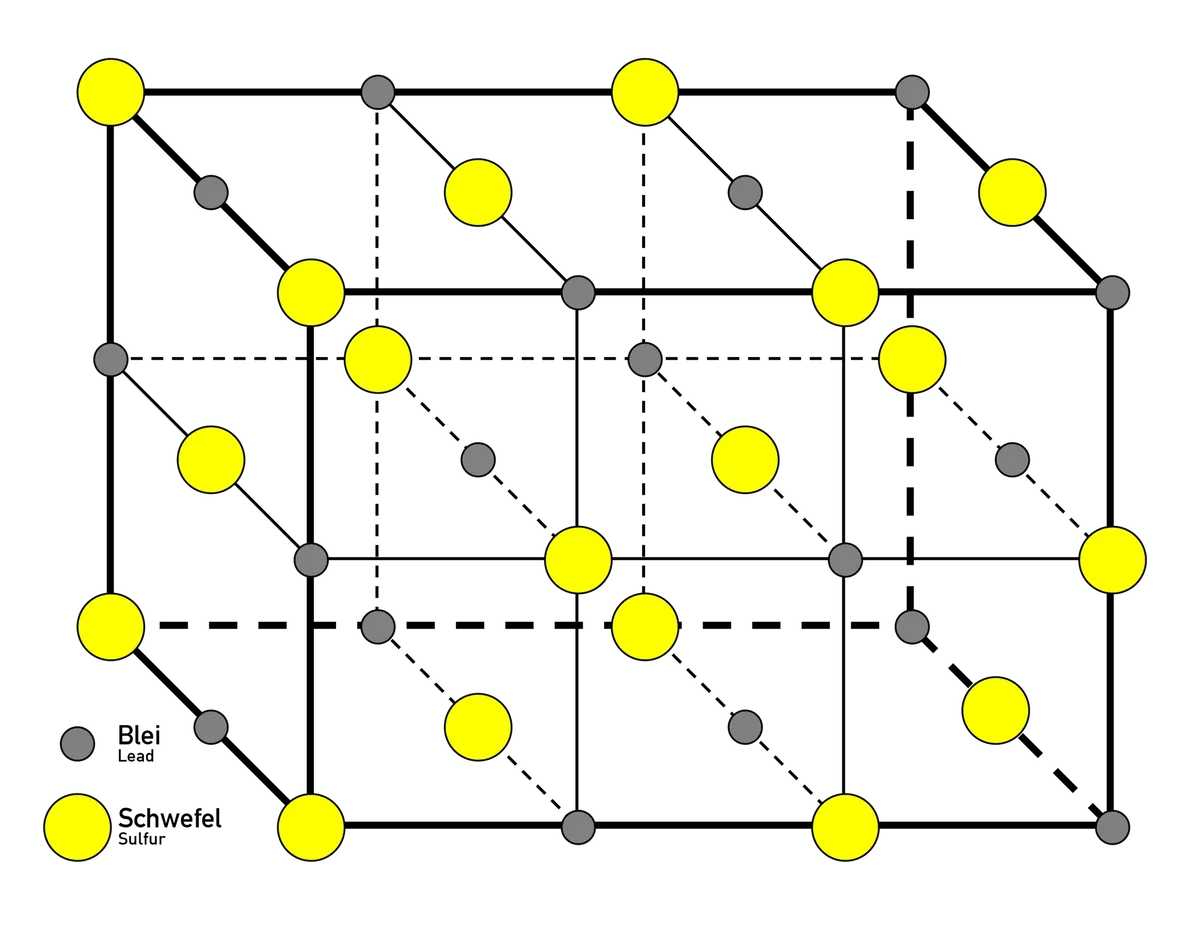
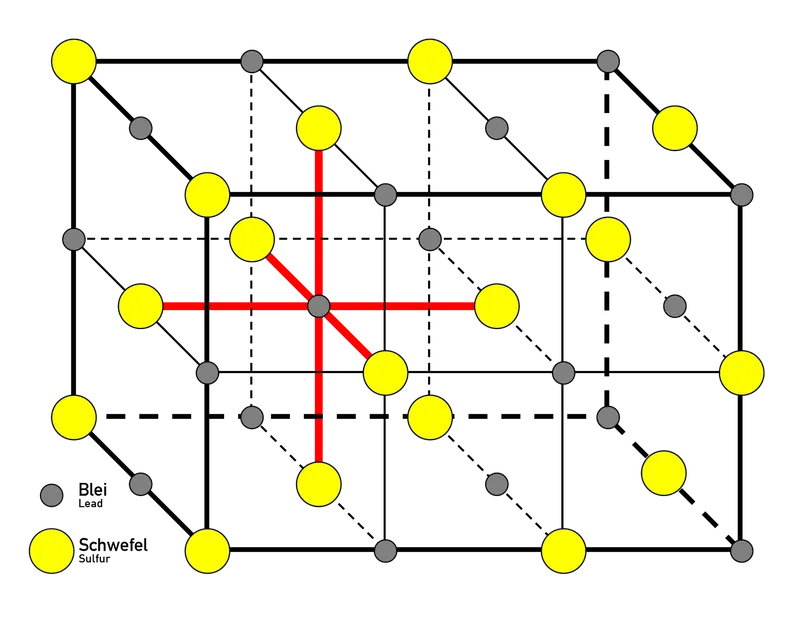
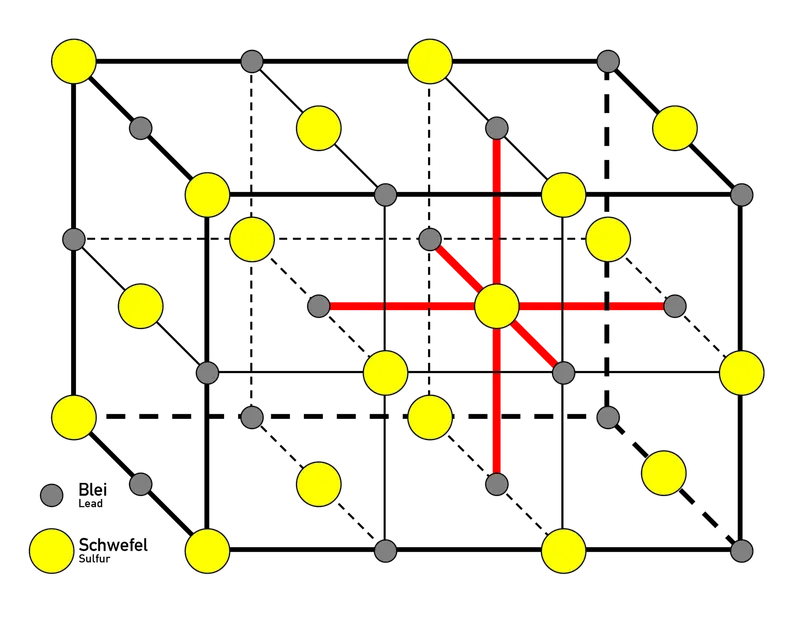
Galena is the most important lead ore globally. It consists of atoms of lead (Pb) and sulphur (S), which together form a substance known in chemistry as lead sulphide (PbS), forming8. The lead atoms and sulphur atoms in lead sulphide are not simply scattered evenly in space, but are arranged regularly. Each lead atom has exactly six sulphur atoms as equally distant nearest neighbors. The reverse is also true. They form a crystal lattice9. Although the atoms are indivisible and more than tiny, you can imagine them as small spheres. Fig. 4 shows model-like10
Typical crystal lattice between lead and sulphur atoms. Paul Gruber photo.
There is an equal distance between the lead and the 4 connected sulphur atoms. Paul Gruber photo.There is also an equal distance between the sulphur and lead atoms. Paul Gruber photo.
Every piece of galena is therefore a crystal, but the collector will not always call it a galena crystal. For him, a crystal must be bounded on the outside by more or less clearly recognizable crystal faces. Other material may be adjacent to the faces, i.e. the crystal may be grown in, or there may be no other material adjacent, some or almost all of the faces protrude into the air and the crystal is grown up. If the crystal lattice shown in Fig. 4 is continued uniformly in all directions, it is plausible that galena crystals tend to be cube-shaped.
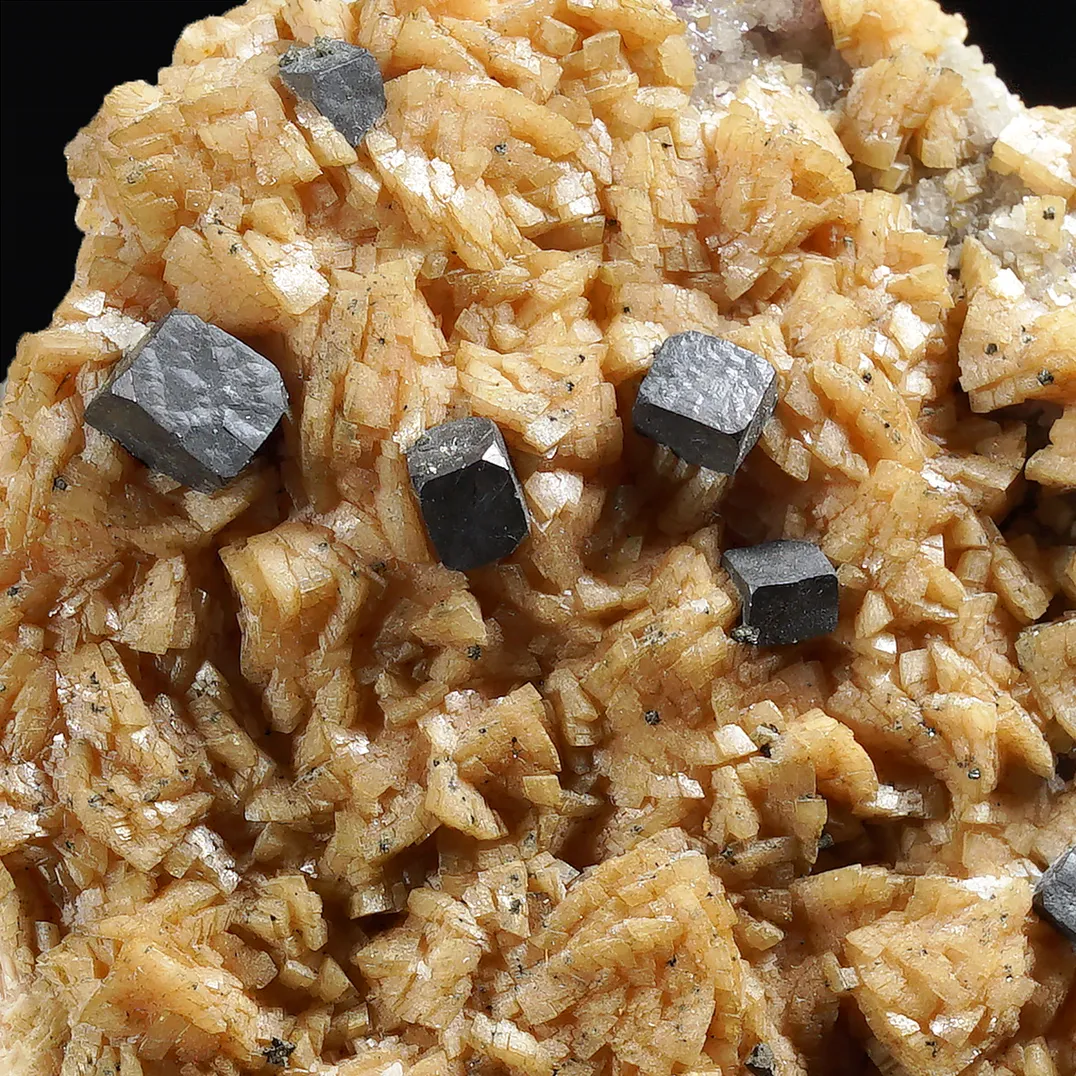
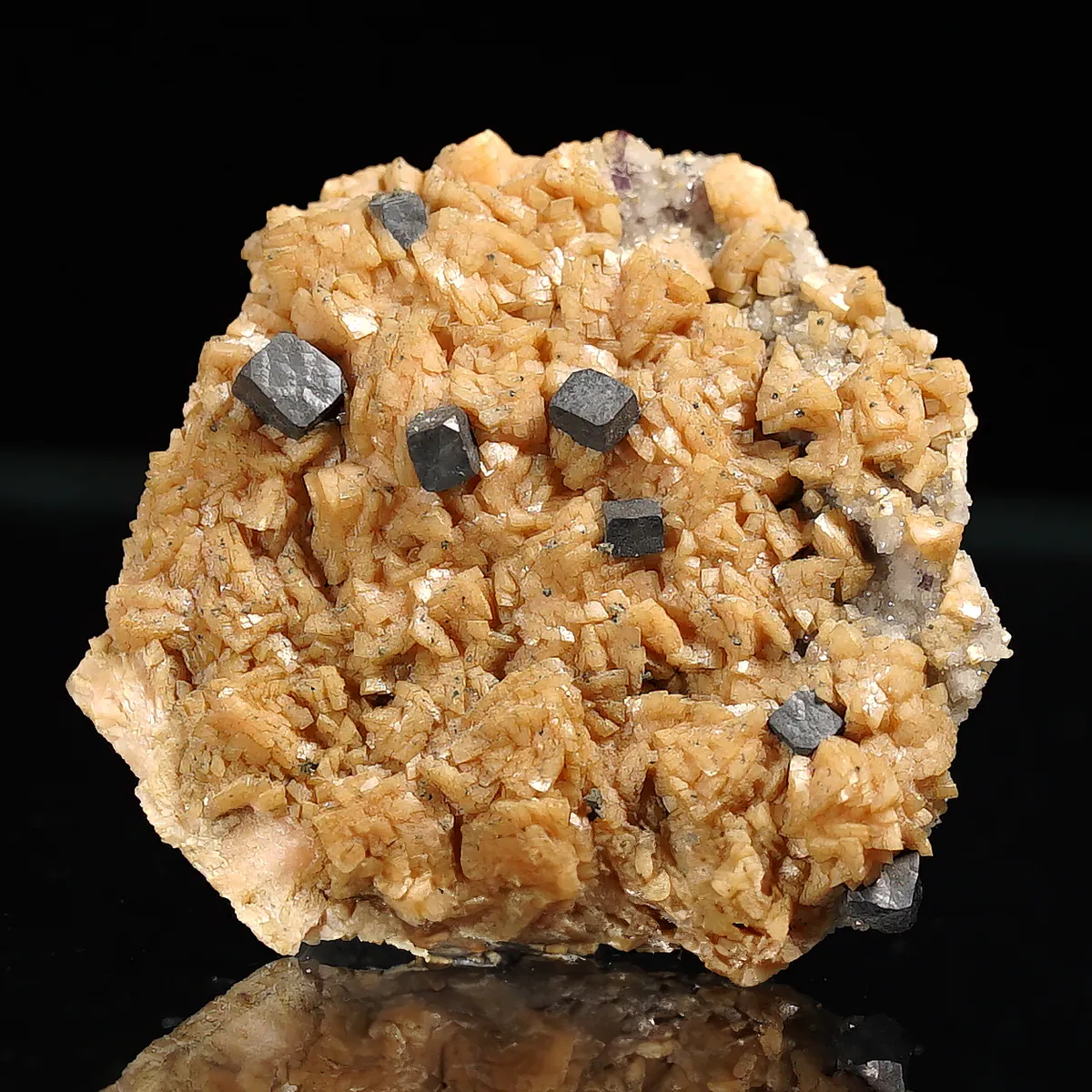
Fig. 5: Galena on dolomite from Marienschacht, Wölsendorf district, image width 6 cm Maximilian Schiller photo.
Fig. 5 shows black appearing, grown cube-shaped galena crystals from the Marienschacht in Wölsendorf. The light-colored material are crystals of dolomite that have grown together and show the curved surfaces characteristic of dolomite. Dolomite is a relative of common lime which, in addition to carbon (C) and oxygen (O), contains not only the element calcium (Ca) but also magnesium (Mg). Chemistry describes its composition as CaMg [CO3]211.
The shape of the octahedron. Paul Gruber photo.Fig. 6: Galena with coating of fluorite from Marienschacht, Wölsendorf district. Picture width 7 cm Maximilian Schiller photo.Fig. 7: Galena in fluorite from the Roland mine, Wölsendorf district. Image width 4 cm Maximilian Schiller photo.
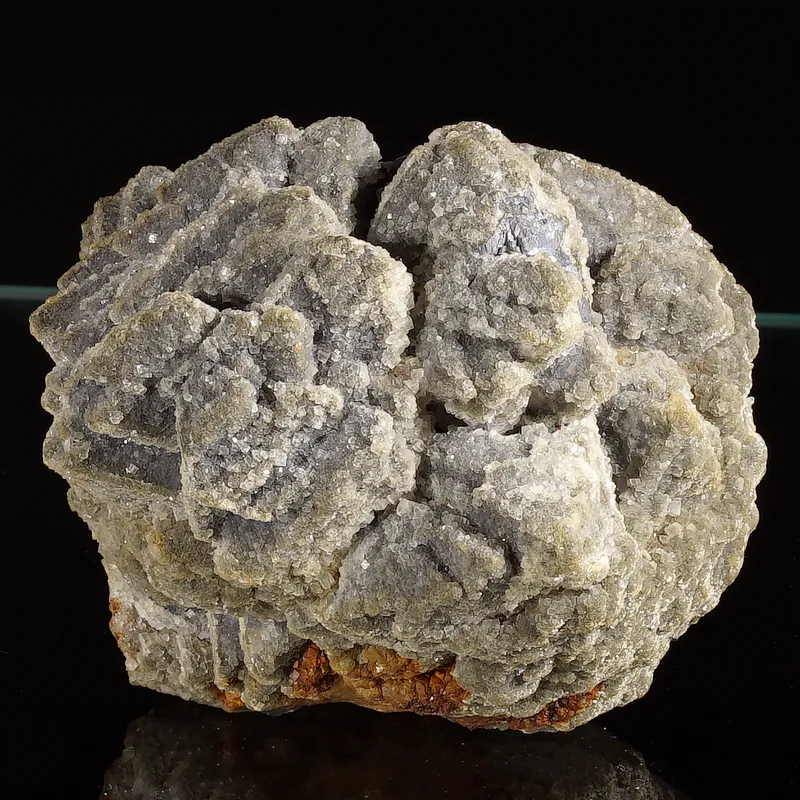
In Fig. 6, the grown crystals of galena are not recognizable at first glance. On the one hand, they have a thin crust of small, colorless fluorite crystals, so that they appear gray and not black. Secondly, they have grown close together so that only a few faces of each crystal can be seen. Finally, they are not cubes, but octahedrons. The triangular faces are clear. The specimen also comes from the Marienschacht.
Galena crystals are also found ingrown. Fig. 7 shows a dark octahedron from the Roland mine in Wölsendorf. It is ingrown in light fluorite. How can you tell that the crystal is ingrown and not grown - the four visible triangular faces are not surrounded by any other material?
Well, on the back of the piece you can see a crystal that has broken through, flush with the surrounding fluorspar. The finder of the piece knows: he has knocked a lump of stone to pieces and the friable fluorspar has detached itself along the crystal faces of the octahedron without destroying it.
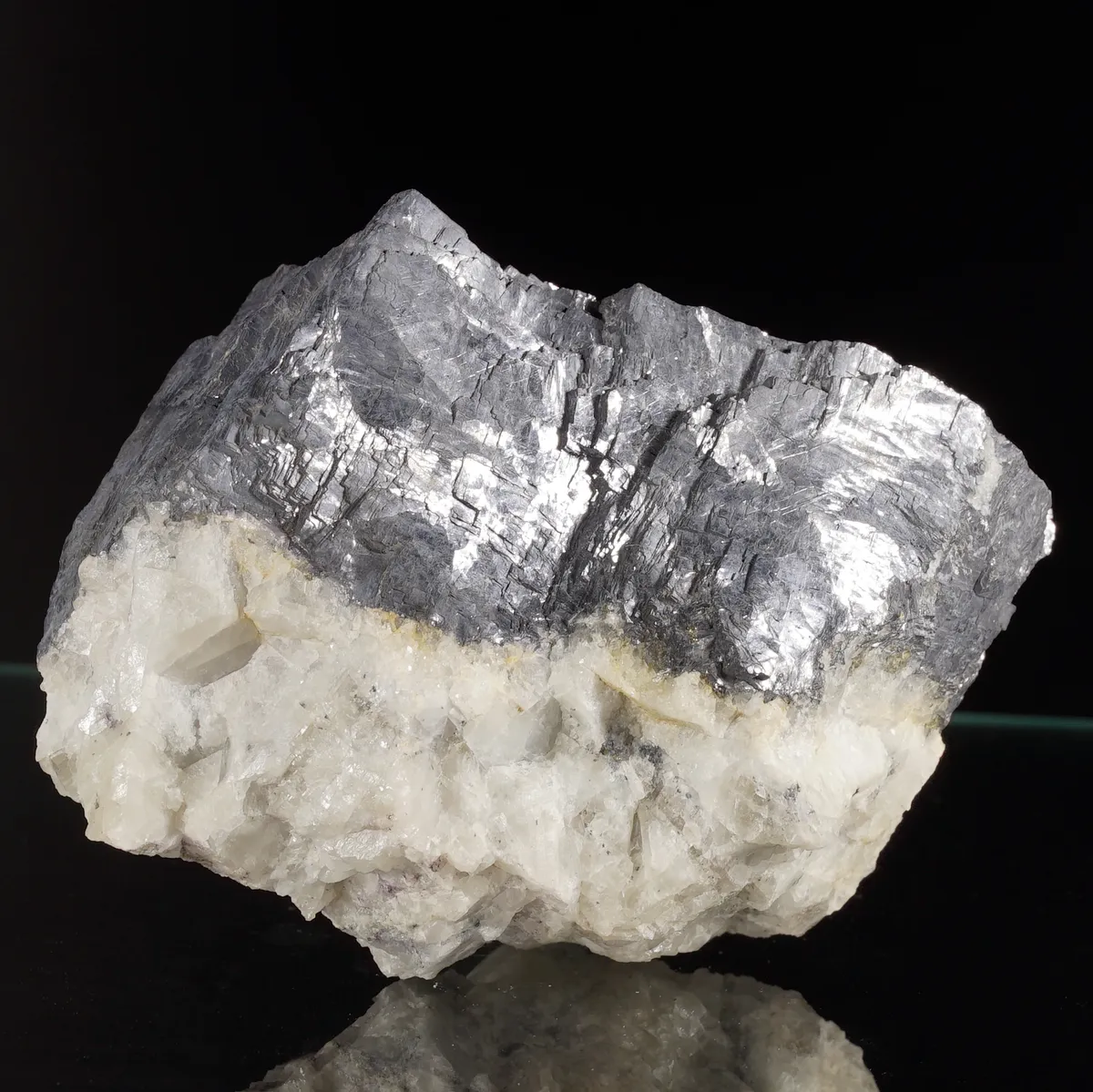
If pure pieces of galena are knocked apart, it can often be observed that the split pieces have gray, highly reflective surfaces. With skill, you can produce cubes with six high-gloss surfaces. This would actually be an ideal galena crystal specimen if it had not been created artificially. Sometimes pure pieces of galena consist of many mm-sized galena grains12 with reflective surfaces that do not form uniform, large surfaces. In this case, no cleavage pieces can be obtained. Each fragment again shows only the grains.
Fig. 8: Galena in fluorite from Marienschacht, Wölsendorf district. Image width 11 cm Maximilian Schiller photo.
A larger split piece of galena from the Marienschacht is shown in Fig. 9. The light-colored mineral is again fluorspar. The galena has a metallic luster.
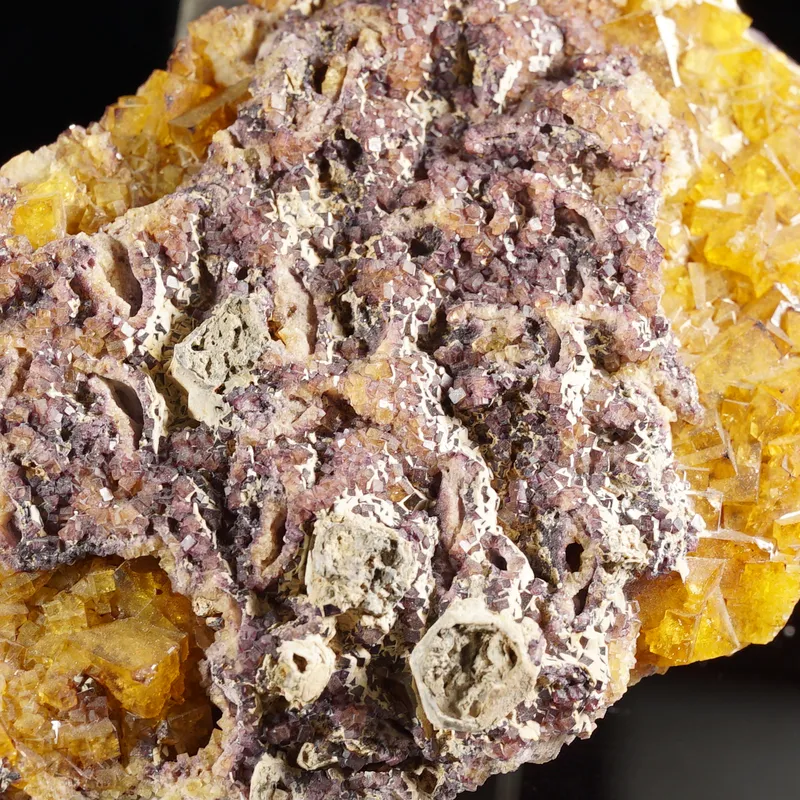
Why are the crystals shown above dull and dark gray? This is because galena tends to transform on the surface, especially under the influence of water. The cavities in the mine where the crystals are found often contain moist clay. Even small cracks in the rock often transport water. The decomposition can go so far that the originally existing galena crystal partially or completely disappears. Sometimes the outermost parts are still preserved. This can be seen in Figure 9.
The shape of the cuboctahedron. Paul Gruber photo.Fig. 9: Galena on fluorite from the Helene mine, Wölsendorf district. Image width 6 cm Maximilian Schiller photo.
Figure 9 shows a yellow lawn of fluorspar cubes. Part of it is covered by a purple fluorspar turf. As this must have formed after the yellow crystals, it is referred to as a "second generation" of fluorspar. The gray mineral, which looks like parts of hollow spheres, is the remainder of decomposed galena crystals. If you take a closer look at the hollow shapes, you can see that originally they were neither cubes nor octahedrons, but "pyramid cubes". Pyramid cubes or cuboctahedrons are obtained by cutting off the eight corners of a cube in such a way that instead of the corner you get a triangular surface with sides of equal length. The specimen shown here comes from the Helen mine in the Wölsendorf district.
If you examine the piece under a reflected light microscope, you will find a tiny elongated crystal of wulfenite in a galena relict. There are also many remnants of light grey, solidified clay. It could be removed, but this would risk destroying the galena.
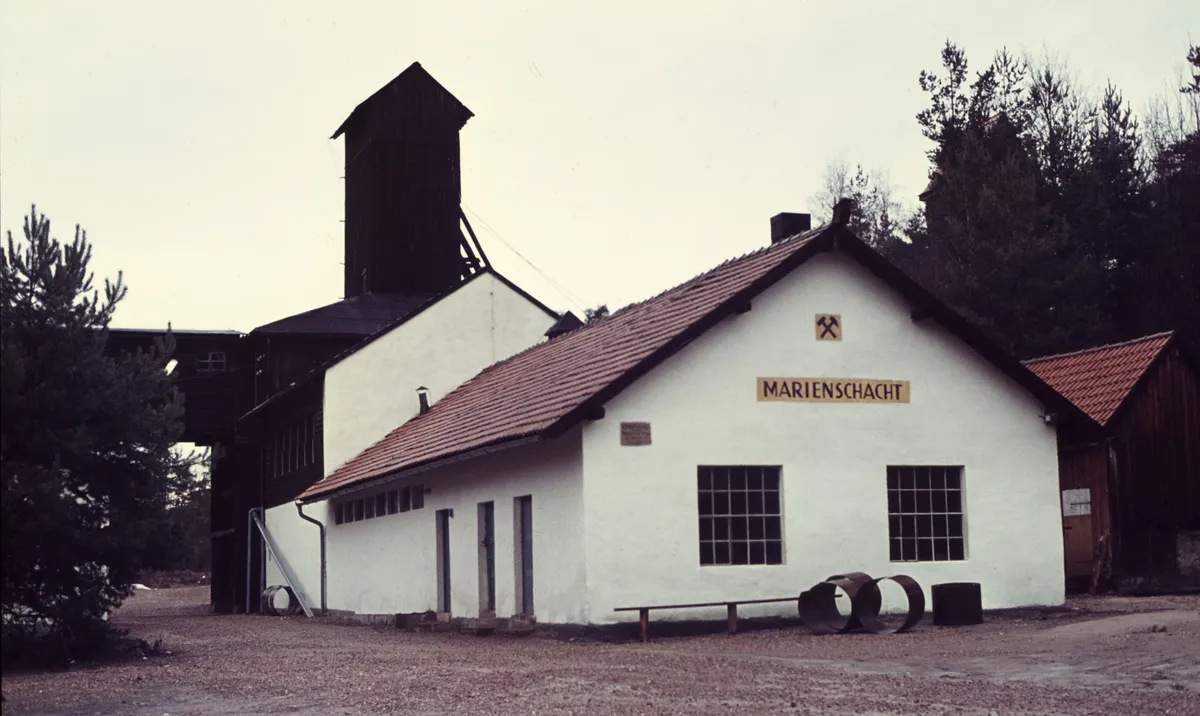
To conclude this short mineralogical journey to Wölsendorf, Figure 10 shows the Marienschacht in Wölsendorf in 1976.
Fig. 10: Marienschacht mine in Wölsendorf, 1976. Paul Gruber photo.
Notes
1. stinkspar: If you smash stinkspar with a hammer, you will notice a peculiar smell ↩
2. specimens: Collectors use "specimen" instead of "piece" for a mineral, especially if they show pretty crystals. The term comes from the miner's language and refers to pieces of rock, especially if they are made of pure ore ↩
3. "Andreasberg": St. Andreasberg is located in the Harz Mountains and is its most famous mining town. Although the mines have been closed down, the mining tradition here, as in other places in the Harz Mountains, is attractively presented to tourists ↩
4. "Grube Clara": The Clara mine, which is still active today, is located in the Black Forest near Oberwolfach. It is operated on fluorspar and barite. For a fee, you can officially search for minerals on a heap where mined material is temporarily stored. There are many different minerals there in small but attractive crystals. Collectors call such small pieces micromounts ↩
5. "Habachtal": The Habachtal valley is located in the Austrian Hohe Tauern National Park. It is known for the occurrence of emerald worthy of cutting. Many smoky quartz crystals also come from there. If you want to collect there yourself, you must observe the regulations of the National Park Act regarding the type and extent of "stone collecting" ↩
6. "Erzgebirge": Like the Harz Mountains, the Erzgebirge is a so-called "classic" discovery area. As early as the 18th century, the then still countless mines supplied beautiful pieces to the collections ("natural history cabinets") that the nobility and bourgeoisie put together ↩
7. "Minas Gerais": Minas Gerais is a 600,000 km² Brazilian state north of Rio de Janeiro. Precious and ornamental stones are mined in many places there today. Compared to Europe, the huge deposits supply the international trade in amethyst, rock crystal and other minerals ↩
8. forming: lead sulphide has neither the properties of lead nor those of sulphur. Nor is it simply a mixture of tiny grains of lead and sulphur. Everyone is familiar with H2O, water, from everyday life. It has neither the properties of hydrogen (H) nor those of oxygen (O). It is also not a mixture of both gases, but also a (chemical) compound ↩
9. crystal lattice: Not every crystal lattice has this structure. There are many types of crystal structures. This is understandable because substances generally consist of different types of atoms ("elements"), which are sometimes arranged in space in a very complicated but regular way. ↩
10. model-like: model-like because the atoms are not spheres and the connections between the spheres do not exist in reality. However, the figure correctly shows the spatial arrangement and the distances (here on an approximate scale of 1: 1 billion) between the atoms. ↩
11. CaMg [CO3]2: The smallest unit of dolomite, a dolomite molecule, contains 1 Ca, 1 Mg, 2 C and 6 O. The brackets are placed because CO3 allows the molecule to be recognized as a "carbonate". Carbonates also exist with other elements, e.g. calcite CaCO3 , the main component of ordinary limestone. At the Styrian Erzberg, siderite FeCO3 is mined as iron ore (Fe) ↩
12. galena grains: Galena is then said to be present in "granular aggregates" ↩
Growth, dissolution and erosion leave traces on diamond crystals that a good loupe already reveals. Erwin Geiss explains what these surfaces tell us about the journey up from deep inside the Earth.
With its emeralds, the Leckbachrinne in the Habachtal is one of the best-known localities in the Eastern Alps. Edith and Otmar Wallenta untangle its patchy mining history and tell of an emerald that only the saw revealed.
Since 2022, three remote mines in the Gran Sabana have been yielding gold wires like few other localities. Michael Wachtler and Alejandro Stern report from the jungle between Venezuela, Brazil and Guyana.