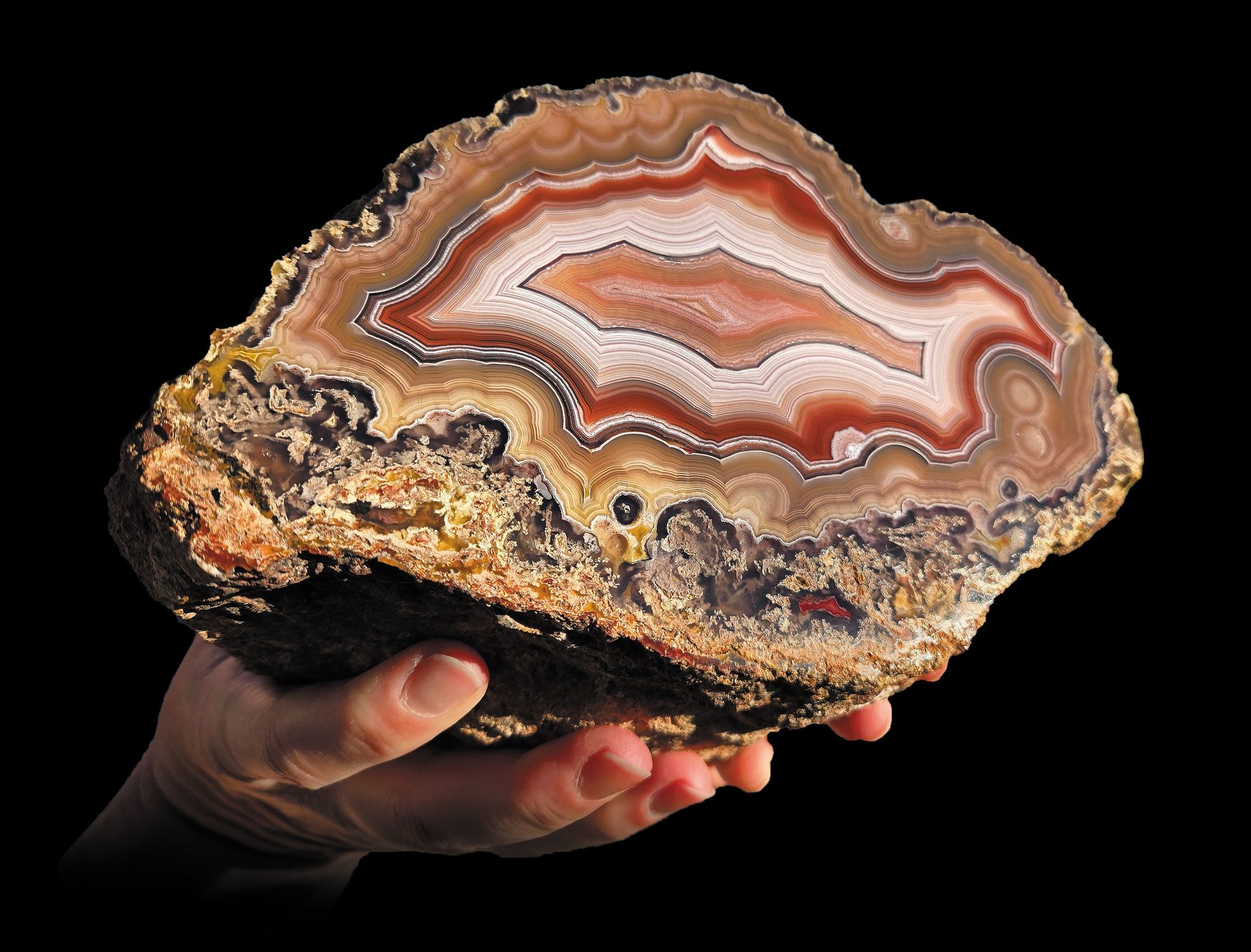
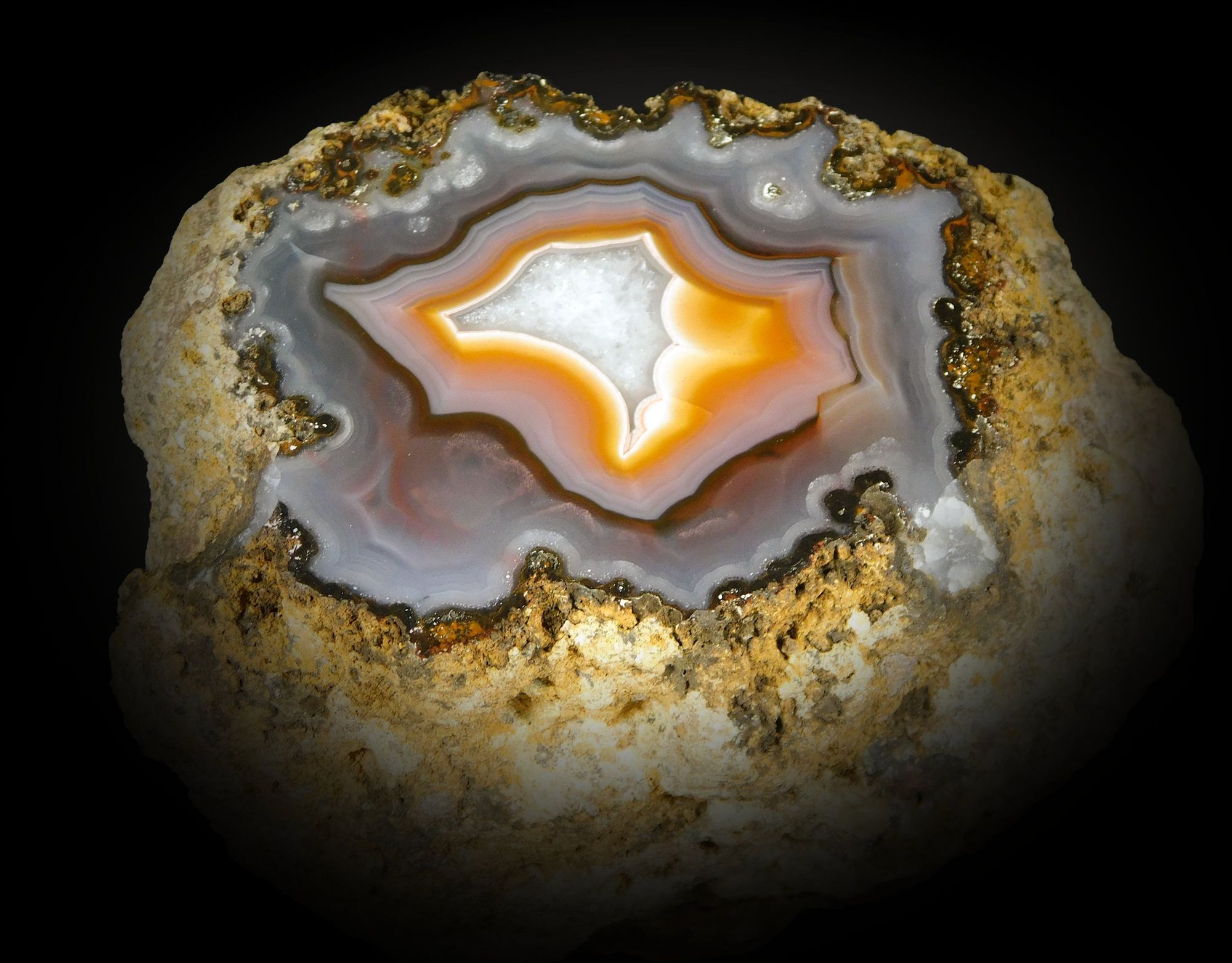
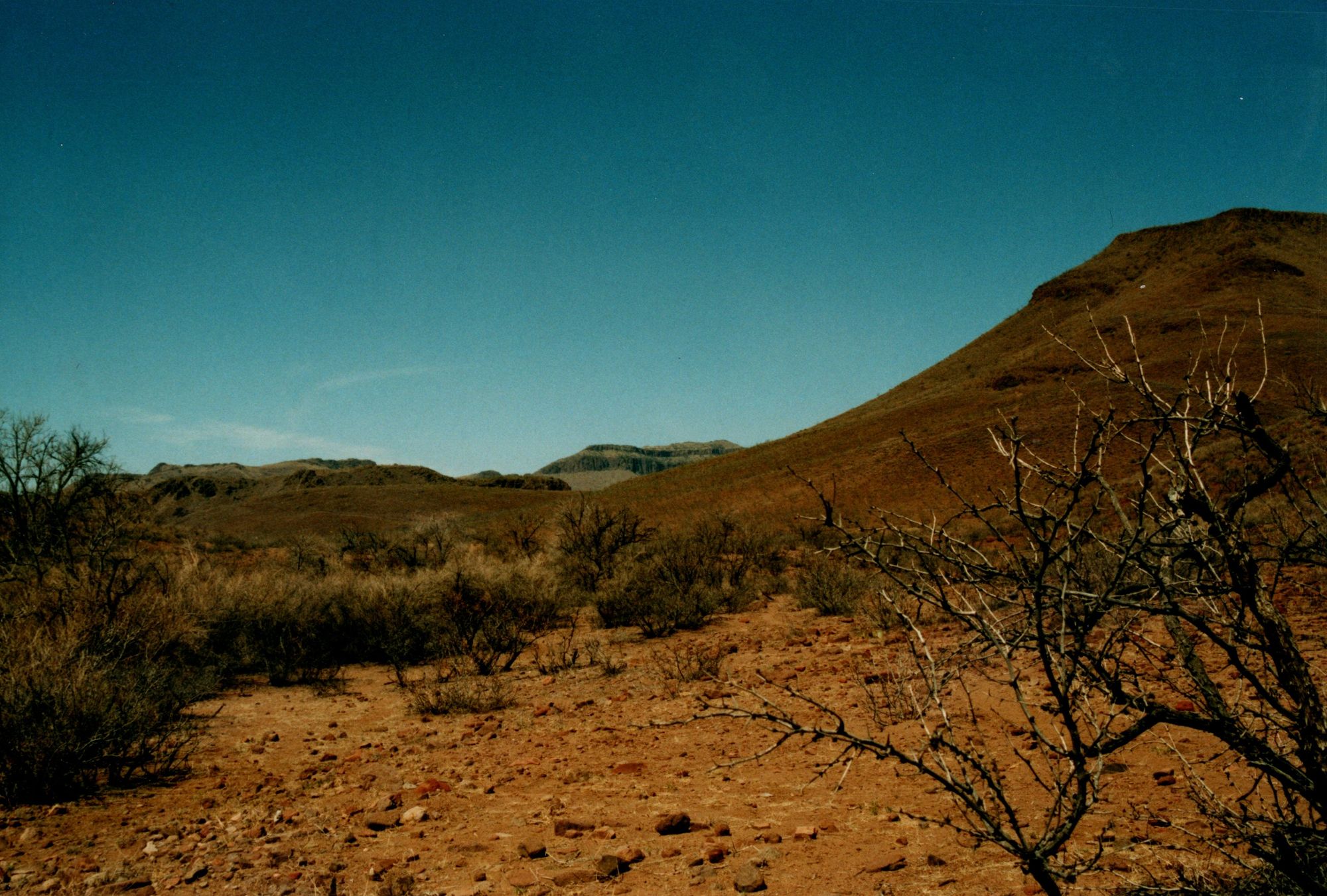
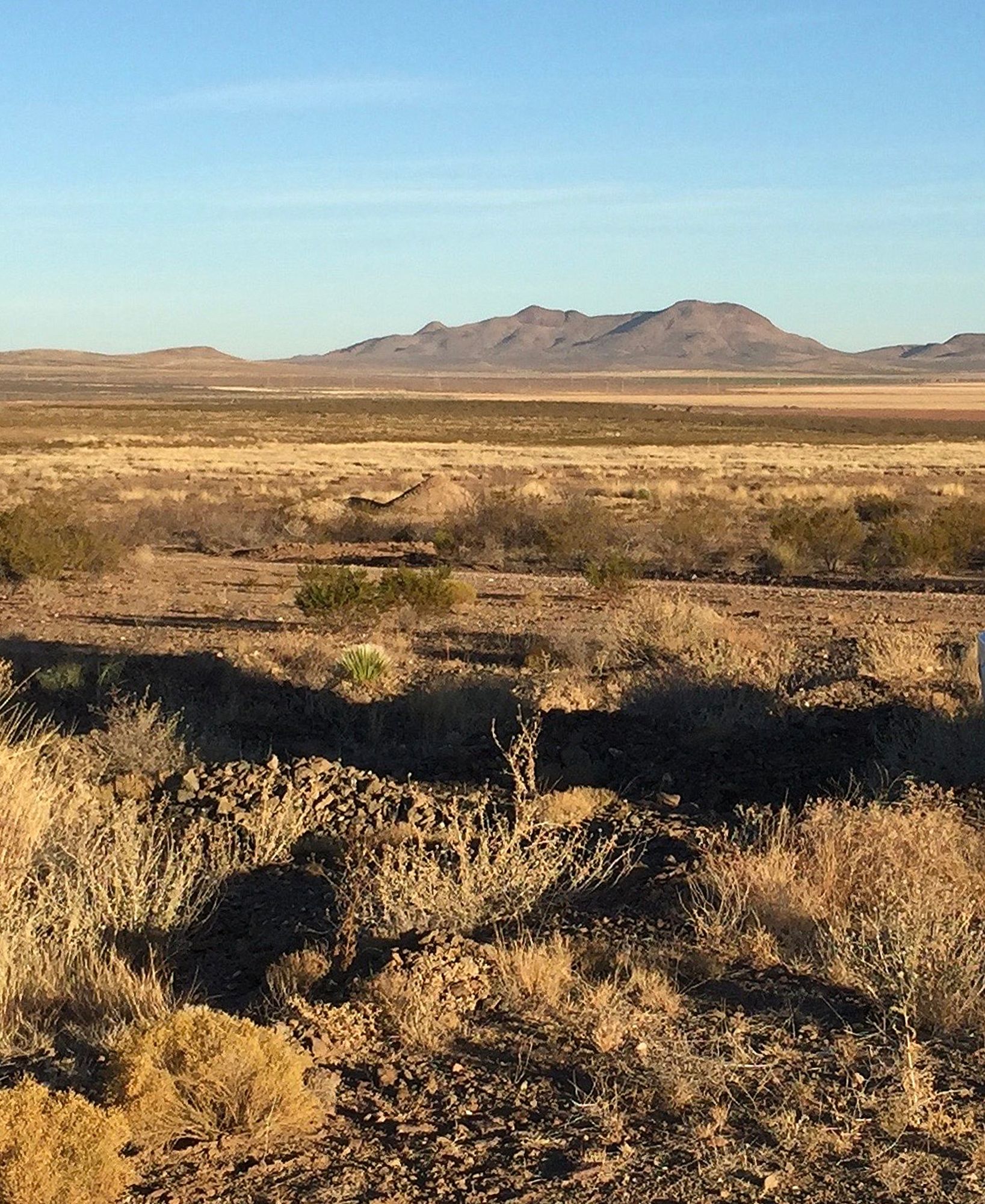
Agates from the northern Mexican province of Chihuahua are particularly prized by collectors all over the world. Hardly anywhere else is there such a variety of colors and patterns as in the agates found in this mostly barren, desert-like landscape not far from the border with the United States of America, where they have been mined for more than 70 years.
Geographical situation
The state of Chihuahua (the name means “dry and sandy place” in the indigenous Nahuatl language) is the largest province in Mexico with an area of just under 250,000 km2. It borders New Mexico and Texas (USA) to the north. On the opposite side of El Paso/Texas is the capital of Chihuahua, Ciudad Juárez, which has been in the news again and again in recent years, mainly due to brutal gang crime and intense drug problems.
The majority of the state consists of a desert-like high plateau with sparse vegetation and the Chihuahua Desert in the north, which extends far into the USA. Despite this, almost the entire area of Chihuahua is divided up among just a few landowners, whose ranchos, including sparse grazing areas for their livestock, sometimes cover huge areas. Until a few years ago, the occasional sale of rough agates by the farmers themselves or temporary agreements for agate mining on their land by mostly American-Mexican cooperatives and miners – especially in times of low cattle prices – provided a very welcome additional income.
The main area where the agates presented here were found is in the area between Villa Ahumada and Ojo Laguna; most of the sites are located in the Sierra del Gallego range.
Geology of the province of Chihuahua
With the exception of the lace agates, which occur in limestones about 180-70 million years old, the northern Mexican agates are all associated with rocks of volcanic origin, which according to CROSS (1996) were formed in the course of volcanic activity about 45-28 million years ago. In the main area of discovery in the Sierra del Gallego, the andesitic rocks (Rancho el Agate-Andesite) consist of numerous different lava flows (KELLER, 1977).
The well-known coconut geodes in the Cerro Mesteño, which in addition to sparkling quartz and calcite crystals often also contain mostly gray-blue agates, however, originate from a gray tuff of the Liebres Formation, which consists of tiny glassy fragments from a former volcanic eruption.
More detailed information on the genesis of northern Mexican agates as well as on the mineralogical, geochemical and geological situation can be found in MROZIK et al. (2023).
Collecting and mining history of northern Mexican agates
According to CROSS (1996), the agates in Chihuahua were first discovered by American collectors (rockhounds) who were able to pick up plenty of colorful agates along Highway 45, which was newly opened in 1945 (connecting the cities of Ciudad Juárez and Ciudad Chihuahua). However, the first mention of northern Mexican agates is already known in a report by the Instituto Geologico de Mexico from 1913.
News of these finds spread quickly in the rockhound clubs in the USA, which were a very popular leisure activity at the time, and soon attracted the first US dealers who, mostly in collaboration with locals, imported large quantities of Mexican rough agate material to the USA until around the mid-1970s. The local middlemen in turn hired helpers (mostly so-called vaqueros = cowboys) who collected the material, which was still abundant on the surface at the time, and handed it over to them for a mostly meagre wage. CROSS (1996) quotes statements by American traders according to which rough agates are said to have been lying on the surface in such large quantities that they could have been shoveled in with an excavator. Gradually, further areas were discovered, which ensured a steady supply of rough agates for almost three decades.
One of the best-known companies involved in the import of Mexican agates at the time was the Southern Gem Mining Company, founded in 1949 by Colonel Elbert Macby Barron, a rather colorful personality. In the early 1960s, for example, he tried to obtain the exclusive rights to sell Laguna agates by making a pact with the landowner at the time and threatening other dealers with legal action for the allegedly illegal sale of Laguna agates. However, financial disputes with the owner of the ranch brought this attempt at a monopoly to a halt after the first shipment of rough agate from Mexico (CROSS, 1996).
Naturally, the surface was soon so heavily searched that the first, generally small-scale mining operations were carried out, working particularly intensively enriched zones with rough agates in the hard Rancho el Agate andesite.
From the mid-1970s to the mid-1990s, only relatively little agate rough from the sites in Chihuahua reached the market, and there were no larger, more significant new finds, although well-known prospectors such as Benny Fenn, well-known from the mineral sector, also made an effort.
The drying up of the agate supply from the Mexican state, which had been producing seemingly inexhaustible rough material for almost a quarter of a century, prompted the best-known American author at the time, June Culp Zeitner, to publish an article entitled “Lament for Laguna” in the most popular US magazine of the time, the Lapidary Journal (1969).
The situation only changed again in the 1990s, mainly due to a find of the century by the Mexican-Texan prospector Gabriel “Gabe” Olvera, who was able to recover what were probably the most beautiful agates found in Ojo Laguna up to that time in his Conejeros mine, and this in large quantities over several years. The American dealers Dave Hignett and Mark Boche, among others, subsequently marketed the best pieces from these finds in the USA.
This unexpected success prompted other US and Mexican miners to take a closer look at the old, supposedly already exploited sites using modern machinery.
For example, the well-known American prospector and dealer Eugene “Gene” Mueller (The Gem Shop, Cedarburg, Wisconsin) worked in cooperation with Mexican landowners at various sites such as Ejido el Apache, Ojo Laguna (Alianza Claim), Rancho Agua Nueva and Rancho Coyamito. This led to a new spring for Mexican agates and a more or less constant supply of interesting rough material and high-quality specimens.
A few years ago, Andres Carrillo, the son of the owner of the Coyamito Ranch, took over the agenda for mining rough agates on his own farm and gradually acquired the mining rights for other northern Mexican sites, such as those in Ojo Laguna.
Unfortunately, due to the enormous price increase for Mexican agates, almost no new rough material has been available for some time, as all rough pieces are sawn and examined on site in order to achieve the highest possible sales value.
It was and is also not possible to collect them yourself at the known sites, as these are all located on private ranches and are all under claim.
The price development of Mexican agates
For many decades, agates were, with a few exceptions, in rather moderate price ranges, both as rough material and in polished condition, and were usually only marginal products for the most mineral collectors. However, various publications after the turn of the millennium and large special exhibitions, such as the Munich Mineral Show in 2005, brought them more and more into the focus of collectors who had now become curious. Knowledge about agates grew and interest in them and international networking increased steadily. The number of collectors willing to spend unprecedented sums on a single agate also grew.
This development, which has been observed on the mineral market for more than 30 years and has led to a remarkable masterpiece hype in the last decade, has also gradually begun to affect agates in general and Mexican agates in particular.
Cut Laguna agate halves in smaller handpieces and very good quality, for example, which a few years ago were still available for a few hundred dollars, are now often offered – and usually sold – for a hundred times the price.
There are various reasons for this: On the one hand, even with intensive mechanical mining, the rough material found is becoming increasingly scarce because the deposits, which tend to be small-scale with a few exceptions, have already been mined to their limits. Working in the incredibly tough andesite is extremely laborious, time-consuming and material-intensive. The costs for both mechanical extraction and the necessary human helpers have risen significantly in recent years and must of course be added to the agate prices.
Furthermore, in contrast to the first commercial exploitation of Mexican agates in the 1950s and 1960s, it is now fortunately increasingly the case that the majority of the proceeds remain with the people of Mexico themselves and do not flow predominantly to foreign dealers.
On the other hand, some insiders cannot avoid the impression that the current price trend could also be, at least in part, a consequence of very clever, modern marketing and sales strategies, which are being implemented very effectively through a shortage of supply and the associated “masterpiece marketing” and ultimately also through an emerging quasi-monopoly position as a claim owner and at the same time exclusive seller of Mexican agates.
Numerous long-standing serious collectors on all continents have thus turned away from Mexican agates as a collecting area in recent years because they can no longer afford or no longer want to pay the often exorbitantly increased prices. For some time now, the acquisition of high-quality Mexican agates has therefore only been possible for financially wealthy collectors, and more and more agates are even seen as an interesting investment opportunity.
What makes agates from Chihuahua so special?
Agates are known worldwide from a variety of different locations (see for example www.agates.click/fundstellen-locations.html) and are still available in excellent collector quality. While in some regions, such as in the German Saar-Nahe region around the well-known gemstone town of Idar-Oberstein, where they have been found and processed for centuries, or in the state of Rio Grande do Sul in Brazil, they were or are available in similar concentrations and quantities, northern Mexican agates have been able to gain a very special status in the international collecting community over the past 80 years.
The main reasons for this are an extraordinary variety of intense colors of the entire possible color spectrum in combination with an extremely distinctive, fine (shadow agate/parallax), high-contrast and intense banding of the agate nodules. This is further enhanced by a rather large number of occurrences, many of which have provided and continue to provide excellent and often clearly distinguishable, individual material.
In addition, northern Mexican agates occur in a variety of forms and types, primarily as nodular agates, vein agates and thundereggs, as well as in the form of so-called fire agates. The most sought-after structures are the sharp-edged banded fortification agates, but there are also iris agates, plume agates, moss agates, eye agates, tubular agates and many other varieties such as interesting pseudo- and perimorphs.
The most important localities and their agates
With his work The Agates of Northern Mexico (1996), the hydrogeologist, author and passionate collector Brad Cross from Texas created the only comprehensive documentation of Mexican agates and their localities to date. In meticulous detail, he visited and researched most of the sites described himself and sought contact with the surviving witnesses of the Mexican agate heyday in the 1950s and 1960s. This book, which has unfortunately been out of print for years, is still the unrivaled standard work on Mexican agates and presents the most important sites and people of the first Mexican agate boom down to the smallest detail.
The American collecting philosophy often means that more precise locality information is not appreciated very much as it is in Europe, much more important here is often the assignment of a good-sounding trade name, which sometimes results from optical similarities (Luna agate because of the lunar crater-like pattern) or simple local references (Laguna agate).
Ejido el Apache
The so-called Apache agate is found on the Rancho La Viñata, west of Ejido el Apache. The first mining period took place between 1957 and 1963, and from 1968 the deposit was worked by Benny Fenn (CROSS, 1996). In 1995, Gene Mueller started the last major mechanical mining attempt to date, but with rather moderate success.
Probably the most famous agate in the world, the so-called “Apache Hooded Owl”, was found here. It shows a realistic image of an owl sitting on a stone or piece of wood. The rough piece was found by prospector Ramon Peña and the entire rough stone lot it came with was initially offered to dealer Irvin Gorin. However, the asking price of 5 US $ per kg was too high for him, so that the rough stone lot containing the “Hooded Owl” was finally sold to the rock shop owner T.B. Williams (Triangle Rock Shop) in Lordsburg, NM. To avoid damage to his saw, he split the stone along a large crack and thus directly hit the famous hooded owl image, only a simple grinding of the rough stone was necessary. In 1972, Irvin Gorin acquired the 8.9 x 8.25 cm “Hooded Owl” from the descendants of T.B. Williams. After many years in Irvin Gorin's possession, the owl finally entered the collection of Brad Cross in 1994 (cf. CROSS, 2021).
Apache agates show predominantly yellowish, orange and brown colors, often in a blue-grey chalcedony ground material. The banding is not particularly pronounced, the fascination of these agates is more due to color zoning, inclusions and images caused by the chromatography phenomenon (color changes independent of banding).
El Sueco
Sueco agates come from Rancho El Sueco (”the Swede") and were first collected commercially in 1946. The agate deposit is partly located on the neighboring Rancho Gallego, which is why the rough material was repeatedly mixed together without a more precise location (CROSS, 1996).
Smaller rough stone lots from El Sueco occasionally came onto the market, and at the end of the 1990s they were sold as Laguna agates by a Dutch dealer at the Munich Mineral Show.
More recently, the deposit has been worked by the well-known Olivas family and has again produced excellent qualities.
The mostly not very large agates show a rounded nodule shape with very small pockmarks and a brown crust. Inside, they impress with a great variety of colors and contrasting banding, mostly in a grey-blue chalcedony base material. Cavities in the center with botryoidal chalcedony are common. The iris phenomenon can also be observed in thin slices.
Estacion Moctezuma
The nodules widely known within collectors as Moctezuma agates are clearly different from other northern Mexican agates and show great individuality, above all due to their bright, often pastel-like colors in predominantly yellow, white and red shades. The so-called chromatography phenomenon also occurs relatively frequently here.
The site is located east of Estacion Moctezuma, whereby the material from the primary deposit at Cerro Brajo de Diablo was deposited on a larger area by erosion in the Rancho el Diablo area. Typical Moctezumas therefore show yellow-white, shell-like weathered outer structures.
The American collector Jason Brown has worked on the primary deposit in recent years and was able to recover excellent material, sometimes in considerable sizes. Beautiful pseudomorphic structures (Sagenite agate) and amethyst can also be found. Unfortunately, the vast majority of the nodules contain only macro-crystalline colorless quartz.
One particular variety found near the primary site was named “Huevos del Diablo” (Devil's Eggs) because of its external shape and smooth bark.
The Loma Pinta agate, which is highly prized among collectors, comes from the other side of Cerro Brajo de Diablo. This deposit was also recently worked by Jason Brown for the first time since the 1970s. The agates show white, reddish and orange bands in mostly gray-blue-greenish chalcedony ground material.
Galeana
Several agate deposits are known in the Galeana region. In the Cerro el Oregano area, for example, so-called Parcelas agate is found. These are mostly gray-blue to violet-white banded agates that are very fissured on the outside and have often been confused with agates from Nuevo Casas Grandes.
The deposit has been worked commercially on and off since the 1950s, including by Benny Fenn and more recently by Alberto Ray.
The latter also markets a thunderegg agate from the region. The mostly ideal-spherical reddish-brown rhyolite thundereggs tend to have smaller agate centers with mostly white to light purple and pink colors inside.
The Galeana region is also home to the very interesting Purple passion agates, which sometimes display particularly intense purple shades. These agates, some of which are quite large, were first found just before the turn of the millennium.
Ojo Laguna
Agates from the region east of Ojo Laguna are considered by many collectors to be the most beautiful and now also by far the most expensive agates in the world. It is the most recently discovered and southernmost deposit in the agate-rich area of the Sierra del Gallego. A first publication is known from the late 1940s in the magazine Lapidary Journal. The discovery of the Laguna agates is attributed to doctor Ralph Mueller, who was one of the first Americans to prospect for agates in Chihuahua (CROSS, 1996).
Over the years, numerous claims have been filed, such as La Morita, Santa Monica, El Puerto, Ojo de San Martin, Diana, Buena Fe, El Hormiguero, EL Mesquite, La Herradura, Ojo Laguna No. 1, Macedonia, Los Tamales and La Alianza. Larger mining operations, such as Gabriel Olvera's former Conejeros mine or Andres Carrillo's Arco Iris mine, are usually referred to as separate mines.
After the surface material had also been largely collected here, smaller extraction sites were usually set up. From the mid-1970s to the early 1990s, only small quantities of rough agates were produced in this way.
A mining operation on the Laguna No. 1 claim in the spring of 1993 yielded about 250 kg of rough material, which was marketed as New Laguna agate (CROSS, 1996).
In 1995, the second spring of agate discoveries around Ojo Laguna began when the aforementioned Gabriel Olvera worked a particularly productive deposit, later known as the Conejeros Mine, which yielded excellent material for several more years.
Somewhat later, Gene Mueller worked some deposits on the Alianza claim in several mining periods in collaboration with a Mexican cooperative.
A few years ago, the mining rights to most of the claims were transferred to Andres Carrillo, who in turn continues to bring outstanding collector agates to the market from the Arco Iris mine and other new mining sites.
The special feature of Laguna agates is the perfect interplay of incredibly intense colors with the finest fortification banding and great contrasts and patterns.
Many rough agates show a greenish-grey, heavily fissured crust; the silicate celadonite (“green earth”) is responsible for this coloration.
There are also some deposits of colorful vein agates and brown, spherical thunderegg agates around Ojo Laguna, which are only mined occasionally.
Rancho Agua Nueva
Since the early 1970s, the Agua Nueva Ranch has repeatedly produced excellent collector's agates, some of which are considerable in size.
Particularly well-known is a colorful vein agate found here, predominantly in violet, blue, yellow, pink and white shades with inclusions of green and golden-brown moss agate structures.
The nodular agates are found not far away and often show the same intense colors.
In 1995, the Mi Sueño claim was filed by Gene Mueller in cooperation with the Mexican company Agata Aldama and was repeatedly worked in the following years (CROSS, 1996).
In recent years, the Olivas family has been primarily responsible for the mining and marketing of Agua Nueva agates.
Rancho Coyamito
The northern Coyamito Ranch presented here is also located in the Sierra del Gallego.
The first agates were collected here by Dave Harris, who ran the company El Paso Rock & Lapidary Supply from 1945-1952 (CROSS, 1996).
Several claims were established during the long mining history of the Coyamito Ranch, such as La Fortuna, La Sonoreña and Los Alamos.
As part of an agreement with ranch owner Marin Carrillo Sr., Gene Mueller worked several deposits from 2003 onwards with excellent success. In the years that followed, Gene Mueller's company, The Gem Shop, continued to bring potentially high-quality rough Coyamito agates onto the market. The author of these lines remembers a visit to the Tucson Showplace, which is run by Gene Mueller: The Carrillo family had just sold and delivered a large shipment of Coyamito rough agates to Gene. He worked all night to select and divide the rough material into 25-pound jute sacks. The next morning, these were ready for sale, and at very moderate prices.
For some years now, the agates on Rancho Coyamito have been mined and marketed by the landowners themselves. Andres Carrillo enriches numerous collections all over the world with his finds. However, finding deposits that are worth mining is becoming increasingly difficult and costly.
Coyamito agates are, with few exceptions, not particularly large, show rusty-brown crusts and impress on the inside above all with particularly intense colors and high-contrast color combinations. In addition, there are sometimes quite large pseudomorphs of chalcedony/agate after aragonite crystals. These can be embedded in the agates and create extremely lively patterns or appear as often sheaf-shaped crystal groups in larger cavities.
Small slices of colorful, mostly red-blue Coyamito agates were often used as jewelry in the 1950s and 1960s.
Material from nearby sites was repeatedly marketed under the more profitable name Coyamito.
Sierra Santa Lucia: Lace Agate
For many years, the best known and most widespread agates from Chihuahua worldwide have been the so-called Lace agates. This is a type of vein agate in predominantly white to yellow, more rarely pink and red colors, which is found at various locations, but mainly in the Sierra Santa Lucia area west of Benito Juarez.
The special feature of this material lies in the incredibly complex, sometimes confused patterns and lines (Crazy lace). Eye patterns, fine banding (Laguna lace) and pseudomorphs after presumably scalenohedral calcite crystals (Dogtooth lace) increase the appeal of Lace agates. There are numerous other trade names, which are mostly derived from the colors or the patterns.
The material is mined in trenches up to 10 meters deep in limestone and has been known since the early 1950s (CROSS, 1996). It is often processed into cabochons and ornamental objects.
Techolocachi: Calandria Agate
This agate, which has only been available on the market in large quantities since the turn of the millennium, is mined in the vicinity of Matachi near Teholocachi. Initially, it was mainly surface finds that came onto the market, all of which had a naturally polished, white-grey to yellow-brown crust.
Inside, the Calandria agates are predominantly grey-white to bluish, yellow-brown and rarely purple in color. The banding is usually relatively rich in contrast and is often enhanced by countless small white dots that float in the agate like snowflakes.
In the early years, the material was occasionally referred to as Kahuna Laguna agate. Larger quantities of rough material have also been available in recent years at the mineral show in Tucson through the company MP Products.
Other agate sites in the province of Chihuahua
The sites described above are only a small selection of the numerous important agate sites in the province of Chihuahua. There is also a large number of other deposits that can only be briefly mentioned here, such as
the fire agate deposits near Aguascalientes,
the large rhyolite agates of Janos (Rainbow agates),
the well-known flame agates found near Jimenez,
the Luna agates, which are violet-greyish-white agates found in large nodules near Terrenates,
the well-known “Coconut geodes”, which often also contain gray-blue agate, from Las Choyas in the Cerro Mesteño area,
the small, round Snowball agates of Los Medanos,
the so-called Red hot agates of Berrendo,
the Casas Grandes agates from Rancho Colorado near Nuevo Casas Grandes,
the eye agates of Paeza
or the Cathedral Agates of San Carlos, whose orange-red-brown-blue botryoidal formations are often reminiscent of the colorful windows of cathedrals.
A detailed overview can also be found in CROSS (1996).